Gamification AI applies game mechanics such as points, badges, levels and challenges to frontline work, and uses AI to decide which of them each agent receives based on their own performance data. Static gamification rewards whoever was already winning. AI-driven gamification looks at where one agent is actually stuck and builds the next task around that gap.
The difference is not the game mechanics, but the order of operations. Points, badges, levels and leaderboards all still exist. What changes is what decides which of them an agent sees today, and why. That decision is made by a signal-to-action loop, and it is the whole subject of this article.
The difference between traditional and AI gamification
Gamification AI works as a continuous feedback system that connects a business objective to an individual agent’s behavior, then keeps adjusting as that behavior changes. It is not simply a points system with a smarter scoreboard.
The shift is from basic rewards to engagement automation, a framework that uses digital dialogue to drive performance through intrinsic motivation rather than prizes. Underneath it sit the same gamification mechanics and experience design that have always worked. What is new is that an algorithm, rather than a program manager, decides which mechanic fires for which person and when.
Defining the signal-to-action loop
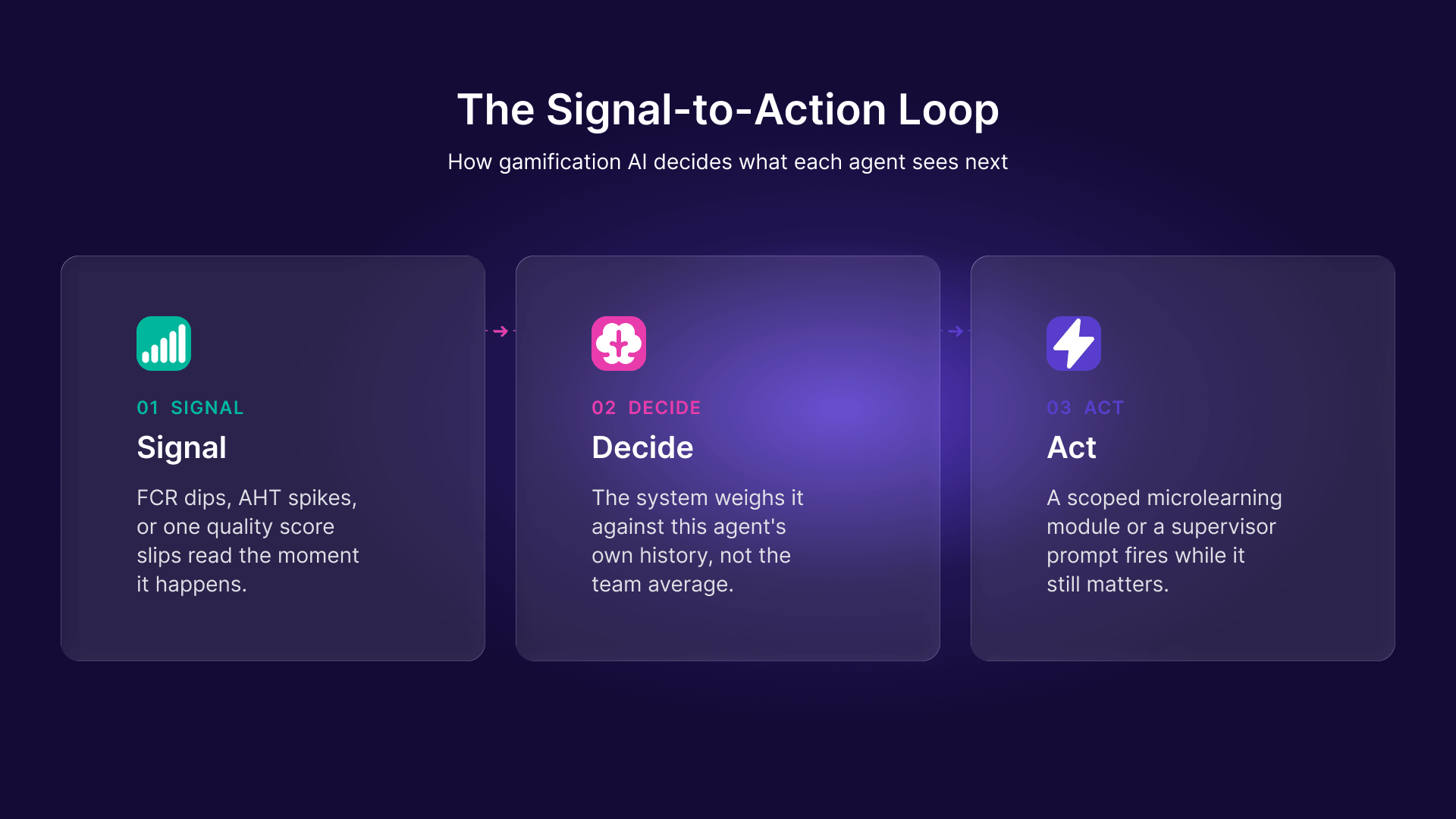
The signal-to-action loop is the spine of modern engagement, and it runs in three beats.
- The system reads a performance signal: a drop in First Call Resolution (FCR), a spike in average handle time, a quality score that fell on one specific evaluation criterion.
- It decides what that signal means for this particular agent, measured against their own history rather than the team average.
- It triggers an action while the context is still fresh, whether that is a two-minute microlearning module, a challenge scoped to that skill, or a prompt to the supervisor.
The part that matters is the second step. Reading signals is easy and most platforms do it. Deciding what a signal means for one person is where static systems stop and AI-driven ones start.
Beyond the leaderboard
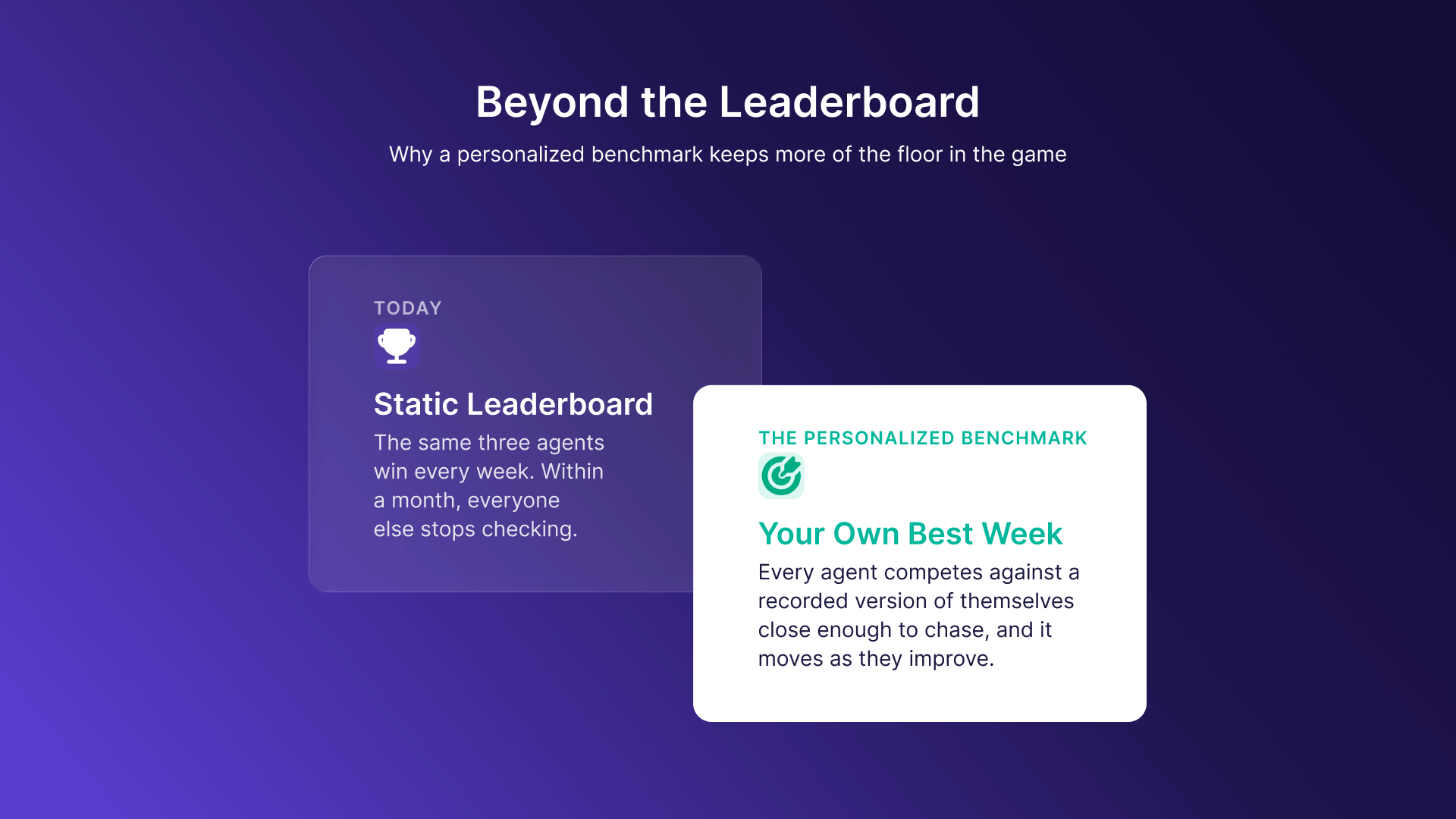
Traditional leaderboards demotivate everyone outside the top tier, which in most operations is the majority of the floor.
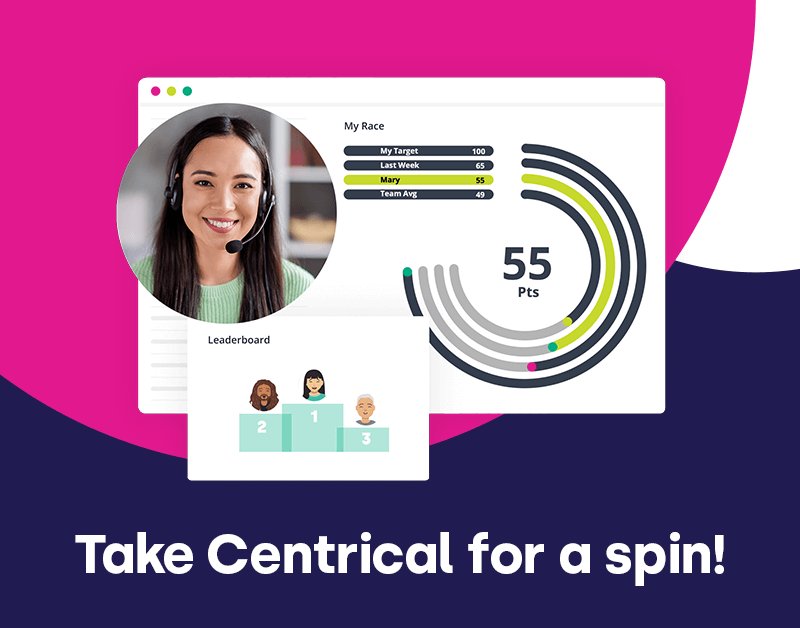
Personalized benchmarks fix the geometry. The clearest version is a “ghost car”: an agent competes against a recorded version of their own best week rather than against the person who was always going to win. The target stays close enough to be worth chasing, and it moves as they improve.
Shifting the focus to individual progress also changes what the game is teaching. Feedback and retrieval practice drive performance more reliably than raw competition, and a benchmark someone can actually reach keeps them practicing long enough for it to matter.
The three pillars of AI-powered engagement
Operational success depends on the speed of the loop. The system watches live KPIs and detects shifts as they happen, so an agent who starts struggling with a new product script is visible within the hour rather than at the end of the month. That speed is what makes the intervention usable, because the call is still in the agent’s head when the help arrives.
Without something deciding which signals matter, live KPIs are only a faster way to produce noise. The filtering is the product. Managers end up supervising the outcomes of those interventions rather than the granular tasks underneath them.
Personalized challenge generation
AI removes the manual work of designing incentives. It reads historical performance and generates challenges that sit in the narrow band between too easy to bother with and too hard to attempt.
A veteran holding high CSAT needs a different stimulus than a new hire in week three, and the same challenge sent to both will land for neither. Implementing demographic-based personalization keeps every agent in a state of flow by matching the gamification strategy to their specific professional motivators.
Adaptive feedback loops
Feedback works when it is frequent and constructive (Gartner). A feedback loop is adaptive in the literal sense: it adjusts how often feedback is delivered and in what form, based on how the agent responded last time. The nudges sent evolve and change based on how the previous ones were handled, resolved, or possibly ignored by the agent.
For managers, the payoff is that performance trends become something to navigate rather than a report to react to after the fact.
What gamification AI looks like in practice
Let’s take a couple of examples that have nothing to do with work, where the stakes are low and the adaptation is easy to understand.
Duolingo personalizes each learner’s path with AI-driven algorithms, tuning lessons to skill level, interests and progress. The points, levels and streaks sit on top of that personalization rather than replacing it. The game is the same for everyone. The curriculum is not.
Zombies, Run! adapts a story to the runner’s pace and performance, turning a repetitive workout into something with a narrative reason to keep going. The mechanic is not the reward. The reward is that the experience changes based on what you actually did.
Inside a contact center the same logic produces smaller, less cinematic interventions:
- An agent whose FCR drops on one product line gets a three-minute refresher on that product, not a general quality module.
- A new hire two weeks into nesting gets a challenge scoped to call control, while the veteran next to them gets one scoped to upsell language.
- A quality score that fell on a single evaluation criterion triggers a coaching prompt naming that criterion, rather than a generic session on the calendar.
Why static gamification fails the frontline
Picture a leaderboard where the same three agents always win. Within a month the bottom tier stops checking it. Within two, the middle stops as well. The board is still running. It is just no longer a game anyone is playing.
Static systems fail because they cannot adapt to a floor that keeps changing. The recurring failure points:
- Mid-performers who can see they will never catch the leaders, so they stop trying.
- Rewards disconnected from actual coaching needs, so winning the game and getting better at the job become separate activities.
- Over-emphasis on raw activity rather than quality-driven outcomes, which teaches speed at the expense of resolution.
The result is a predictable decay in frontline engagement once the novelty of badges wears off, usually somewhere between week six and the end of the first quarter.
The contact center is where the mechanism is easiest to measure, but it is not where it started, and the cross-industry versions are useful for separating what is general from what is specific.
Education. Personalized learning pathways that adapt to how an individual student learns and how far they have progressed. What produces the result is the personalization, not the badges layered on top of it.
Healthcare. Patient-facing programs that encourage healthy behavior and adherence to treatment plans, where the challenge has to scale to what the patient can realistically manage this week.
Marketing. Tailored campaigns where engagement mechanics are tuned per segment rather than run as one promotion for everyone.
Human Resources. Training and onboarding that personalizes what each employee sees based on the skills they are missing, rather than routing everyone through the same catalogue.
What holds across all four is the same order of operations: read the signal, decide what it means for this person, then choose the mechanic. What differs is only the signal being read and the action available.
Rolling out gamification AI: where to start
Four steps, and the order matters more than any of them individually.
Define the objective before the mechanic. Name what should change: FCR on a product line, ramp time for a cohort, quality scores on one evaluation criterion. A gamification program without a named target becomes an engagement activity, which is a different and much harder thing to fund.
Choose a platform that reads your signals. The question is not which mechanics it offers, because every platform has points and leaderboards. The question is what performance data it can ingest, how quickly, and what it is able to trigger once it has it.
Design the loop, not the game. Map each signal you care about to the specific action it should produce and the person who owns that action. If a signal has no defined next step, it does not belong in the program yet.
Monitor and adjust. Review which challenges people complete, which they abandon, and whether completion moved the metric the challenge was built for. A challenge with high completion and no metric movement is entertainment.
Operational outcomes: from engagement to ROI
Enterprises use contact center gamification to move specific numbers rather than to raise morale in the abstract. A modern sales gamification platform works on revenue-generating behaviors by tying individual motivation to team quota. In service operations the same loop shows up in First Call Resolution and CSAT.
The reason those results hold rather than spiking and fading is the loop itself. A program that re-reads performance every day cannot go stale the way a fixed quarterly competition does, because what it asks of people changes as the people change.
Engagement is not the outcome here. It is the mechanism. The outcome is the metric it was pointed at.
Before you go: getting started with gamification AI
What do you need in place before rolling out gamification AI?
Three things: performance data that updates at least daily, a named objective the program is supposed to move, and someone who owns the action each signal triggers. Missing the first makes the loop slow. Missing the second makes it unaccountable. Missing the third makes it decorative.
How is gamification AI different from a leaderboard?
A leaderboard ranks people against each other on a metric someone chose in advance. Gamification AI decides what each person should be working on next, then applies a mechanic to it. A leaderboard is one possible output of that decision, not a substitute for it.
Change what they are competing against. Ranked against the top of the floor, a mid-performer is permanently losing. Measured against their own best week, they are in a race they can win. That is the practical argument for personalized benchmarks over a single public board.
How do you measure whether gamification AI is working?
Not by participation. Completion rates tell you the game is enjoyable, which is not the same as useful. The measure is whether the metric each challenge was built for actually moved for the people who completed it, compared with those who did not.
How do you implement AI-powered coaching?
Three steps. Audit the current coaching cadence to find where real-time signals are being missed. Replace peer-ranked leaderboards with personalized benchmarks that emphasise individual growth. Wire microlearning triggers directly into performance challenges so a skill gap closes where it appears. AI-powered coaching does not run the session. It tells a manager which session is worth running.
See it running end to end
Take the interactive product tour to see how goals, coaching, learning and gamification run as one program.






 Turn any business goal into a running performance program in minutes.
 Engage and motivate your frontline teams
 Deliver world class CX with dynamic, actionable quality evaluations
 Boost performance with personalized, actionable goals
 Nurture employee success with the power of AI
 Listen and respond to your frontline, continuously
 Drive productivity with performance-driven learning that sticks
 Drive agent efficiency, deliver client results
 Keep tech teams motivated and proficient on products and services while exceeding targets
 Maintain compliance while building customer happiness and loyalty
 Enlighten energy teams to boost engagement
 Engage, develop, and retain your agents while driving better CX
 Improve the employee experience for your reservations and service desk agents

 Gal Rimon
 Madeleine Freind

 Natalie Roth
 Linat Mart













 Doron Neumann
 Daphne Saragosti
 Ella Davidson
 Ariel Herman
 Ronen Botzer