Six things actually reduce employee attrition: engaging new hires before day one, setting expectations the job will match, showing support and appreciation, training people with tools they will use, communicating often enough that nobody feels forgotten, and paying fairly while recognizing the people carrying the team.
Replacing an employee can cost up to twice their annual salary, according to Gallup, which is why the order matters: the cheapest of the six to fix is the first one, engaging new hires as soon as they start their job.
Knowing why people leave is what lets an organization put processes and tools behind satisfaction instead of behind exit interviews. Two questions decide whether any of it works. How do you recognize an employee who has disengaged? And when you recognize one, what should you do next?
Why employees leave
Frontline attrition has three recurring drivers, and only one of them is money.
The first is burnout. The role is genuinely hard, and it gets harder when support is thin. “Well-being, if you drive it through that kind of value lens, is something that we should all be doing more often in this industry, because the role is super tough,” says Ian Chappell, Director of Consulting, International at Centrical.
The second is disconnection: from the manager, from the team, and from any sense of where the job leads. The third is the gap between the job as described and the job as experienced, which does most of its damage inside the first 90 days.
One distinction matters before any of the six. Not all attrition is the same problem. “Voluntary and involuntary attrition are two different things,” says Melissa Chang Esposito, Senior Director of Customer Success at Centrical. “You have to tackle them separately.” A retention program aimed at the wrong half will look like it is failing.
Signs of disengagement in employees
Recognizing disengagement early can help prevent further disengagement and subsequent attrition. The tell-tale indicators are consistent across operations:
- Withdrawal from non-essential activities with coworkers
- Start and end times quietly contracting
- A drop in work quality and productivity
- More breaks in the normal routine
- Visible loss of motivation
- Absenteeism
None of these are mysterious. Clear job expectations, the tools the role actually needs, and communication that stays open prevent most of them. And the best operations do not treat the watch as a 90-day exercise. “They look at attrition not just during those first 30 or 90 days but attrition as an ongoing battle,” Esposito says.
From signal to action: what to do the moment you see one
Noticing a disengagement sign only helps if a manager has a specific next step they can follow. A signal without a clear action is just noise, and “watch for these signs” can easily turn into a checklist nobody acts on.
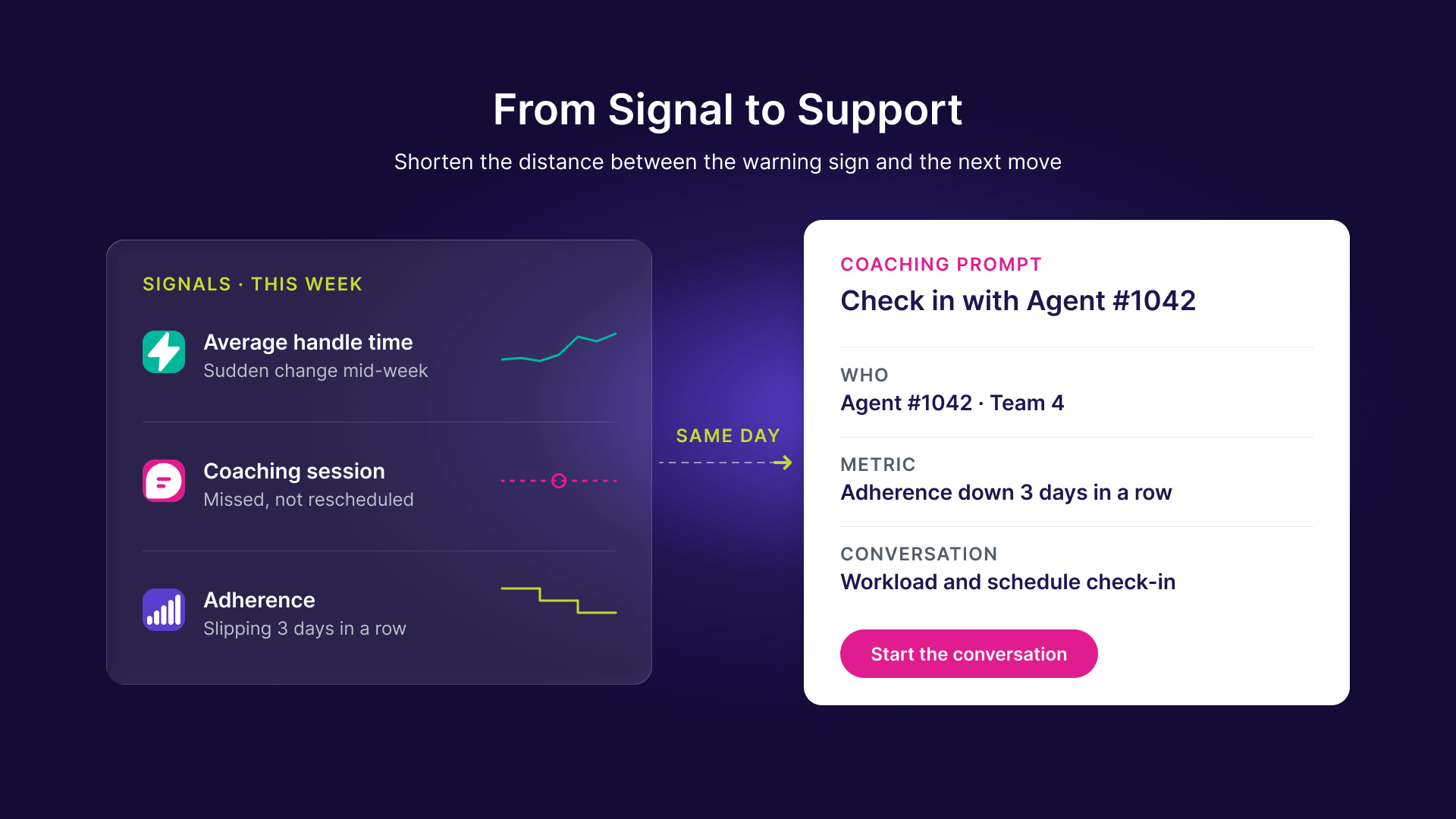
Disengagement rarely happens overnight. It starts as small shifts in operational metrics: a sudden change in average handle time, a missed coaching session, adherence slipping three days in a row. If managers only see those trends in a monthly review, the intervention arrives after the decision has already been made. The employee has left – they just have not said so yet.
Turning that raw data into actionable intelligence is what moves an operation from damage control to prevention, and the fastest single way to reduce agent attrition is to shorten the distance between the signal and the support. The mechanism is simple. When a performance dip is identified, the supervisor gets a prompt naming the agent, the metric, and the conversation to have. The manager still owns the conversation. What changes is that they walk in knowing who, and why.
That is the difference between support that is prioritized and support that is coincidental.
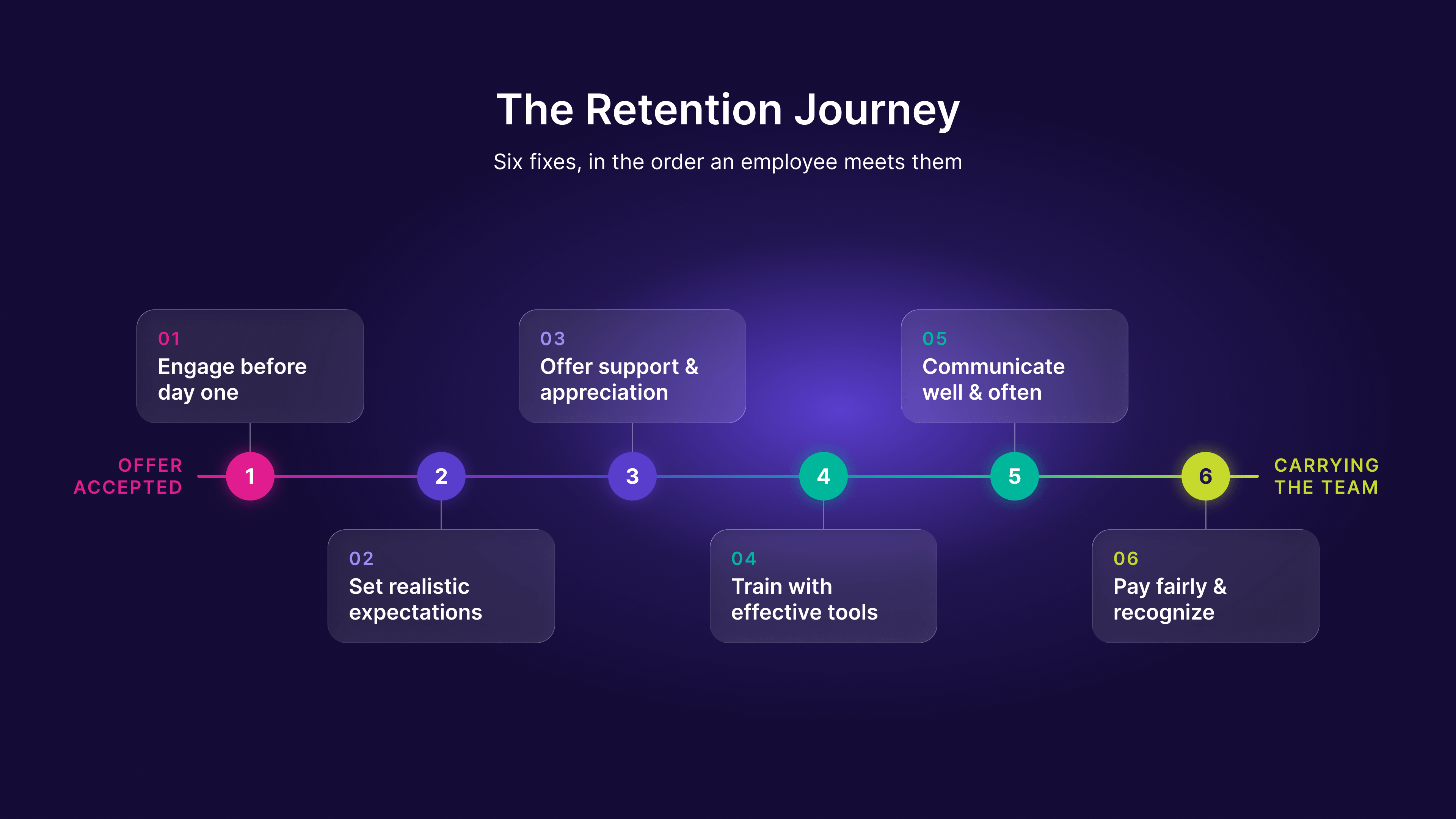
6 ways to prevent high employee attrition rates
The six below run roughly in the order an employee meets them, from the weeks before their first day to the point where they are carrying the team.
1. Start engagement early
First-day ghosting, where a new hire accepts the offer but doesn’t show up on their first day of work, is almost always a gap in the weeks between acceptance and day one. Nothing happened, so nothing held. Preventing it can be surprisingly simple: a note from the manager, an invitation to meet the team and visit the floor, clearly explaining what the first day will actually involve, and straightforward information on equipment. Early-stage attrition is the least expensive to prevent and the most commonly ignored.
2. Set realistic expectations
A large share of early exits come from people who understood the job differently than the job turned out to be. Post-hire shock is avoidable by sharing specific information: what a day looks like hour by hour, what will be measured, and what good looks like in the first month. Expectations set precisely are also what make the signals in the previous section readable. You cannot spot a deviation from a baseline nobody established.
3. Offer support and show appreciation
Workplace culture either produces a supportive environment or it produces people who feel stressed and undervalued. Frequent, specific appreciation reduces turnover more reliably than most programs designed to.
Support works better when it is structural than when it depends on personal goodwill. Small cross-functional pods encourage peer learning. Shared team goals make collective success worth something. Regular huddles focused on wellness and problem-solving give the hard parts of the role somewhere to go. And AI-assisted coaching lets a manager support a larger team without shortening the conversation, by taking over the preparation rather than the interaction. Structural support is what turns frontline employee engagement from a survey score into something a manager does on a Tuesday.
Esposito frames the questions a working support model keeps asking: “What’s going on in their headspace, what’s going on with their workspace? How do we help them stay at the company?”
Lack of training and no visible path for growth is one of the largest contributors to attrition, and it applies twice: once to agents, once to the people promoted to lead them.
For agents, the practical version is microlearning that fits inside the workflow, skill-based pathing that shows a trajectory beyond the current role, certifications that validate progress, and gamification that ties daily targets to visible achievement rather than to a monthly number nobody sees.
5. Communicate well and often
Clear, effective communication can help sustain engagement after onboarding ends, which is exactly when most of it stops. Agents who felt well-informed in week one often feel isolated by month three, and remote and hybrid teams feel it sooner. Share organizational goals and what changed, on a rhythm, through the channels people actually read. And keep the traffic two-way: an agent who raised something and watched nothing happen has learned more about the organization than any all-hands will teach them.
Compensation is not the top driver of attrition, but it is the fastest way to lose someone who was otherwise staying. Review salaries against the market on a schedule rather than in response to a resignation.
Recognition is the half that gets skipped. High performers need the money and the acknowledgment, and the acknowledgment has to come from someone whose opinion counts. Chappell’s version of the whole argument is shorter than any of this: “Happy employees, happy customers, happy CEO.”
What changes when you roll out a new retention program
One warning about doing any of the above. Every new tool, KPI, or process creates new skills and coaching needs for the people around it, and retention programs are no exception. Introduce a recognition scheme and managers now need to know what is worth recognizing. Add real-time dashboards and supervisors need to know which movements to act on and which to leave alone. Give supervisors an AI assistant that prepares their coaching sessions and the job of coaching changes shape.
That ripple is the part most rollouts underestimate, and it is usually why a program that worked in the pilot has faded by the third quarter. Plan for what the program asks of managers, not only for what it offers agents.
It is also why this is a discipline rather than a project, and why the cost savings that come with frontline retention accrue to the operations that keep at it. “When you have a true strategic and transformation team tackling attrition and looking at the different parts of the employee journey, you get a lot more out of your different strategic initiatives,” Esposito says.
Before you go: getting started with attrition reduction
Which of the six should we do first?
The first one, because it is the cheapest and it compounds. Every hire you keep through day one is a hire you do not replace at twice their salary. After that, work in the order an employee meets them rather than in the order of what is easiest to buy.
What is the difference between voluntary and involuntary attrition?
Voluntary attrition is people choosing to leave. Involuntary is the organization ending it. They have different causes and different fixes, and a single contact center attrition number hides both. Measure them separately or you will aim a retention program at the wrong half.
How do you recognize disengagement before someone resigns?
By watching for deviation, not for mood. Shrinking start and end times, a drop in quality, more unplanned breaks, withdrawal from the team. The signs are readable early. What usually fails is the step after noticing.
How does real-time data impact agent retention?
It shortens the gap between a problem appearing and someone doing something about it. That gap is where most resignations get decided.
Can gamification replace traditional management?
No. It makes progress visible; it does not decide what progress means. A manager still sets the goal and has the conversation.
Build a frontline people stay in
Reducing attrition is less about launching one initiative than about shortening the distance between a warning sign and a manager’s next move.
Book a demo to see how the Orchestration System turns that distance into a repeatable coaching rhythm for your frontline.






 Engage and motivate your frontline teams
 Deliver world class CX with dynamic, actionable quality evaluations
 Boost performance with personalized, actionable goals
 Nurture employee success with the power of AI
 Listen and respond to your frontline, continuously
 Drive productivity with performance-driven learning that sticks
 Drive agent efficiency, deliver client results
 Keep tech teams motivated and proficient on products and services while exceeding targets
 Maintain compliance while building customer happiness and loyalty
 Enlighten energy teams to boost engagement
 Engage, develop, and retain your agents while driving better CX
 Improve the employee experience for your reservations and service desk agents

 Gal Rimon
 Madeleine Freind
 Natalie Roth
 Linat Mart












 Doron Neumann
 Daphne Saragosti
 Ella Davidson
 Ariel Herman
 Ronen Botzer