From new hire to high-performer, frontline teams need realistic practice that builds confidence and shows up in results.
Today, we’re introducing AI Role-Play: always-on, AI-powered simulations built directly into Centrical.
Centrical is the only AI performance engine that connects practice, coaching, learning, and continuous performance reinforcement, all measured against real operational outcomes.
The gap between training and real-world performance costs organizations time, money, and talent.
60% of frontline attrition happens before new hires reach full productivity
Only 21% of frontline employees are engaged globally
Managers spend just 8–12% of their time coaching—because everything else gets in the way
These aren’t isolated problems. They’re part of a wider issue: traditional training doesn’t create enough consistent, applied practice opportunities for employees to succeed in their roles.
That’s because traditional role-play sessions are manager-dependent, scored subjectively, and often the first thing to get skipped when queues spike. When practice is inconsistent, performance becomes unpredictable.
Your teams need practice that’s scalable, objective, and available on demand.
Always-On Practice, Instant Feedback
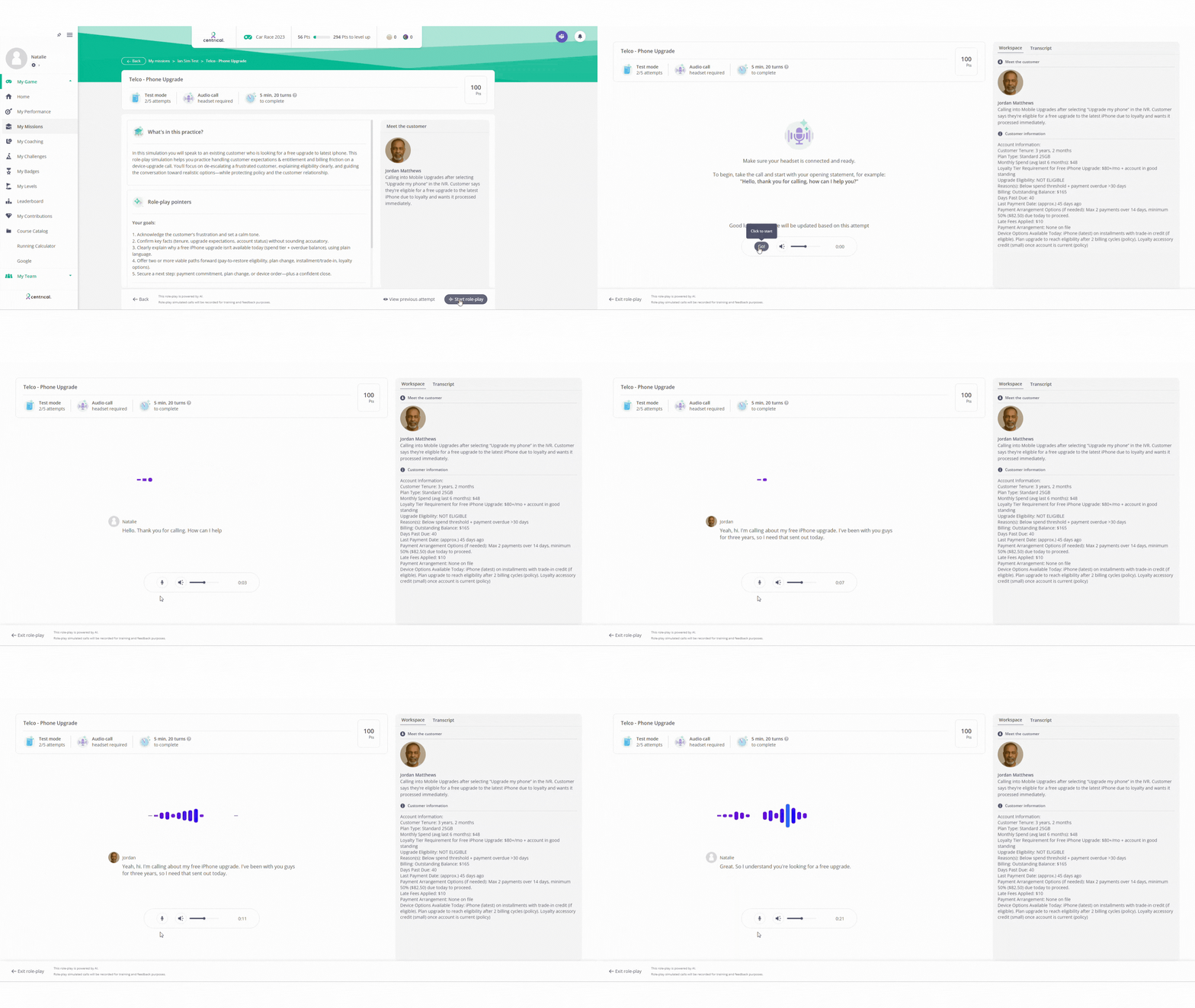
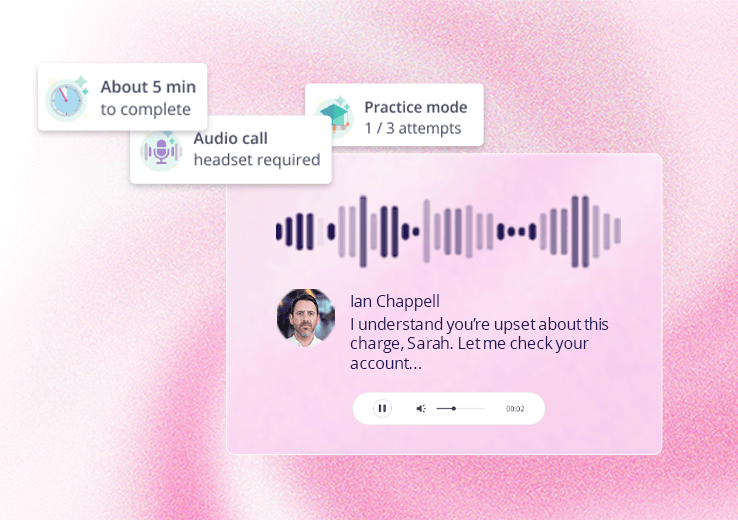
AI Role-Play gives frontline teams realistic practice on-demand, with immediate AI coaching. No need to wait for the next training session, no manager time required.
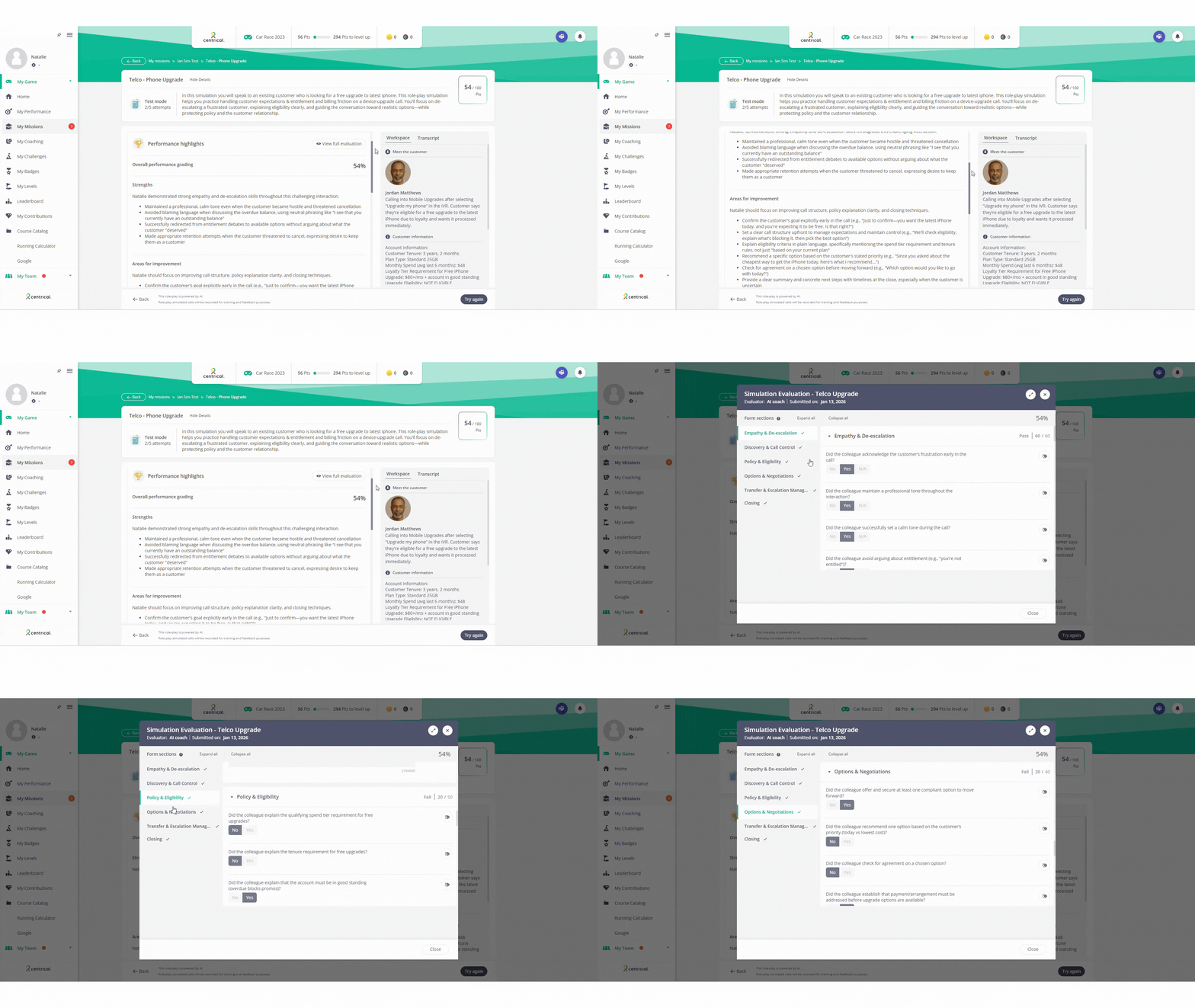
Employees run voice or chat simulations that mirror real conversations and friction points. Every simulation is evaluated consistently with immediate feedback and a clear next step, so improvement happens in the moment, not weeks later.
What Employees and Managers Get
Realistic Scenarios
Practice real customer conversations—objection handling, escalations, product questions, policy explanations—through voice or chat simulations that mirror real interactions.
Instant AI Coaching
Every simulation is scored and analyzed using your organization’s defined success criteria, delivering specific, behavior-based feedback. Employees can replay key moments, understand their gaps, and improve on the spot.
Practice Until Ready
Multiple attempts mean employees can refine their approach and build confidence before handling live customer interactions.
Manager Intelligence
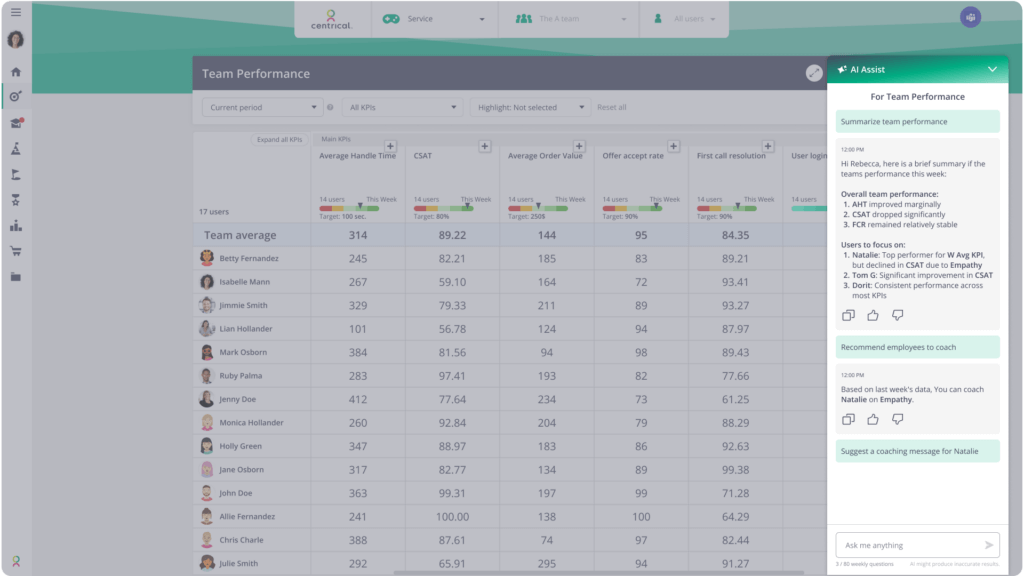
Managers get clear visibility into readiness, performance trends, and coaching priorities, all automatically surfaced by Centrical’s AI Assistant.
Built for Speed
Create role-plays in hours, not weeks, using AI-assisted validation and smart templates. Scale practice consistently across teams and locations.
Engaging Missions
Delivered through Centrical’s gamified performance intelligence platform, role-plays integrate naturally into the employee experience—not another training or compliance task.
From New Hire to High-Performer
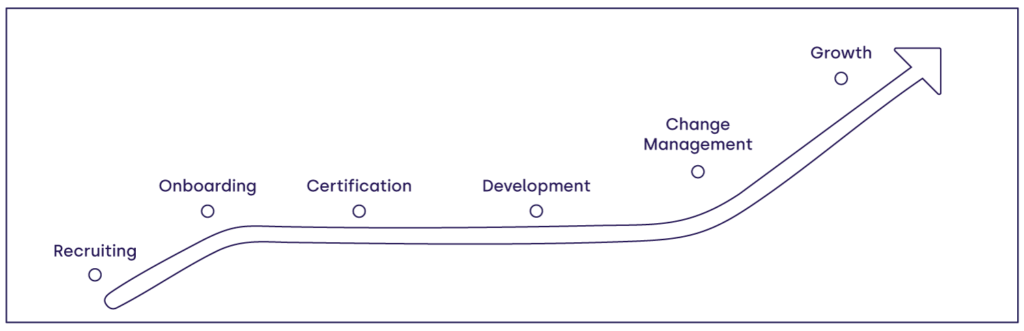
AI Role-Play supports every stage of the employee journey, building skills and confidence through continuous practice that translates into measurable results.
Recruiting: Evaluate candidates through simulation-based assessments
Onboarding: Reinforce processes and reduce time to proficiency by 20-40%
Certification: Ensure readiness for live interactions with objective scoring
Development: Address performance and skills gaps with targeted practice
Change Management: Launch new products and processes with confidence
Growth: Enable upskilling, cross-skilling, and career mobility
Manager Coaching: Practice coaching conversations and get structured feedback
Real Impact, Measurable Results
Organizations using AI-powered practice report:
20–40% faster time to proficiency for new hires
30–50% reduction in manager time spent on repetitive coaching
5–15% improvement in KPIs like sales conversion, CSAT, and FCR
Value Across the Entire Organization
Employees
Build confidence before speaking to real customers
Practice high-stakes scenarios in a safe environment
Receive immediate, actionable feedback
Reach proficiency faster
Managers
Spend less time on basic drills, and more on high-impact coaching
Get unbiased behavioral evaluations
Focus coaching where impact is highest
Improve your own coaching skills through practice
The Business
Accelerate onboarding and ramp-up cycles
Increase sales conversion and customer satisfaction
Deliver more consistent frontline experiences
Reduce early attrition while boosting productivity
Why a Performance Ecosystem Beats Standalone Tools
Most AI role-play solutions stop at the simulation.
❌ They don’t connect practice to KPIs ❌ They don’t trigger follow-up practice when performance slips ❌ They don’t surface clear coaching priorities ❌ They don’t close the loop between practice and outcomes
AI Role-Play, powered by Centrical, is built into a connected performance system. It links simulations to coaching, learning, reinforcement, and operational outcomes—so practice translates into measurable improvement.
With Centrical, every role-play becomes a performance signal. If an employee struggles with objection handling, the system triggers targeted practice, surfaces priorities to their manager, and tracks progress over time. That’s closed-loop performance orchestration.
Why Now Matters
AI simulations are quickly becoming standard. The question isn’t whether you’ll adopt AI-powered practice, but whether you’ll connect it to measurable operational outcomes or let it become another standalone training activity.
Organizations that connect practice to coaching, reinforcement, and real performance outcomes see compounding gains. Those who treat simulations as a one-off training tool struggle to prove impact.
Ready to See AI Role-Play in Action?
See how always-on simulations deliver consistent practice, clear coaching priorities, and measurable operational outcomes.
What makes Centrical’s AI Role-Play different from other AI role-play or simulation tools?
AI Role-Play is built directly into Centrical, so practice is automatically connected to coaching, learning, and performance—rather than living as a separate training activity. Every simulation is evaluated against customer-defined rubrics and procedures.
How does AI Role-Play connect to real performance outcomes like CSAT, sales conversion, or FCR?
Practice is driven by real performance gaps, and role-play results directly inform coaching actions, skill development, and progress against key business metrics.
Is AI Role-Play meant to replace human coaching?
No. AI Role-Play handles repeatable practice and feedback, so managers can spend more time on meaningful, personalized coaching that drives improvement.
Why is AI Role-Play built into a performance ecosystem rather than offered as a standalone tool?
Because practice on its own doesn’t change behavior. When role-play is embedded into daily coaching and performance routines, it reinforces the right skills at the right time and leads to measurable improvement.
What You Can Do with AI Role-Play
What types of role-play experiences are supported today?
In Early Access, AI Role-Play supports voice and chat-based simulations for onboarding, sales, service, coaching, and skill development, delivered directly through Centrical missions.
How realistic are the AI simulations compared to real customer interactions?
The simulations reflect real conversations and common friction points, using AI personas aligned to your policies, scenarios, and evaluation criteria, with consistent, objective feedback.
Can role-plays be customized to our industry, products, and policies?
Yes. Teams can tailor simulations using company-specific scenarios, personas, policies, and evaluation criteria to match real-world conditions.
What’s on the roadmap for AI Role-Play?
Planned enhancements include in-the-moment AI coaching, multi-language support, industry-specific libraries, mobile access, deeper analytics, and expanded simulation formats.
Getting Started & Scaling with AI Role-Play
How long does it take to create and launch a role-play scenario?
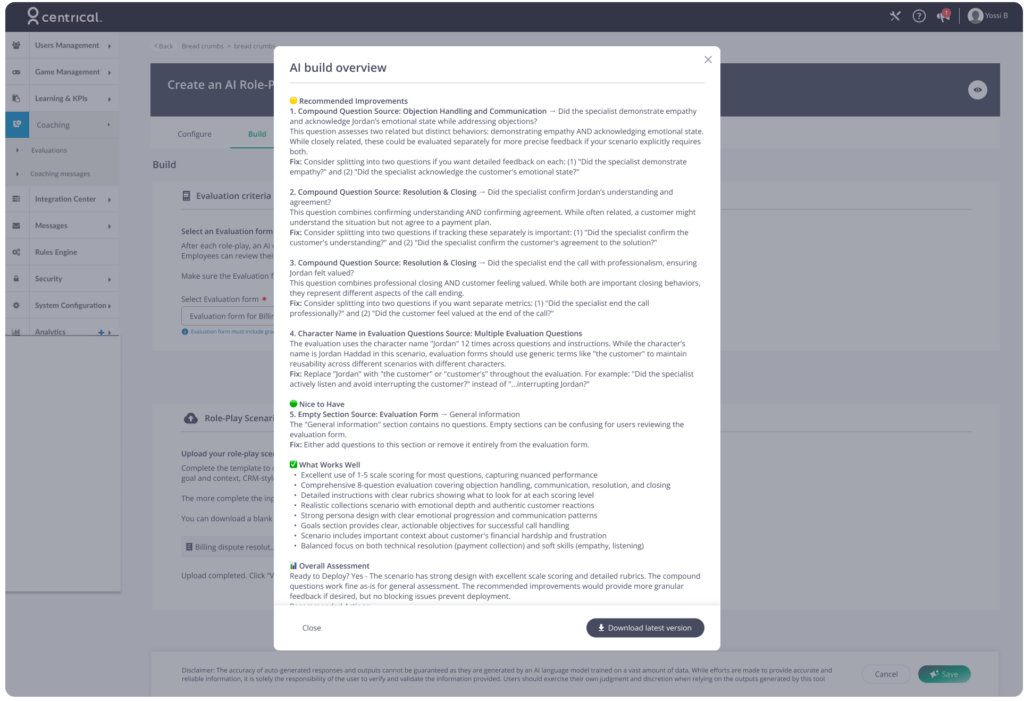
Most role-plays can be created and validated in hours using AI-assisted templates, with built-in checks and recommendations to ensure scenarios and evaluation criteria are aligned before the launch.
Who typically builds and manages role-plays—L&D, operations, or frontline managers?
Role-plays are usually created by L&D, enablement, or operations teams, while frontline managers use them to support coaching and performance improvement.
How easy is it to update role-plays when products, policies, or scripts change?
Updates are quick and straightforward. Teams can adjust scenarios or content as needed, with AI helping ensure consistency and accuracy.
How does AI Role-Play fit into existing Centrical deployments?
AI Role-Play works natively within Centrical alongside Performance, Learning, Coaching, and Evaluations. No additional systems or integrations required.
Packaging & Availability
Is AI Role-Play available as a standalone product?
No. AI Role-Play is part of Centrical’s Performance Intelligence platform, where practice, coaching, learning, and performance insights work together to drive results.
How is AI Role-Play packaged within the Centrical platform?
AI Role-Play is offered as an add-on capability within Centrical’s Performance Intelligence platform, alongside performance, microlearning, coaching, and evaluation solutions.
What does implementation look like for new vs. existing customers?
Existing customers can enable AI Role-Play quickly within their current setup, while new customers onboard through Centrical’s standard implementation process.
Expected Business Impact & ROI
What kind of results can organizations expect from AI Role-Play?
Organizations typically see faster time to proficiency, stronger sales and service outcomes, and more consistent performance across teams.
Which teams and use cases see the fastest time to value?
Onboarding, sales enablement, and frontline service teams often see the quickest impact due to immediate, targeted practice and feedback.
How does AI Role-Play help reduce manager workload while improving results
By automating repeatable practice and feedback, AI Role-Play reduces time spent on basic drills and enables managers to focus on higher-value coaching and stronger team development.
See Centrical in Action - Level up frontline team performance with gamification
Let's stay in touch
Prepare your employees to deliver success! Get tips and insights in your inbox a few times a month.
We'll never share your email address and you can opt out at any time, we promise.
Request a Free Demo
Madeleine Freind
VP, Customer Success
Madeleine Freind is a senior Customer Success leader with deep experience building and scaling SaaS and managed services businesses. At Centrical, she leads the Customer Success teams across North and South America, partnering with clients to drive measurable business impact through the platform.
Before joining Centrical, Madeleine was Head of Customer Success at Quantifind, an AI-powered analytics company, where she led strategic relationships with brands like Hershey’s, KFC, J.P. Morgan Chase, and Dunkin’ Brands. Her ability to translate complex data into clear, actionable solutions consistently helped customers achieve their goals.
Earlier in her career, Madeleine spent over a decade on the agency side, managing CRM and digital marketing programs for Fortune 500 companies through smart, data-driven strategies.
Michael Ciancio
CMO
Michael Ciancio serves as the Chief Marketing Officer (CMO) at Centrical, bringing decades of experience in marketing and go-to-market strategy. In this role, he leads the company’s global marketing efforts to drive brand growth and market expansion.
Prior to joining Centrical, Michael held marketing leadership positions at notable technology companies, including IntelePeer, Infor, and Vonage. Throughout his career, he has successfully guided teams in scaling products, strengthening brands, and significantly expanding market presence.
Michael’s expertise lies in scaling high-growth software companies, particularly in AI, performance management, and employee engagement solutions for customer experience teams. His strategic vision and leadership continue to be instrumental in advancing Centrical’s mission to transform how organizations engage and motivate their frontline teams.
Michael holds a Bachelor’s Degree in Economics from Gettysburg College and a Master of Business Administration (MBA) in Marketing from Montclair State University.
Natalie Roth VP, Corporate Marketing
Natalie Roth brings over 15 years of experience in brand and product marketing for SaaS solutions. Before joining Centrical, she was Senior Product Marketing Manager at Frontline Education, where she led go-to-market strategies for enterprise K-12 solutions and played a key role in integrating and positioning products following multiple acquisitions.
Previously, Natalie served as Director of Marketing at Accelify Solutions, where she drove marketing strategy, new product launches, and customer communications. She played a pivotal role in business growth, expanding market presence, and deepening client engagement, contributing to the company’s success and eventual acquisition by Frontline Education.
Natalie holds a BA in Creative Writing and Digital Media from New York University, graduating magna cum laude.
Linat Mart
VP, Product Management
Linat Polak Mart has more than 15 years of expertise in managing product strategy and operations in high-volume organizations.Previously, she held the role of Head of Product Experience and Communications for LivePerson, a leading Conversational AI platform, where she played crucial part in delivering significant product innovation and customer growth. Prior to her time at LivePerson, she held multiple senior product roles at NICE, a leading enterprise customer experience (CX) software provider, including Director of Product Portfolio and Director of Product Management.
Linat holds an MBA from Tel Aviv University and a BA in Computer Science from Reichman University (IDC Herzliya). She graduated magna cum laude from both institutions.
“CX leaders should stop isolating contact centers from other departments. Customer experience is increasingly cross-functional. In 2025, integrating CX insights across the organization will be critical to delivering seamless and cohesive experiences.”
Tompkins comes to Centrical with more than 25 years of experience in software and hardware sales. Prior to joining his role as Chief Revenue Officer at Centrical, he was CEO at Workspot. He held the position of Chief Revenue Officer at IGEL as well as senior sales leadership positions with Red Hat, Hewlett Packard (now Hewlett Packard Enterprise), and Citrix.
Tompkins holds an MBA in Business Administration and Management from the University of Virginia, Darden Graduate School of Business Administration and served in the US Navy as a Nuclear Propulsion Technician.
“To start, give customers a choice: digital or live support. And if they go digital first and can’t get what they want, make it super-easy for them to connect to a live agent.”
“Knowledge Management: It is not exactly underrated but it will be bigger than what it is in 2025. Vendors are likely to boost R&D investment in knowledge management for contact centers in 2025.”
“Human-centered AI, where AI is used not just to automate and drop money to the bottom line, but used to service up insights to support team members and delight customers. I see generative AI with conversational context and tonal analysis as pretty critical here.”
“The future? Goodness, there’s so much, but I really believe 2025 is the year of community. We’re not just taking tickets anymore—folks we’re drawing people in, getting proactive, and co-creating with customers. Community will become a normal service channel, with customer service workers facilitating and adding value.”
“The myth that technology/AI is a quickly implemented CX superpower. Companies will realize that we can’t harness a lot of these gains without quality data that is clean and well-organized.”
“By 2025 the buzzword omnichannel may be on its’ last leg. Customers want their issues resolved quickly and accurately and they would prefer not to need to contact us in multiple channels that we can see at one time.”
“For 2025, the main trend I’m watching is ‘AI agents’—bots powered by AI that are becoming more autonomous. Unlike basic responses, these AI agents can handle end-to-end customer interactions, reducing the need for human intervention. Expect significant developments from vendors.”
“Stop talking about AI. It’s like talking about the internet being a thing. It’s here. The better focus is start thinking about how AI enhances the lives of your team. So stop talking about AI and start doing something about it.”
“AI and CX will drive hyper-personalization, using consumer data to segment customers, deliver key messages, and provide fast, accurate responses. Technologies like chatbots and predictive analytics will close the gap between brands and consumers.”
“The blending of CX and EX will accelerate. The days of reducing friction for customers at the expense of employees are over. Indeed, because AI-enabled customer experiences often require AI usage by customer-facing employees, leaders will have to ensure a frictionless work experience to drive AI adoption and deliver value.”
One myth that will be debunked in 2025?: “Customers are on the edge of their seat waiting to hear what you have to say. We need to learn about what’s important to customers by asking more questions.”
Doron is a seasoned R&D professional with a a deep expertise in SaaS and enterprise software. He leads product development at Centrical. Prior to joining the company, he was Director of R&D at Tipalti, where he was part of the team that designed and developed the Tiplati product and the infrastructure it uses. Prior to that he was Director of R&D Sensor Management, which joined from Orsus, which was acquired by Nice Systems. Prior to that he held various R&D positions at Orsus. Doron holds a B.Sc in Computer Science from the Tel Aviv Yafo Academic College and a MBA degree from the University of Tel Aviv.
Gal Rimon
Founder and CEO
Gal founded Centrical (previously GamEffective) in 2013, with the vision of helping companies empower their employees’ performance, making them the center of business success.Prior to that he was CEO of Gilon-Synergy Business Insight, a national leader in Business Intelligence. In 2010, Gilon-Synergy was acquired by Ness Technologies (NASDAQ:NSTC) and Gal went on to serve as Senior VP at Ness, and was member of its executive management.
Prior to that he was VP customer relations and operations at Deloitte Consulting. He also worked at EDS and Bashan. He holds a MBA degree in Marketing and Information Technologies from the Tel Aviv University.
Daphne Saragosti
Chief Customer Officer
Daphne has over 15 years of experience in Customer Relations and Retention in both B2B and B2C environments. Her area of expertise is leading customer success, consulting and global professional services teams within public and private sector companies. She is focused on leading teams to grow the partnership with our clients.
Prior to Centrical, Daphne worked software and service companies in the online marketing and gaming industry.
Daphne holds MA in Statistics – Specialization in Operations Research and a MBA degree, both from the Hebrew University of Jerusalem.
Ella Davidson
VP Global HR
Ella Davidson is responsible for managing Centrical’s employee relations worldwide, including organizational development, talent management, benefits and recruitment. Ella has more than 18 years of human resources management experience. Prior to joining Centrical she was vice president of human resources at myThings and OpTier – leading SW companies, and consulted numerous entrepreneurs and startups in the Israeli hi-tech industry and Israel and in the US.Ella holds a B.A in Psychology from the Hebrew University and MSc in Organizational Behavior from Recanati Business School at Tel Aviv University.
Ariel Herman
VP Research and Development
Ariel has over 16 years’ experience in a wide variety of R&D leadership roles. He is highly experienced at building R&D teams from the ground up, driving high levels of accountability and ownership and setting up automation infrastructures. For the past 10 years Ariel has managed both in-house and offshore development teams at companies ranging from startups to enterprise organizations.
Prior to joining Centrical, Ariel served as VP of R&D at Worthy.com where his team dramatically improved product stability, quality and execution. Before that, he was VP R&D at Applicaster where he led infrastructure changes from project to product. Ariel has also held various R&D positions at Retalix (later acquired by NCR).
Ariel holds B.sc in Computer science & Math, and MBA degree in Information Technologies, both from Bar Ilan University
Ronen Botzer
CFO
Ronen is a Finance and Business Development executive with 20+ years of leadership experience in startups and global companies across all aspects of management. He has direct experience with companies in the areas of software, services and capital equipment, including fund raising as well as M&As across different continents. Ronen is a CPA and holds an LLM degree from Bar Ilan university and B.A in business administration from the College of Business Management.
See a Preview
Employee Performance Experience Bundle
Get access to these Employee Performance Experience assets: ePX Definitive Guide, Cheat Sheet, and Engagement Index. All delivered to your Inbox.
Onboarding One-Pager
Transform Onboarding with the AI Copilot Built for Frontline Teams
Quality Management One-Pager
Find out how you can deliver better customer experiences in this one-pager
Performance Management One-Pager
Learn what’s possible with Centrical’s Performance Management Platform
Coaching One-Pager
Learn how you can leverage Centrical’s Coaching capabilities to scale frontline manager impact.
Voice of Employee One-Pager
Learn how you can keep your frontline emotionally connected, motivated, and productive, wherever they work.
Gamification One-Pager
Learn all about Gamification and how you can benefit from it to proactively engage your frontline, from anywhere.





 Engage and motivate your frontline teams
 Improve performance with an AI-powered digital coach
 Deliver world class CX with dynamic, actionable quality evaluations
 Boost performance with personalized, actionable goals
 Nurture employee success with the power of AI
 Listen and respond to your frontline, continuously
 Drive productivity with performance-driven learning that sticks
 Drive agent efficiency, deliver client results
 Keep tech teams motivated and proficient on products and services while exceeding targets
 Maintain compliance while building customer happiness and loyalty
 Enlighten energy teams to boost engagement
 Engage, develop, and retain your agents while driving better CX
 Improve the employee experience for your reservations and service desk agents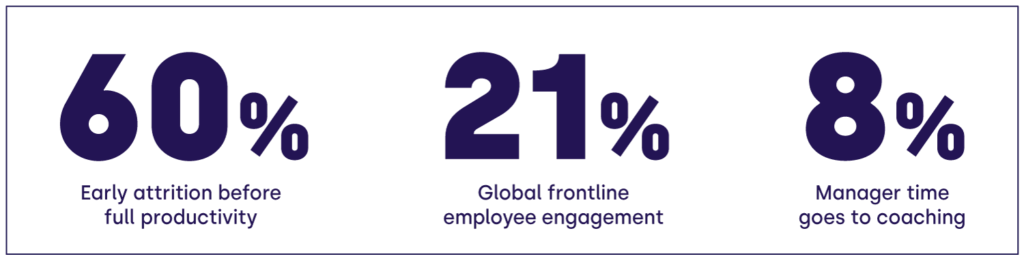
 Madeleine Freind
 Natalie Roth
 Linat Mart












 Doron Neumann
 Gal Rimon
 Daphne Saragosti
 Ella Davidson
 Ariel Herman
 Ronen Botzer