A supervisor in a high-volume contact center watches three AI tools flag the same agent in different ways. One recommends coaching. Another changes the priority queue. A third surfaces a learning module. The frontline team spends more time interpreting software than solving customer problems.
Three tools can each be right about the same agent and still leave the supervisor with three different next moves.
A Workforce Orchestration System coordinates AI agents, human workflows, and business rules around a shared outcome. Individual tools can improve a task. Orchestration connects those tasks into an operating rhythm that can adjust as conditions change.
What is a Workforce Orchestration System?
Defining the orchestration layer
A Workforce Orchestration System is the coordination layer between specialized AI agents, operational data, and the people responsible for decisions. It determines which capability should act. It also manages what information that capability needs and when a manager must review or approve the next step.
The distinction matters in a contact center. An AI agent may identify a knowledge gap or recommend a coaching topic, but the supervisor decides how to address it, weighing context, empathy, and prior performance. The system supports that decision without holding the conversation or deciding whether someone keeps their job. The transition from reactive tools to active systems requires a shift toward intent-based supervision.
Why individual AI agents are not enough
Enterprise AI agents become useful when they work across a process rather than inside separate applications. The industry is moving toward an Agent-as-A-Service model to coordinate specialized agents across complex business processes that were previously siloed. The numbers cut both ways. Deloitte estimates that orchestrating agents well could add as much as US$45 billion to the market by 2030, while Gartner expects more than 40% of today’s agentic AI projects to be canceled by 2027 on cost and complexity.
Workflow automation CX improves when leaders connect quality signals, performance data, learning content, and supervisor action. CX Today reports productivity gains above 60% where that orchestration is in place. Without that layer, each tool optimizes its own task and leaves managers to reconcile conflicting alerts by hand. Effective automation requires reducing manual handoffs across the entire workflow through multi-tool orchestration.
Why orchestration matters for the next decade
From static programs to adaptive systems
A fixed performance program decays when products, policies, customer expectations, or the capability of the floor shifts underneath it. Orchestration gives you a mechanism for continuous adjustment, routing new signals into the right workflow while a person stays in control of the decision.
The shift is structural. Leaders are moving from managing software features to managing how systems respond to operational conditions. The move is from reactive assistants to an architecture where software carries the multi-step reasoning, so managers spend less of the day stitching tools together.
The compounding effect of integrated workflows
Disconnected tactics can help in isolation. A unified operating rhythm makes those tactics reinforce one another:
- A quality signal informs the next coaching priority
- The coaching priority guides targeted practice
- Practice results update the manager’s view of readiness
- New performance data adjusts the next intervention
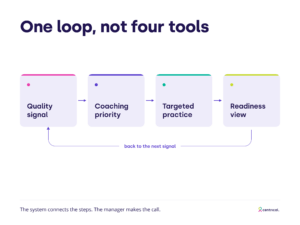
The loop gives supervisors a way to improve the system as the work changes, and it aims the intervention at what actually motivates the agent instead of stopping at the metric.
Scaling AI-powered coaching
AI-powered coaching should prepare managers for better conversations rather than stand in for them. The system organizes the evidence, names a likely development need, and suggests a practice activity; the supervisor adds context, chooses the response, and speaks with the agent.
The human boundary matters for adoption, because people are still what makes the difference in high-stakes performance improvement. While some fear automation, the focus is on using AI to enhance employee growth and efficiency simultaneously.
Linking ramp time and CSAT
Frontline productivity tools create value when they connect daily behavior to business outcomes. A ramp program should show which behaviors a new agent needs to practice, yet traditional training often leaves employees unprepared for the nuance of live interactions. Deploying simulations for AI readiness lets new agents rehearse those skills in a low-stakes environment before they ever face a customer.
Quality and customer feedback then show whether that practice is appearing in live interactions. The same loop applies to CSAT. A lower score should lead to a defined investigation and a manager-led coaching response. Orchestration keeps those steps connected, preventing L&D, QA, and operations from running separate programs.
What to do next: build your orchestration roadmap
- Map one high-impact workflow from signal to manager action, including every system and handoff.
- Define which tasks an AI agent can perform, which outputs require review, and which decisions remain with supervisors. By designing for intent-based supervision, you keep managers in control of the strategy.
- Pilot one closed loop across performance data, learning, coaching, and follow-up before adding more tools.
The next decade belongs to leaders who build adaptive operating systems around outcomes. Start by connecting one workflow, then hold the dial as your operation learns.
Before you go
What is the difference between an AI agent and a Workforce Orchestration System?
An AI agent performs a task: it drafts, classifies, retrieves, or recommends. A Workforce Orchestration System decides which agent acts, what context it gets, and where a manager has to review the output before anything reaches an employee. One does the work; the other runs the sequence.
Where do you start with enterprise AI agents?
Start with one workflow you already measure, and map it from the first signal to the manager action it should trigger. If the map needs a manual export or a side conversation to work, that gap is where orchestration pays first.
What stays with the manager?
The conversation, the judgment call, and the accountability for the outcome. The system can rank who needs attention and suggest the practice, but a recommendation a manager never reviewed is not a coaching decision.
Book a demo to see how the Workforce Orchestration System turns a business goal into a running performance program for your frontline.






 Engage and motivate your frontline teams
 Deliver world class CX with dynamic, actionable quality evaluations
 Boost performance with personalized, actionable goals
 Nurture employee success with the power of AI
 Listen and respond to your frontline, continuously
 Drive productivity with performance-driven learning that sticks
 Drive agent efficiency, deliver client results
 Keep tech teams motivated and proficient on products and services while exceeding targets
 Maintain compliance while building customer happiness and loyalty
 Enlighten energy teams to boost engagement
 Engage, develop, and retain your agents while driving better CX
 Improve the employee experience for your reservations and service desk agents
 Gal Rimon
 Madeleine Freind

 Natalie Roth
 Linat Mart













 Doron Neumann
 Daphne Saragosti
 Ella Davidson
 Ariel Herman
 Ronen Botzer