Many AI business cases in the contact center start with the same number: the calls that no longer reach a person. Too often, the spreadsheet ends there. What happens to the calls that still reach someone never makes it into the model.
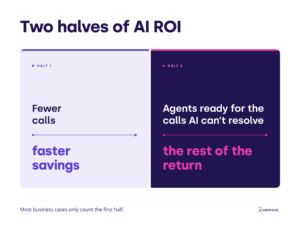
Fewer calls means faster savings. However, the rest of the return depends on what your agents do with the calls AI can’t resolve.
The gap is the missing half of the business case. While the first half of AI ROI comes from removing work, the second half depends on how human agents handle the high-stakes interactions that remain. Frontline enablement targets that second half: the complex customer moments that still need a person.
The missing half of AI ROI is the value created when human agents gain the skills and context required for higher-complexity work after automation changes the queue. Operations often fail to capture it because they apply traditional productivity formulas focused only on time saved, which miss the compounding value of new human capabilities.
When the queue changes, the quality criteria must change with it. Agents now need to interpret difficult cases rather than follow a script for routine tasks. Without addressing those shifts, the business case fails because it omits the cost of getting agents ready for the work that is left.
Actionable intelligence connects those operational signals to the next action for the frontline. It identifies where a skill gap appears and which behavior affects a KPI. The system recommends a learning or coaching action, but the manager keeps responsibility for the conversation and the judgment behind it. The loop that connects automation, performance data, learning, and human coaching is what lets companies pursue efficiency and employee growth at the same time.
The hidden costs of an automation-first strategy
An automation-first business case often counts avoided labor while leaving the human operating costs outside the spreadsheet. Gartner forecast $80 billion in reduced agent labor costs from conversational AI by 2026. Unmeasured enablement requirements eat into that number.
Operational cost factors
| Cost category |
What it costs you |
| Retraining time |
Increases as agents move to complex cases |
| Quality criteria |
Requires revised scorecards and calibration |
| Escalation paths |
Creates uncertainty during live interactions |
| Manager load |
Supervisors support unfamiliar behaviors |
These costs do not invalidate the technology, but they define the work required to capture value safely. Operations that ignore this face the problem IKEA ran into when a chatbot took nearly half its incoming calls. That’s why IKEA reskilled 8,500 agents as design consultants and ended up building a $1.4 billion business line out of them.
How AI-powered coaching recovers the value
Generative AI changes service delivery by giving agents support closer to the moment of work. CCW Digital reports that Sonos resolved 24% of customer inquiries instantly once it put AI in front of the queue. The practical question for your operation is whether agents receive guidance tied to the interaction, the KPI, and the specific skill they need to improve. Modern operations can accelerate training and speed-to-proficiency by using performance management data to target specific skill gaps while improving resolution rates.
AI-powered coaching surfaces a targeted practice or feedback moment to support the agent and manager. It does not perform the coaching conversation or decide an employment outcome. Managers should look for platforms that integrate these prompts into the daily workflow rather than standalone tools that add to the agent’s cognitive load.
Managers need a clear coaching cadence after automation changes the work. A human-centric approach to productivity runs on real-time data and feedback the agent can act on during the shift. To prepare teams for this transition, organizations are closing the AI readiness gap with automated simulations that bridge the distance between traditional training and real-world performance. The manager still holds the dial, while the technology reduces the search time between a signal and a useful action. Frontline productivity tools provide the necessary support for agents navigating these increasingly complex interactions.
Before you go
How do you measure total AI impact?
To measure total impact, track automated contacts, human-handled complexity, escalation volume, CSAT, adherence, and agent productivity before and after deployment.
What are the enablement costs?
Enablement costs include retraining time, scorecard changes, calibration effort, and manager coaching hours. Record them alongside the automation savings to see the real number.
You close the performance loop by comparing agent proficiency and quality trends with the coaching and learning actions delivered. A Workforce Orchestration System separates what it recommended from what a manager approved and carried out.
Book a demo to see how the Workforce Orchestration System turns a business goal into a running performance program for your frontline.






 Engage and motivate your frontline teams
 Deliver world class CX with dynamic, actionable quality evaluations
 Boost performance with personalized, actionable goals
 Nurture employee success with the power of AI
 Listen and respond to your frontline, continuously
 Drive productivity with performance-driven learning that sticks
 Drive agent efficiency, deliver client results
 Keep tech teams motivated and proficient on products and services while exceeding targets
 Maintain compliance while building customer happiness and loyalty
 Enlighten energy teams to boost engagement
 Engage, develop, and retain your agents while driving better CX
 Improve the employee experience for your reservations and service desk agents

 Gal Rimon
 Madeleine Freind

 Natalie Roth
 Linat Mart













 Doron Neumann
 Daphne Saragosti
 Ella Davidson
 Ariel Herman
 Ronen Botzer