An AI agent can qualify a lead, draft the follow-up, and hand the account back while its human counterpart is still at lunch. It has no manager, no scorecard, and no coaching record. The person who picks up that account has all three.
Yet the performance review still covers only the person, even though half the work now runs on software.
Closing that gap takes a unified workforce approach, which brings human representatives and AI agents into one operating view. It treats AI as a workforce segment with defined duties: set responsibilities, performance signals, and hand-offs. The software can run multi-step tasks on its own, but the human manager stays accountable for judgment, empathy, and performance decisions.
Defining a unified workforce management approach
From chatbots to active coworkers
Revenue enablement AI now handles more complex work than basic FAQ responses. AI agents can sort requests, gather information, and draft responses, then pass the case to a person when the next call needs judgment. Designing these interactions means moving from chat-based assistants to a supervision layer where managers steer outcomes instead of individual tasks. A contact center AI strategy has to account for those transitions or service breaks at the seam.
For sales and revenue enablement leaders, the same pattern appears in lead qualification and account research. It also applies to proposal preparation and follow-up. The representative still owns the customer relationship, and the software handles defined tasks inside agreed boundaries. Deloitte found that 84% of companies have not redesigned jobs to fit AI. The work moved; the job description did not.
The coordination requirement
A unified workforce management approach connects the work instead of measuring each side in isolation. A manager needs to see where an AI agent handed off a case, whether the representative had the right information at that moment, and which skill moved the result.
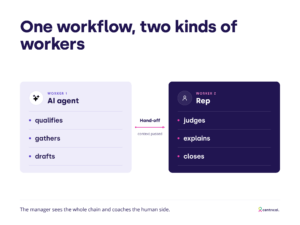
Benefits of AI-powered coaching become clearer when the system shows the full interaction. A weak outcome may reflect a knowledge gap, a poor hand-off, or an unclear rule for the software agent. Treating every issue as a human performance problem sends coaching in the wrong direction. High-stakes customer interactions still rely on the human element as the critical factor for performance improvement.
Implementing a hybrid workforce model for AI agents
A Workforce Orchestration System should connect operational signals to the decisions managers make each day. It provides the infrastructure to run representatives and AI agents as one group, leaves human accountability where it is, and shows managers where to act.
Operational shifts for hybrid teams
Coordination requires four specific operational shifts:
- Work allocation: Show which tasks an AI agent handled and which tasks reached a human representative.
- Hand-off visibility: Record the context passed between the software and the person.
- Actionable intelligence: Connect service levels, quality reviews, adherence, and sales outcomes to the full workflow.
- Action guidance: Surface a coaching recommendation for a manager to review, accept, adjust, or reject.
Engagement automation turns those four shifts into a daily rhythm: the system sends the prompt, the goal, or the recognition that matches what the signal just showed. Software can organize signals and generate recommendations; people decide how to respond.
AI-powered coaching for the human side of the loop
When AI agents handle routine or complex steps, human work changes. Representatives have to interpret AI output, check the context behind it, recover from weak hand-offs, and explain the decision to the customer. Managers need to coach those behaviors alongside product knowledge and selling skills. RSM now tells CHROs to govern AI agents as digital workers, with the same cost centers and performance expectations as the people beside them.
For sales teams, this means coaching to the “attach rate” of AI-generated insights to final closed deals. Digital feedback tools can deliver practice prompts and short feedback, acting as a digital coach for employees who need real-time support. Continuous feedback works when the conversation happens close to the moment it is about. AI role-play gives representatives somewhere to rehearse the hand-off before a live customer is on the other end.
As automation handles more routine queries, operations has to reskill representatives into higher-value consulting roles. The shift holds when it works on the psychological drivers of motivation, autonomy and trust, rather than on transactional rewards.
Operational changes for QA and managers
Your unified workforce operating model should change the weekly review. It should not sit in a separate technology project. Start with three actions:
- Audit the complete interaction. Review the AI action, the hand-off, the human response, and the final customer outcome in one QA record.
- Adjust the coaching cadence. Coach representatives on recurring hand-off and judgment patterns. Update guidance when the workflow changes.
- Assign accountability clearly. Managers own human performance and escalation decisions. Operations and technology teams own the rules, data, and evaluation criteria for AI agents.
Can your performance data explain what happened between the AI action and the human outcome? If it cannot, audit that hand-off data this week. A unified workforce starts with a shared view of the work.
Before you go
What is a hybrid workforce model for AI agents?
A hybrid workforce model puts human representatives and software agents in one operating view, with defined duties, performance signals, and hand-offs on both sides. The manager still owns judgment and accountability, and the model gives them the full picture to judge with.
How do you QA an interaction that AI and a person both touched?
Review it as one record. Log the AI action, the context it passed over, the human response, and the customer outcome in the same place. A QA form that scores only the human half will keep coaching the wrong thing.
What should a digital coach for employees actually do?
Deliver the practice prompt and the short piece of feedback at the moment the signal appears, then check whether the behavior changed. A digital coach that only serves content is a library. The coaching conversation stays with the manager.






 Engage and motivate your frontline teams
 Deliver world class CX with dynamic, actionable quality evaluations
 Boost performance with personalized, actionable goals
 Nurture employee success with the power of AI
 Listen and respond to your frontline, continuously
 Drive productivity with performance-driven learning that sticks
 Drive agent efficiency, deliver client results
 Keep tech teams motivated and proficient on products and services while exceeding targets
 Maintain compliance while building customer happiness and loyalty
 Enlighten energy teams to boost engagement
 Engage, develop, and retain your agents while driving better CX
 Improve the employee experience for your reservations and service desk agents
 Gal Rimon
 Madeleine Freind

 Natalie Roth
 Linat Mart











 Doron Neumann
 Daphne Saragosti
 Ella Davidson
 Ariel Herman
 Ronen Botzer