A sales rep misses a critical buying signal during a high-value discovery call. By the time a manager reviews the call recording and provides feedback, the rep has already moved on to three other prospects. This delay is the cost of disconnected systems.
The real measure of a WEM stack is how fast a performance signal reaches the manager who can act on it.
Workforce Engagement Management (WEM) is the suite of tools used to manage staff performance and engagement. For sales enablement leaders, a modern WEM stack must connect performance signals to timely action to drive revenue. While AI handles the data, managers remain responsible for judgment and coaching because people are the critical factor in navigating high-stakes customer interactions.
The definition of a modern WEM AI stack
From silos to orchestration
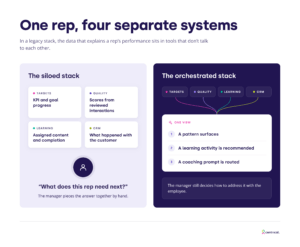
A Workforce Orchestration System connects sales targets, learning content, and CRM data through defined workflows. It can surface a pattern in sales velocity or recommend a learning activity on a specific product line. It can also route a coaching prompt based on rules the operation sets. The manager still decides how to address the issue with the employee.
In a legacy stack, that data lives in separate systems. Sales targets sit in one tool, while learning content and CRM data sit in others. Before enablement managers can decide what a rep needs next to hit quota, they have to piece the story together by hand. That’s the core difference between WEM and WFM: WFM manages the schedule, while WEM manages the person behind it. Buyers now judge these platforms on how well their AI-driven automation closes those gaps.
Why real-time data is the new standard
A performance report delivered at the end of the month cannot support a coaching cadence built around today’s targets. Real-time actionable intelligence brings operational signals closer to the moment when a supervisor can act on them. Real-time coaching automation puts those insights in front of the manager in the moment, not days later.
This shift allows organizations to become AI-first by focusing on internal adoption and upskilling. Adoption depends on engagement, and engagement depends on whether reps get useful feedback, clear goals, and visible support. Connecting performance data to goals, points, and recognition gives reps a reason to practice the behavior the data flagged. The payoff shows on the balance sheet: ContactBabel’s research on AI for contact center cost reduction traces the savings to fewer callbacks, cheaper channels, and lower agent turnover.
Three signs your current stack is decaying
Look for these technical bottlenecks during a stack review:
- Delayed feedback loops. Supervisors receive performance signals after the relevant behavior has passed, so coaching becomes retrospective rather than proactive for the next deal.
- Disconnected insights. Quality, learning, scheduling, and performance tools do not share the context needed to recommend a useful next action for rep development.
- Manual data processing. Managers export reports, compare spreadsheets, and move information between systems before they can coach or update a leaderboard.
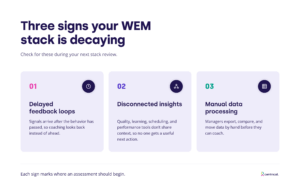
These signs show where an assessment should begin. When evaluating potential upgrades, revenue leaders should use a framework for evaluating call center software that prioritizes operational outcomes. This assessment is a core part of contact center AI optimization for the modern enterprise.
The ROI of AI-powered coaching
AI-powered coaching reduces operational waste when it helps managers focus on the right rep at the right time. For example, Arise Virtual Solutions, a global platform connecting the world’s largest companies with independent customer service agents, used AI-powered coaching to cut speed-to-proficiency in half, dropping training from four weeks to two and lifting first-call resolution by 22%.
The practical test is simple: can the WEM stack connect a performance signal to a manager action? Can it then connect that action to an outcome such as quota attainment, attach rate, or ramp progress? If the answer is no, the operation has a visibility problem and a coaching consistency problem.
A consistency problem on the floor is usually a coaching problem. AI role-play for frontline practice can help reps create repeatable practice for handling objections. The manager still owns the conversation, context, and judgment, and the system supports that loop without taking it over.
Before you go
Is your stack AI-ready?
Your stack is AI-ready when a signal reaches a manager fast enough to change the next conversation. A contact center optimization assessment tells you whether it does:
- Map your signals.
- Measure the delay between behavior and visibility.
- Trace the action from KPI to manager response.
ICMI’s AI optimization assessment works through team readiness, knowledge base, process intelligence, and data centralization before a single tool goes in. Beyond assessment, closing the AI readiness gap requires using simulations to bridge the distance between static training and live performance.
What is the difference between WEM and WFM?
WEM covers the tools that develop and motivate the person: quality, coaching, learning, recognition, and performance. WFM covers the tools that place that person on the schedule: forecasting, staffing, and adherence. A sales enablement leader needs both, and only the WEM side answers what a rep should work on next.
Within the same shift for behavior a manager can still coach, and within the same day for anything tied to a live deal. Real-time coaching automation exists to close that window. Measure your current lag before you shop for a platform, because that number is the one a vendor should have to improve.
What should a WEM AI stack automate, and what stays with the manager?
Automate the detection, the prioritization, and the practice: which rep needs attention, what the pattern looks like, and how they rehearse it. The conversation, the context, and the accountability stay with the manager. Automation that crosses that line produces coaching nobody trusts.






 Turn any business goal into a running performance program in minutes.
 Engage and motivate your frontline teams
 Deliver world class CX with dynamic, actionable quality evaluations
 Boost performance with personalized, actionable goals
 Nurture employee success with the power of AI
 Listen and respond to your frontline, continuously
 Drive productivity with performance-driven learning that sticks
 Drive agent efficiency, deliver client results
 Keep tech teams motivated and proficient on products and services while exceeding targets
 Maintain compliance while building customer happiness and loyalty
 Enlighten energy teams to boost engagement
 Engage, develop, and retain your agents while driving better CX
 Improve the employee experience for your reservations and service desk agents
 Gal Rimon
 Madeleine Freind

 Natalie Roth
 Linat Mart













 Doron Neumann
 Daphne Saragosti
 Ella Davidson
 Ariel Herman
 Ronen Botzer