Average Handle Time (AHT) is the most-watched number on the contact center floor and one of the least discussed in the boardroom. Operations leaders report it every week. It arrives upstairs as a cost figure with no behavior attached to it, and a cost figure with nothing attached is easy to ignore.
AHT earns a place on the board agenda only when someone can show which frontline behaviors drive it and what business outcomes those behaviors affect.
AHT measures the total duration of a customer interaction, including talk time, hold time, and wrap-up work. It remains important for workforce management and contact center operational efficiency. The problem starts when leaders treat it as the final goal rather than a signal that needs context. The harder problem is what teams do with call center data once they have it: most operations lack a bridge between that data and frontline action.
Why average handle time in the boardroom is a vanity metric
The cost-control versus quality trap
AHT is primarily a cost-control metric that helps operations understand staffing demand and transaction efficiency. Yet it does not explain whether the customer received a complete resolution, stayed loyal, or found an easier route to service. To fix this, leaders are adopting modern contact center metrics that replace 20-year-old standards with measures that directly connect to resolution and customer effort.
The gap explains why Average Handle Time in the boardroom often disappears from the agenda. A board can discuss margin, retention, revenue, and customer experience, and AHT enters that conversation only after someone shows how a change in handle time affects those measures. Using automated board reporting can help unify these operational signals with strategic outcomes.
The hidden cost of a rushed agent
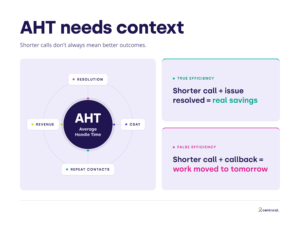
Rushing agents to end calls sooner can reduce the duration of one interaction, but it often creates work somewhere else. Brightmetrics describes what agents do when AHT pressure rises: they cut diagnostic depth, skip edge cases, and close before they are certain. Calls get shorter, repeat contacts go up, and the work reappears in tomorrow’s queue.
AHT vs CSAT looks like a trade-off only when you look at one metric at a time. A shorter call can support profit when the customer receives the right resolution. It can also increase total demand when speed becomes the primary coaching message.
Why agents miss the strategic mark
A dashboard can show that a target is off, but it cannot tell a supervisor which behavior caused the gap, which agent needs support, or what should change on the next interaction. Many organizations find that seeing the problem was never the hard part; the difficulty lies in closing the gap between seeing data and changing behavior.
Modern frontline productivity tools let supervisors pinpoint those behavioral variances quickly. The signal-to-action loop closes when each metric points to a defined owner and response.
Self-service is the clearest example. Gartner surveyed 5,801 customers in early 2025 and found that 60% of agents never promote self-service, and another 12% talk it down. Leadership set the strategy, finance funded it, and the behavior on the floor never changed. Closing that gap takes a targeted refresher, a manager-led coaching conversation, or a review of the knowledge content the agent is reading from.
The system can recommend the next action, and the manager stays responsible for the decision and the conversation.
The failure of the static dashboard
Static reporting describes yesterday. Reporting that earns its keep shortens the time to insight and connects the current signal to a suggested action, while leaving employment and coaching decisions to a person.
- Static AHT reporting shows the variance; a manager investigates the cause.
- A real-time signal identifies a behavior; a supervisor selects the coaching response.
- A performance goal names the outcome; the frontline sees the daily practice behind it.
- A follow-up review checks whether the behavior changed; the manager adjusts the plan.
The difference is between data visibility and a Workforce Orchestration System that turns a signal into a next action. The focus moves from collecting more measures to connecting behaviors to metrics, a shift that prioritizes the human actions driving the numbers over the raw data points themselves.
Translating speed into strategic value
Connecting AHT to customer lifetime value
AHT becomes strategically useful when it sits beside resolution, CSAT, repeat contact, and revenue outcomes. Reducing time should improve profit without damaging the customer relationship. By deploying practical AI use cases, operations can provide the targeted coaching necessary to ensure that efficiency gains do not come at the expense of service quality.
The practical question is simple: what behavior should change when AHT rises? And what customer or business result should that behavior protect? The answer turns a cost measure into an operating decision.
Actionable performance goals translate leadership priorities into behaviors an agent can practice during the shift. Effective agent coaching ensures that supervisors connect a target to learning, recognition, and follow-up. People remain responsible for judgment, empathy, and coaching.
Before you go
Which metrics belong in a board deck?
Every board-level metric should name the customer, revenue, or retention outcome it moves. Review the list and document that link for each one. A metric with no answer is a metric the board does not need.
What should you pair AHT with?
Pair AHT with resolution, CSAT, and repeat-contact signals before you change any coaching target. Read together, they show whether a shorter call saved money or moved the work somewhere else.
A named manager, with a date on the follow-up. Assign each gap to an owner, define the next behavior, and review whether the manager-led action changed the result.
What the board needs is a clear connection between frontline behavior and customer value. Start by linking your reporting to the actions your supervisors can run this week.
Book a demo to see how the Workforce Orchestration System turns a business goal into a running performance program for your frontline.

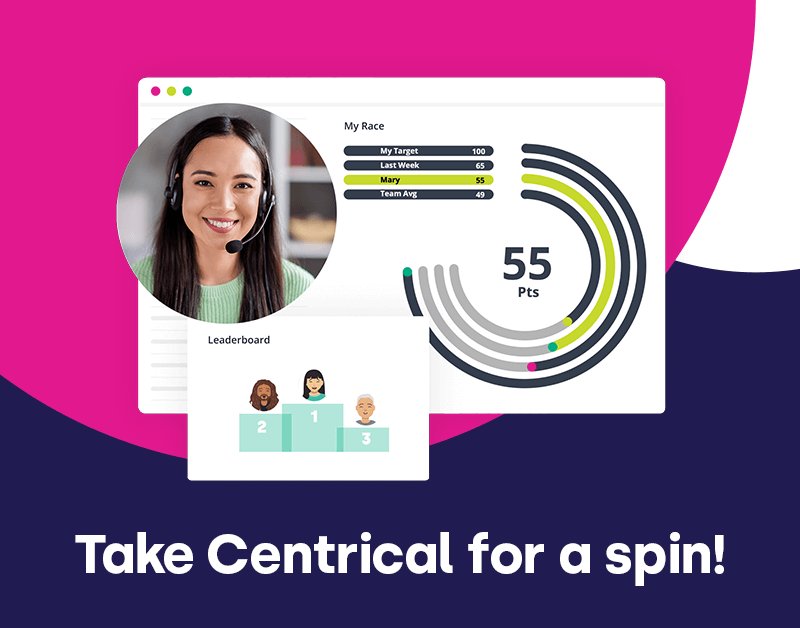





 Turn any business goal into a running performance program in minutes.
 Engage and motivate your frontline teams
 Deliver world class CX with dynamic, actionable quality evaluations
 Boost performance with personalized, actionable goals
 Nurture employee success with the power of AI
 Listen and respond to your frontline, continuously
 Drive productivity with performance-driven learning that sticks
 Drive agent efficiency, deliver client results
 Keep tech teams motivated and proficient on products and services while exceeding targets
 Maintain compliance while building customer happiness and loyalty
 Enlighten energy teams to boost engagement
 Engage, develop, and retain your agents while driving better CX
 Improve the employee experience for your reservations and service desk agents

 Gal Rimon
 Madeleine Freind

 Natalie Roth
 Linat Mart













 Doron Neumann
 Daphne Saragosti
 Ella Davidson
 Ariel Herman
 Ronen Botzer