Operations leaders have plenty of signals about frontline performance. Turning it into behavior change is where the quarter gets lost. That gap rarely surfaces in a procurement review, because every tool in the stack does exactly what it was sold to do.
Your stack is missing the layer that turns a signal into a manager’s next move.
A contact center can run capable tools for quality, scheduling, and customer conversations and still struggle to change frontline behavior, because performance data sits apart from the coaching and learning actions meant to improve it. The pressure is rising: generative AI adoption in contact centers is growing at a 34% compound annual rate, and structural weaknesses in technology integration often stall behavioral change.
What is the AI fragmentation problem?
Defining the data-action gap
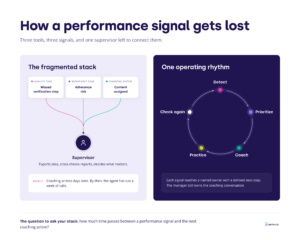
AI fragmentation occurs when separate tools produce signals but do not connect performance signals to a manager’s next action. A quality tool may identify a missed verification step. A workforce tool may show adherence risk. A learning system may assign content. The supervisor still has to connect the dots, decide what matters, and follow up manually.
That delay creates the data-action gap. Operations teams often find that the problem lies in what they do with call center data: nothing bridges that data to frontline behavior. More technology does not close the gap when each tool operates on a separate schedule. This often stems from task-specialized architecture that lacks an orchestration layer to unify these signals.
Why point solutions stall frontline teams
Point solutions optimize individual tasks, but frontline teams work across connected tasks. A change to a script creates a new knowledge requirement. A new customer-intent model changes how agents classify calls. A new compliance rule changes the coaching conversation. Gartner projects that conversational AI could save $80 billion in agent costs by 2026. Capturing that saving depends on replacing fragmented tools with cohesive systems.
When those ripples stay outside the coaching cadence, managers spend time translating data instead of helping agents apply it. The result is a stack of capable tools and an inconsistent operating rhythm. Moving toward intent-based supervision helps managers oversee these automated outputs rather than performing granular data reconciliation themselves.
The hidden cost of disconnected AI tactics
Fragmentation results in operational costs that are easy to misdiagnose. When performance signals arrive separately from the action they should trigger, behavior change slows down. Market leaders are prioritizing platform advantages to overcome the inefficiencies of isolated point solutions.
Common symptoms of fragmentation
- Higher average handle time when agents receive conflicting guidance or have to search across systems for answers.
- Manager burnout as supervisors cross-check reports before they can actually start coaching their agents.
- Training lag when new skills are introduced without a clear practice and follow-up loop.
For many organizations, automation succeeds when they reskill agents into higher-value roles rather than simply reducing headcount. This transition depends on connecting technology capability to how people work, learn, and receive feedback. Fragmentation breaks this connection by siloing the metrics from the development path.
Moving toward an AI Workforce Orchestration System
Unifying actionable intelligence
A Workforce Orchestration System connects actionable intelligence to the operating decisions that follow. It shows which KPI moved and identifies the behavior associated with that movement. It also gives the manager a clear starting point for action. The goal is one operating rhythm: detect, prioritize, coach, practice, and check again. This requires a shift toward continuous performance tracking rather than relying on annual or monthly reviews that arrive too late to affect current outcomes.
Closing the loop with coaching
Automation can recommend a practice activity or surface a targeted conversation through AI-powered coaching. The manager keeps responsibility for the coaching judgment and the human discussion. That boundary is what keeps coaching credible. Performance improvement requires context, empathy, and a response to what happened in the interaction. Even with advanced automation, human intervention remains critical in high-stakes coaching and customer outcomes.
An action-gap framework starts with a simple question: how much time passes between identifying a performance issue and taking the next coaching action? The longer the lag, the more likely the signal is to lose relevance. To solve this, leading teams deploy automated simulations to provide immediate, scalable practice that bridges the distance between training and real-world execution.
How to diagnose fragmentation in your stack
Effective diagnosis requires mapping how data travels through the operation. Three steps show where the chain breaks:
- Map each performance signal to the team that receives it and the specific action it is supposed to trigger. If this map requires manual exports or separate manager routines, fragmentation is affecting execution.
- Measure the time between a performance insight and the manager’s coaching response.
- List every new skill requirement created by a recent tool, workflow, or policy change, and check whether one operating view connects those requirements to learning and coaching.
If these elements are disconnected, the ROI of your technology stack remains capped by the manual effort required to link them.
The next buying decision is less about adding another model and more about unifying data around frontline work. Frontline productivity tools need to connect insight with action while keeping managers in the loop where judgment matters. Transitioning from reactive software to an agent-as-a-service model can help automate the administrative overhead of these workflows.
Audit your coaching-to-data lag time this week. That measurement gives your rollout a practical starting point for improvement.
Before you go: What buyers want to know
How does AI fragmentation affect agent engagement?
AI fragmentation in contact centers leads to agent frustration because people receive feedback that is disconnected from their actual daily workflows. When insights from quality monitoring do not reach the coaching loop quickly, agents feel they are being measured against outdated or irrelevant criteria.
The data-action gap is the time between a system producing a performance signal and a manager acting on it. A quality score that lands on Monday for a behavior from last Tuesday has already lost most of its value, because the agent has run a week of calls since. Measure that lag before you buy anything else.
Not on its own. Adding a tool to a stack that already fails to connect signal and action gives the supervisor one more window to check. Automation closes the gap when it routes the signal to a named owner with a defined next step, and stops short of the coaching conversation itself.
Book a demo to see how the Workforce Orchestration System turns a business goal into a running performance program for your frontline.

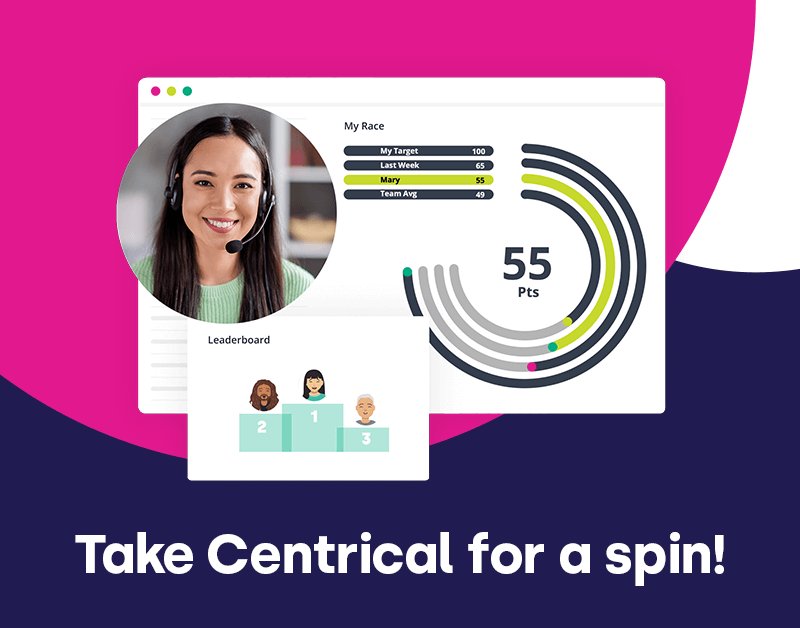





 Turn any business goal into a running performance program in minutes.
 Engage and motivate your frontline teams
 Deliver world class CX with dynamic, actionable quality evaluations
 Boost performance with personalized, actionable goals
 Nurture employee success with the power of AI
 Listen and respond to your frontline, continuously
 Drive productivity with performance-driven learning that sticks
 Drive agent efficiency, deliver client results
 Keep tech teams motivated and proficient on products and services while exceeding targets
 Maintain compliance while building customer happiness and loyalty
 Enlighten energy teams to boost engagement
 Engage, develop, and retain your agents while driving better CX
 Improve the employee experience for your reservations and service desk agents

 Gal Rimon
 Madeleine Freind

 Natalie Roth
 Linat Mart













 Doron Neumann
 Daphne Saragosti
 Ella Davidson
 Ariel Herman
 Ronen Botzer