This is the third installment of The Contact Center Gap, a series featuring expert perspectives from people who have spent years inside contact center operations: running them, selling into them, supporting them, and watching what separates the ones that perform from the ones that plateau.
Ian Chappell has been working in the contact center space since 1999. He started as a call handler, moved into workforce planning, spent time inside a BPO, and has spent the last eight years consulting on contact center operations across EMEA and APAC. He has seen a lot of scorecards.
When Chappell talks about what most operations still measure, the word he describes it as “alarming.”
“We still see [operations] obsessing over average handle time,” Chappell says. “Old voice frameworks. We still see that as a driving factor in how they plan, how they staff, how they recruit.”
Not in 2003. Now.
The problem usually stems from familiarity.
“We obsess over metrics we have measured for years because we know how to do it.”
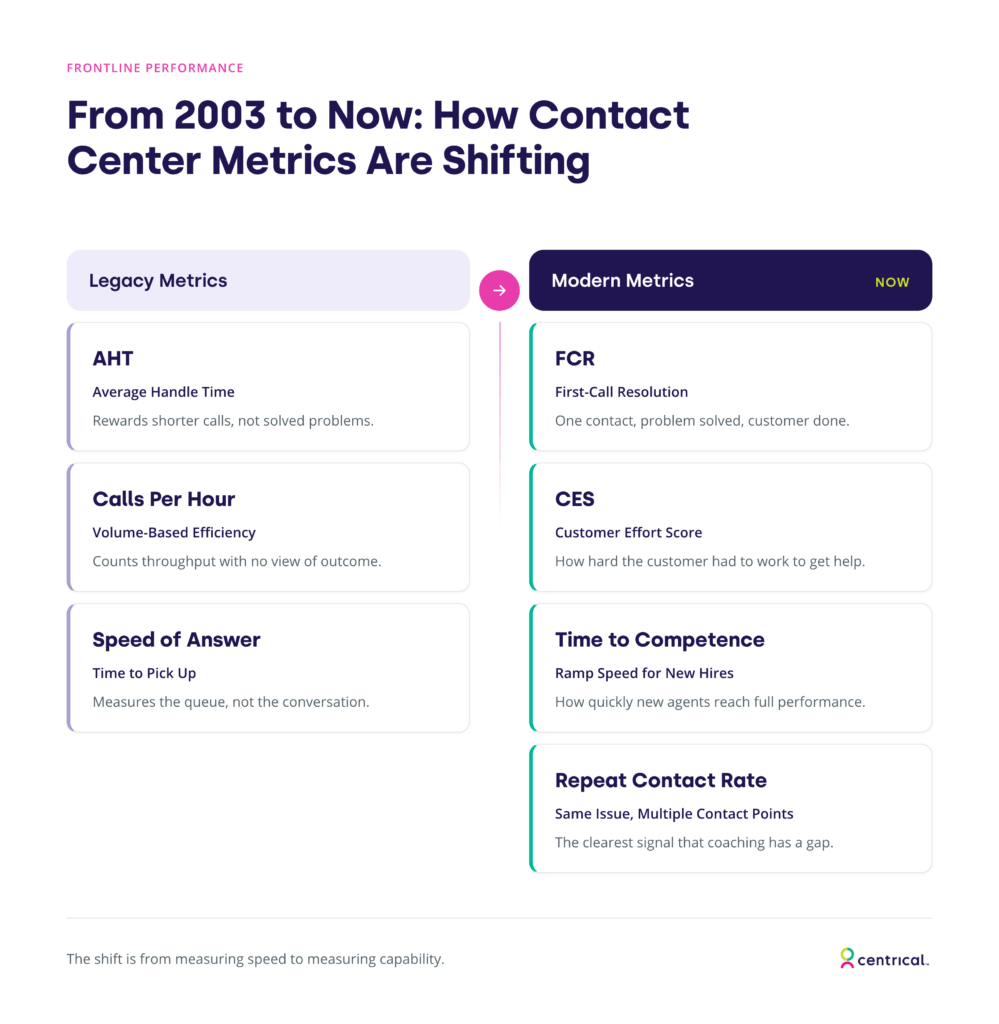
Average handle time. Calls per hour. Average speed of answer. These were the right metrics for a voice-only operation with simple transaction types and a single channel. Businesses built processes around them, hired staff to hit them, and promoted people who delivered them.
But as the world around us changed, the metrics didn’t.
“Modern operations need to look at things in a different way,” Chappell says.
Not only are the metrics outdated, but chasing them can sometimes do more harm than good.
When agents know they’re measured on call duration, they rush interactions. When supervisors are evaluated on handle time, they push agents to close faster. The customer on the other end often hangs up with a problem that wasn’t fully resolved, calls back, and starts the cycle again.
Melissa Esposito, Senior Director of Customer Success at Centrical, has watched the shift happen in real time with her customers.
“Handle time is no longer the biggest deal,” Esposito says. “Some clients have removed AHT from the agent scorecards.” For those operations, other measures now take priority — ones that tell you whether the interaction actually served the customer, not just how quickly it ended.
What call center metrics actually predict customer loyalty
Average handle time tells you how long a call took. First contact resolution, instead, tells you whether the customer actually left with their problem solved.
“Customers are probably willing to wait a little bit longer if it’s done right first-time,” Chappell says. “That is a much better customer experience than numbers on a spreadsheet.”
First-contact resolution (FCR) across all channels — not just voice — has become one of the strongest leading indicators of customer satisfaction. But even FCR has a more powerful successor waiting.
Customer effort score (CES) measures how hard customers had to work to get their issue resolved. According to Gartner, customer effort is 40% more accurate at predicting customer loyalty than customer satisfaction scores.
For contact centers still optimizing for speed, that finding reframes the entire operation. A customer can hang up satisfied but still churn if every interaction requires real effort on their end: transfers, repetition, channel switching, unresolved issues that require a callback. AHT doesn’t capture any of that, but CES does.
The best operations still track an agent’s handle time. They just don’t lead with it, or let agents chase it at the expense of getting the answer right.
The correlation problem most operations miss
Fixing which metrics you track is one part of the problem. The other is more structural, and Chappell argues it’s the one most contact center operations still haven’t addressed.
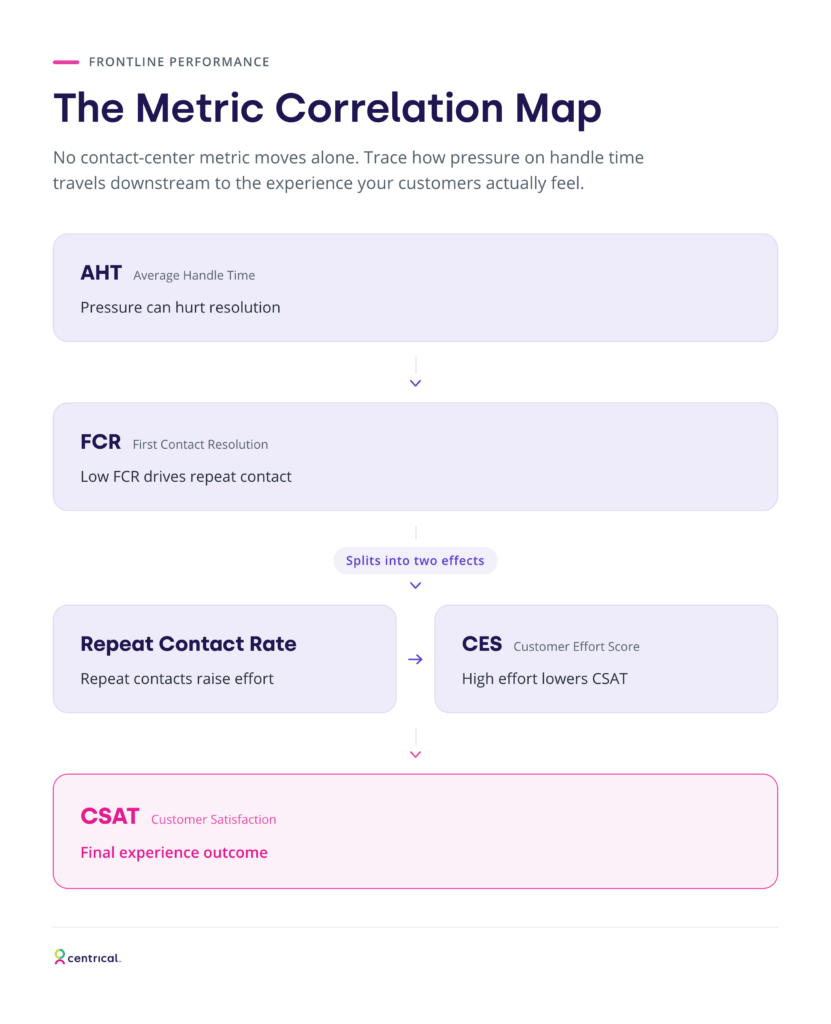
“We need to correlate: if you push metric A, what does that do downstream?”
Every contact center KPI exists in relationship with other KPIs. Quality scores affect CSAT; FCR affects repeat contact rate; agent coaching consistency affects performance variance. But most operations manage these metrics in isolation — different teams, different dashboards, different reporting cycles — without mapping what one does to the others.
The result, Chappell says, is that operations end up optimizing locally at the expense of the wider picture.
“If I’m a manager and my quality’s great, and my CSAT scores are great, my first contact resolution’s great — why would I be obsessing about keeping my average handle time down?”
In that scenario, obsessing over AHT might actively work against the outcomes the business cares about most. Keeping agents under time pressure erodes quality and increases the likelihood of repeat contacts, both of which cost more than a longer call that resolves the issue cleanly.
The operations that get this right, Chappell says, have done the work to map those dependencies explicitly. Agents understand what they’re measured on, and why. They also understand what gets better downstream when they get a specific thing right.
There’s a fourth metric Chappell flags that almost no one measures well: time to competence.
Attrition in contact centers runs high. New agents join constantly. Existing agents get moved between product lines, channels, and roles. Every time a skill gap exists, it lives inside customer interactions before it shows up in performance data.
The question that time to competence answers is: how long does it take before an agent can handle a given contact type at the standard the business expects?
Most operations can’t answer that question. They know when training completed; but they don’t know when competence was actually achieved, or how that competence held up under real call volume. And without that data, they can’t make informed decisions about readiness, staffing, or where coaching should focus.
Tracking time to competence requires connecting learning data to performance data, and seeing whether what happened in training had the desired effect on the floor. Without that link, operations are left guessing whether their training investment worked.
Esposito has seen the shift play out in detail. Contact centers that joined Centrical three or four years ago with AHT at the top of every agent’s scorecard now operate with a fundamentally different metric hierarchy. CSAT and first contact resolution have moved to the front. AHT, where it remains on the scorecard at all, shows up as an indicator rather than a target.
Separately, as AI handles more of the routine, transactional contact types, the human agents typically handle the interactions that require judgment, empathy, and sustained attention.
The operations doing this well share a few characteristics:
- Metrics are fewer in number and more clearly linked to outcomes.
- Supervisors can explain to any agent why a specific metric matters, and what it does for the customer when that agent gets it right.
- Performance conversations happen around data that’s specific, timely, and actionable.
“Businesses need to get better at continually rethinking what they want to measure, based on what they’re trying to achieve,” Chappell says.
Before you go
Are most contact centers still using average handle time?
Yes, and it remains one of the most commonly tracked metrics across both voice and digital channels. The shift away from AHT as a primary performance driver is happening, but unevenly. Some operations have removed it from agent-visible scorecards entirely. Others still use it as a leading KPI despite operating across multiple channels where its value as a quality signal is limited.
What should replace average handle time as the primary call center metric?
First contact resolution (FCR) and customer effort score (CES) are the two metrics most consistently cited by contact center experts as better predictors of customer outcomes. FCR measures whether the customer’s issue was resolved during the interaction. CES measures how hard the customer had to work to get there. Gartner research indicates that customer effort is 40% more accurate at predicting loyalty than satisfaction scores.
Why do so many contact centers still track outdated metrics?
Familiarity and infrastructure are the main drivers. Metrics like AHT and speed of answer have been tracked for decades. Reporting systems are built around them. Hiring targets reference them. Changing the metric architecture requires agreement across operations, HR, finance, and frontline management, which makes it a change management challenge as much as a measurement one.
What is time to competence and why does it matter?
Time to competence measures how long it takes an agent to perform a given task or handle a given contact type at the standard the operation expects, not just when training completes, but when real performance matches the target. With attrition running high and constant upskilling demands, operations that can’t measure time to competence struggle to know whether their training investment is working, or when agents are truly ready for higher-complexity interactions.
How do you start fixing metric alignment in a contact center?
The practical starting point, according to Chappell, is to work backwards from outcomes: decide what the business needs to achieve for customers, then map which metrics actually predict progress toward that goal, then trace the dependencies between those metrics. The operations that do this well are the ones where frontline agents can articulate not just what they’re measured on, but why, and what gets better for the customer when they move a specific number.
About our experts
Ian Chappell is Director of Consulting, International at Centrical, leading presales consulting across EMEA and APAC. With over 20 years in contact centers and customer operations, he has worked across the frontline, workforce planning, BPO, and solution consulting, and is now one of Centrical’s specialists for the contact center and BPO space.
Melissa Chang Esposito is Senior Director of Customer Success at Centrical, where she helps enterprises turn employee engagement into stronger business results. She brings more than eight years of guiding clients across the full customer lifecycle and a foundation in organizational transformation from Deloitte Consulting’s Human Capital practice.






 Engage and motivate your frontline teams
 Deliver world class CX with dynamic, actionable quality evaluations
 Boost performance with personalized, actionable goals
 Nurture employee success with the power of AI
 Listen and respond to your frontline, continuously
 Drive productivity with performance-driven learning that sticks
 Drive agent efficiency, deliver client results
 Keep tech teams motivated and proficient on products and services while exceeding targets
 Maintain compliance while building customer happiness and loyalty
 Enlighten energy teams to boost engagement
 Engage, develop, and retain your agents while driving better CX
 Improve the employee experience for your reservations and service desk agents


 Gal Rimon
 Madeleine Freind
 Natalie Roth
 Linat Mart












 Doron Neumann
 Daphne Saragosti
 Ella Davidson
 Ariel Herman
 Ronen Botzer