The page below compares Centrical and AmplifAI for enterprise contact center and CX leaders who have both on a shortlist. It covers where each platform leads, where each one still has gaps, and which buyer profile each fits best. If you’re deep in a vendor evaluation and want something you can forward to your stakeholders, read on.
Updated on: October 28, 2026
Centrical vs AmplifAI at a glance
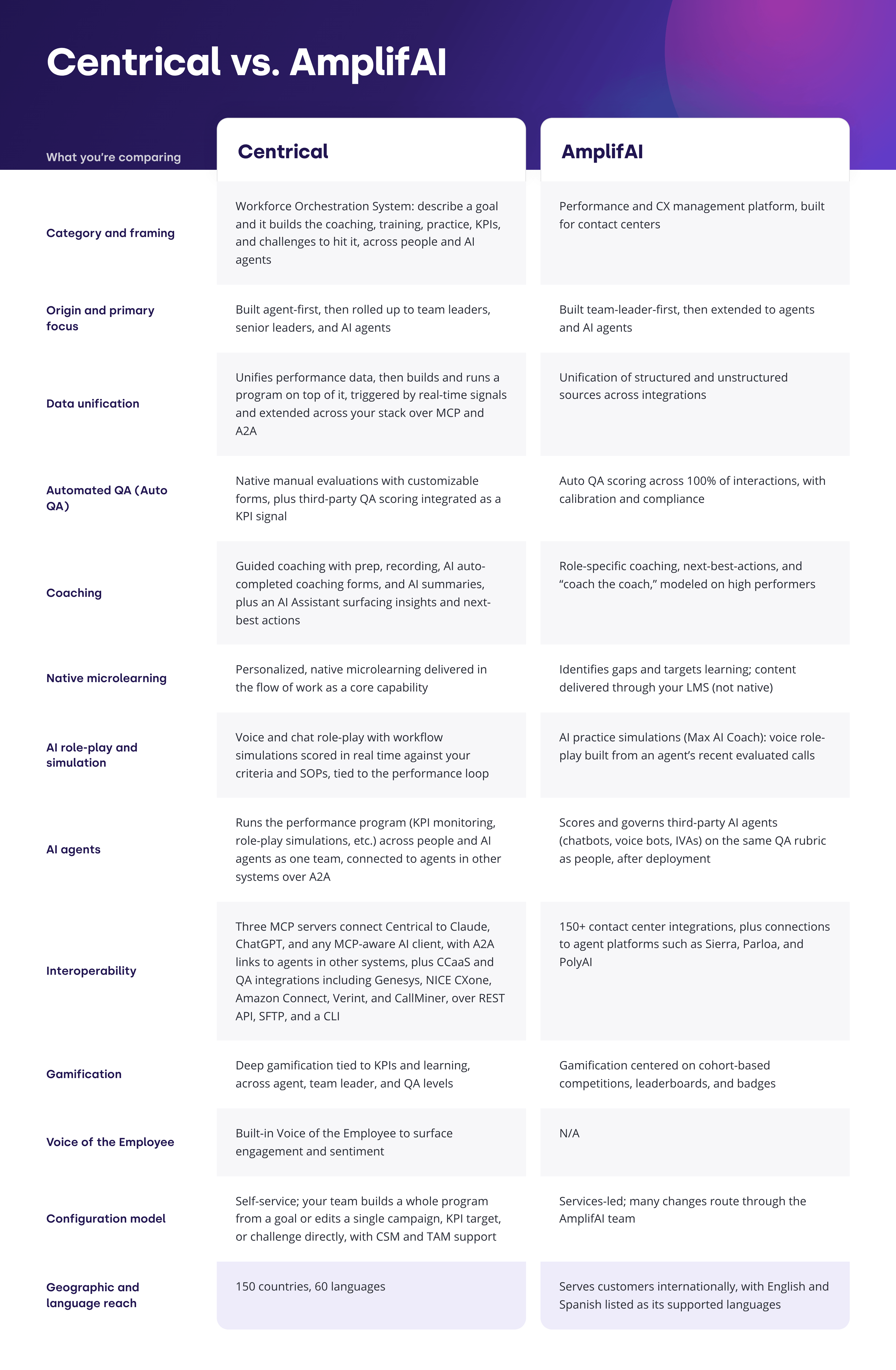
Data unification: Both platforms do this well, and the difference is what each one does with the data next. AmplifAI brings structured and unstructured sources together, across voice, chat, email, surveys, CRM, WFM, QA, and CCaaS, into one performance view, and it markets 150+ integrations to do it. For a contact center drowning in disconnected dashboards, that single source of truth is a real strength. Centrical unifies the same performance data and reads KPIs across CCaaS, QA, CRM, WFM, and HR systems, then it uses that data to build and run a program rather than stopping at the insight. It also reads performance signals in real time: a quality failure, an SLA breach, a policy violation or an NPS drop fires a prioritized notification with the suggested action attached, and the same signal can auto-trigger microlearning, AI role-play or a coaching session. Connection runs both ways. Three Model Context Protocol (MCP) servers put Centrical data inside Claude, ChatGPT and any MCP-aware assistant, so leaders and admins ask, analyze and act without leaving the tool they already work in. Agent-to-agent (A2A) communication lets Centrical AI agents exchange context and actions with agents in other systems, delegating work out to whichever tool is best placed to do it and bringing insight in, such as conversation insights from Gong, with the results landing back in Centrical.
Automated QA: AmplifAI runs native Auto QA, scoring interactions with calibration workflows, compliance monitoring, and flexible evaluation forms. Centrical runs its own quality evaluations, with customizable manual forms for any channel or process and AI-generated feedback based on evaluator comments and scoring, and its AI scores role-play interactions automatically. What it does not do is score 100% of live interactions automatically: it ingests automated outputs from CCaaS and conversational intelligence systems directly and integrates with QA tools, including a partner solution through Etech/QEval, then pulls those scores in as KPI signals that drive coaching and learning.
Coaching: Both platforms coach. AmplifAI started as a team-leader tool; it delivers role-specific next-best-actions that tell a supervisor who to coach, what to coach, and how, plus a “coach the coach” capability for certifying how team leaders coach. Centrical has built out guided coaching with session prep and recording, AI auto-completed coaching forms, and AI summaries, run through its conversational AI Assistant. The same AI Assistant carries AI-Assisted Coaching recommendations: Centrical analyzes performance, quality evaluations, and coaching patterns to surface who to coach, what to focus on, and who to recognize, delivers those next-best actions straight from the performance dashboard, and offers prompts and suggested questions during a live session. Managers using it save up to four to ten hours a week and take three times as many coaching actions. The philosophies differ: AmplifAI models an ideal high-performer persona and works to replicate it, while Centrical builds coaching around each person’s goals and development plan.
Learning and practice: Both platforms offer AI practice. AmplifAI added simulations through Max AI Coach, which runs voice role-play built from an agent’s recent evaluated calls and scores the practice against evidence. Centrical runs voice and chat role-play scored in real time against your company’s criteria and SOPs. The difference sits in learning and in how practice connects to everything else. AmplifAI identifies knowledge gaps and targets learning, with the content living in your LMS, while Centrical delivers native microlearning in the flow of work, builds the content itself from files you already have, including quizzes and translations into other languages, and ties practice, microlearning, coaching, and gamification into one running program keyed to each agent’s KPIs.
AI agents: Both platforms address the hybrid frontline (people and AI agents), but in different ways. AmplifAI scores and governs AI agents that you built elsewhere, connecting to agent platforms such as Sierra, Parloa, Salesforce, Google, AWS, Decagon, and PolyAI, then grading chatbots, voice bots, and IVAs on variants of the same QA rubric it applies to people after deployment. Centrical runs the performance program itself across people and AI agents as one team. Agent-to-agent (A2A) communication is how the program reaches past Centrical: its AI agents exchange context and actions with agents in other systems, so the program runs across the stack instead of stopping at one platform’s edge. An AI agent gets the same treatment as a person: KPIs, scored role-play against your criteria and SOPs before it reaches a customer, and a place in the same program. A team focused on QA and governance of bots already in production will value AmplifAI’s approach; a team that wants people and AI agents coordinated inside one running program will lean toward Centrical.
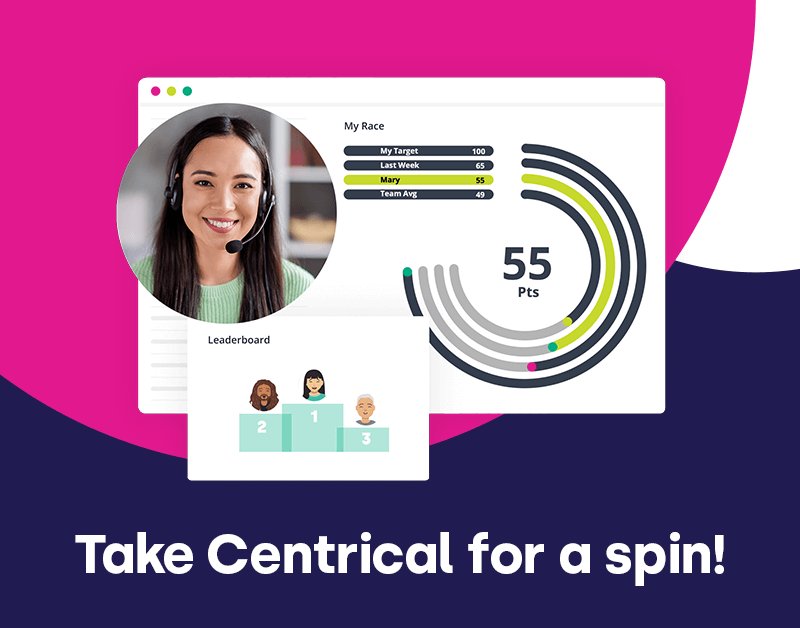
Gamification: AmplifAI offers cohort-based competitions that pit new agents against new agents and top performers against top performers, plus leaderboards, badges, and avatars. Centrical’s gamification runs deeper and wider. It ties to KPIs and to the learning loop, it reaches beyond agents to team leaders and QA specialists, and it has run at enterprise scale since 2013.
Configuration model: Centrical is self-service. The Workforce Orchestration System handles big and small asks the same way. Give it a business goal, and it builds the whole program. Ask it to run a campaign on one KPI, add a challenge, or change a target, and it builds it. AmplifAI leans on a services-led model, where many changes route through its team. The model suits buyers who want the work done for them, and it slows down buyers who want to move at their own pace and without roadblocks.
Reach: Centrical serves frontline teams across the enterprise in 150 countries and 60 languages. AmplifAI serves customers internationally, including global BPOs, and lists English and Spanish as its supported languages. For a buyer running frontline teams in dozens of languages, that gap in coverage shaped at least one large global buyer’s decision to standardize on a platform with wider reach.
The section below walks through the goals a contact center team is usually working toward in this evaluation, and how each platform helps with each one.
Most teams reach this evaluation with data scattered across QA, WFM, CRM, survey, and CCaaS systems. AmplifAI pulls structured and unstructured sources into one view across its integration library. Centrical also consolidates performance data and reads KPIs from multiple systems, so an agent sees one dashboard instead of many. Both platforms get you to one view, so the real question is what happens next. AmplifAI unifies the data and reports on it. Centrical treats unification as step one, then builds the coaching, training, and practice the data points to and adjusts them as results come in.
Goal 2: Automate quality assurance across interactions
For a team that wants to move off manual call sampling and score every interaction, AmplifAI’s native Auto QA is a strong fit, with calibration, compliance monitoring, and multiple evaluation forms. Centrical takes a different path. It runs native quality evaluations with customizable forms and AI-generated feedback, ingests automated QA outputs from CCaaS and conversational intelligence systems, and integrates your existing QA scoring, then turns all of it into a KPI that drives coaching and learning rather than scoring every live interaction itself. Teams that already run a QA tool they like, and want to keep it, should confirm integration options with each vendor before deciding.
Goal 3: Coach team leaders and managers consistently
Both platforms are strong here. AmplifAI’s next-best-actions and “coach the coach” model help a supervisor know where to spend coaching time, and its high-performer persona approach appeals to leaders who want to replicate their best people. Centrical now offers AI-Guided Coaching workflows with prep, recording, AI-completed coaching forms, and AI summaries, built around individual goals rather than a single benchmark, plus AI-Assisted Coaching recommendations that tell a manager who to coach, what to focus on, and who to recognize. The AI Assistant sits on the performance dashboard, so a manager explores the data, takes the next-best action from there, and gets prompts during the session itself, which saves up to four to ten hours a week and drives three times as many coaching actions. Buyers who want a manager-first coaching engine will find AmplifAI compelling; buyers who want coaching tied into the same program as learning, practice, and engagement will prefer Centrical.
A coaching insight only pays off when the agent does something with it. Both platforms offer AI practice: AmplifAI’s Max AI Coach runs role-play built from an agent’s recent calls, and Centrical runs voice and chat role-play scored against your criteria. The difference is what wraps around the practice. Centrical serves native microlearning tied to a KPI dip, kicks off role-play automatically when performance data calls for it, and rewards the follow-through with gamification, all in one program. AmplifAI targets learning at the agents who need it and routes the content through your LMS, so the learning layer sits a step outside the platform.
Dive deeper: Your call center data isn’t the problem. But what you do with it is.
Goal 5: Keep frontline agents engaged
AmplifAI began as a supervisor tool and added an agent view later, and it has since built agent-facing practice. Buyers still tend to describe the core daily agent experience as the lighter side of the platform. Centrical was built agent-first, so the agent uses the platform for much of the workday, taking learning, acting on coaching, and competing in gamified missions, which in turn gives managers more to see and act on. If the agent experience and daily engagement are central to the outcome you want, that origin difference shows up in practice.
Centrical is self-service by design. Your team asks the Workforce Orchestration System for what it needs: a full program built from a business goal, or a single campaign on one KPI, a new challenge, a change to a target, a different audience, or new learning content and quizzes generated from files you already have. None of it waits on the vendor. AmplifAI routes many changes through its own team. Some buyers like having that work done for them, while others end up waiting on the vendor for routine updates. The right choice depends on how much control your team wants over day-to-day configuration.
A closer look at Centrical
Centrical is a Workforce Orchestration System for frontline sales and service teams, where people and AI agents work as one team. A leader describes a business goal in plain language, and the system builds and runs the performance program needed to hit it, including KPIs, learning, coaching, simulations, and challenges, then keeps improving it as results come in. Smaller asks work the same way: a campaign focused on one KPI, a new challenge, a change to a target mid-quarter.
Centrical started with the agent, then rolled the same context up to team leaders and senior leaders, so each level gets its own view of the same underlying data.
The through-line is a closed loop: performance signals feed AI insight, insight drives coaching, coaching connects to personalized microlearning, microlearning pairs with adaptive AI role-play practice, and the results feed back into measurement. Gamification runs across all of it, tied to KPIs rather than bolted on, and Centrical has operated that engine at enterprise scale since 2013.
The program also runs outside Centrical. Three Model Context Protocol (MCP) servers connect Centrical to Claude, ChatGPT, and any MCP-aware AI client, so leaders and admins ask, analyze, and act on Centrical data without leaving the assistant they already use, with a CLI available as well. Agent-to-agent (A2A) communication lets Centrical AI agents exchange context and actions with agents in other systems, delegating work out to whichever tool is best placed to do it and bringing data in, such as conversation insights from CallMiner, with results coming back into Centrical. Real-Time Signals catch the moments a business cannot afford to miss across people and AI agents, a quality failure, an SLA breach, a policy violation, an NPS drop, and each signal fires a prioritized notification with suggested actions drawn from your existing processes.
With Centrical, managers get a full picture of team engagement, learning progress, and self-service activity, not only scorecard metrics. Centrical also includes Voice of the Employee to surface engagement and sentiment, and it serves frontline teams in 150 countries and 60 languages.
Centrical has been recognized as a leader in Workforce Engagement Management by Frost & Sullivan and QKS Group; it has offices in New York, London, and Tel Aviv.
A closer look at AmplifAI
AmplifAI sells a performance and CX management platform built specifically for contact centers. The Texas-based company is led by founder and CEO Sean Minter. It markets dozens of features across seven integrated modules, grouped as performance enablement, quality intelligence, customer analytics, AI simulations, and AI agent management, on a foundation of data integration and its patented contact center AI engine, all framed around a “unify the data, then act” story.
What does AmplifAI do best? First, data unification across many contact center sources, which it frames as the readiness step most companies skip. Second, its Auto QA, which scores every interaction and routes findings into coaching and recognition workflows.
Its reviewers point to honest limitations. On G2 and Gartner Peer Insights, AmplifAI’s own users raise recurring notes about limited or dated reporting, dashboard views that lack display options, a user interface that could feel more modern, and a learning curve to get through the platform’s many capabilities.
One gap shows up against a full performance program. AmplifAI identifies knowledge gaps and targets learning, but the content stays in your LMS rather than being delivered as native microlearning in the flow of work.
When to choose AmplifAI
- You want native Auto QA scoring across 100% of interactions inside one platform, and quality management is the center of your evaluation.
- Analyzing unstructured interaction data across voice, chat, email, and surveys is the core job to be done, and a reporting layer on top of it is enough.
- You want to score and govern third-party AI agents (chatbots, voice bots, IVAs) on the same quality rubric as your human teams, after they go live.
- You want coaching modeled on an ideal high-performer persona, with a “coach the coach” workflow for certifying how supervisors coach.
- You prefer a services-led model where the vendor stands up and maintains the configuration for you, rather than owning it in-house.
When Centrical is the better AmplifAI alternative
- You want an orchestration system that turns a business goal into a running program, with KPIs, learning, coaching, simulations, and gamification built and adjusted together, not assembled by hand.
- You want native microlearning and practice tied to each agent’s KPIs, triggered by the performance signals themselves, so a quality failure, an SLA breach, or an NPS drop reaches the manager with the next best action attached.
- The agent experience and daily engagement are central to the outcome you want, and you value an agent-first design.
- You want to own the platform and make changes yourself, without routing configuration through a vendor services team.
- You want a conversational AI Assistant that surfaces coaching priorities and next-best actions from the performance dashboard.
- You run frontline teams across many countries and languages, or beyond the contact center, and you want Voice of the Employee built in.
- You want native quality evaluations with customizable forms and AI-generated feedback in the same platform as coaching and learning, or you already run a QA tool and want its scores integrated as a signal rather than replaced.
- You want the program to work across whatever stack you already run, through open APIs, named CCaaS, QA, CRM, and HR connectors, MCP servers that put Centrical data inside Claude or ChatGPT, and A2A links to agents in other systems.
- You want to test AI agents in scored role-play against your own criteria and SOPs before they reach customers, not only grade them after go-live.
How the two rate with independent reviewers
Read these ratings with a caveat: the review samples are far apart in size, so a higher average built on fewer reviews is not a clean advantage.
G2 ratings, as of October 2026
On Gartner Peer Insights, AmplifAI carries about 72 ratings at 4.4 out of 5, while Centrical’s presence there and on Capterra is light, so a fair side-by-side across those sources is not possible yet.
Before you go: What buyers want to know
Does Centrical do automated QA like AmplifAI? Partly. AmplifAI scores 100% of live interactions automatically, and Centrical does not. Centrical runs native quality evaluations with customizable manual forms and AI-generated feedback, scores role-play automatically, ingests automated QA outputs from CCaaS and conversational intelligence systems, and integrates with QA tools including a partner solution, then brings the scores in as a KPI that drives coaching and learning. So if automated scoring of every live call is the core of your evaluation, AmplifAI is the better fit; if you want evaluations, coaching, and learning in one place with your existing QA scores feeding them, Centrical is.
Do both platforms offer AI role-play practice? Yes. AmplifAI added native simulations through Max AI Coach, which runs voice role-play built from an agent’s recent evaluated calls. Centrical runs voice and chat role-play and workflow simulations, scored in real time against your criteria and SOPs. The difference is how practice connects to the rest: Centrical triggers it automatically from KPI data and ties it to microlearning, coaching, and gamification in one program, while AmplifAI runs practice as part of coaching.
How do the two handle AI agents? AmplifAI scores and governs AI agents you built elsewhere, grading third-party chatbots, voice bots, and IVAs on the same QA rubric it applies to people, after deployment. Centrical manages AI agents the way it manages people: same KPIs, same scored role-play before go-live, same program. A2A connections let it work with agents built in other systems. Both address the hybrid frontline; the question is whether you want to govern bots already in production or coordinate people and AI agents inside one running program.
Can your team make changes, or do you depend on the vendor? With Centrical, your own team runs it. Describe a goal and the Workforce Orchestration System builds the program, your admins approve it, and they change the KPIs, missions, content, and audiences themselves afterwards. AmplifAI leans on a services-led model, where many changes route through its team, which some buyers prefer and others experience as a wait.
Is there an added cost for changes or dedicated support with AmplifAI? Buyers evaluating AmplifAI have reported that some configuration changes, additional evaluation forms, or a dedicated success manager may carry an added fee, though experiences vary and pricing is not public. Confirm the specifics directly with the vendor during your evaluation. Centrical includes self-service configuration and unlimited content and quiz creation.
What does Centrical do that AmplifAI does not? Centrical builds and runs the program itself. Describe a goal and it assembles the KPIs, coaching, learning, and practice needed to hit it, your team approves it, and your admins change it afterwards without waiting on the vendor. AI agents sit in that same program, tested in scored role-play and measured on KPIs alongside people. Managers get AI-Assisted Coaching recommendations worth up to four to ten hours a week and three times as many coaching actions, with native microlearning, Voice of the Employee, and gamification feeding the same loop. AmplifAI unifies data and acts on it with Auto QA, coaching, next–best-actions, and bot governance, with learning content routed through your LMS. The practical difference is whether you want the program built and run for the goal, or the data unified and acted on a layer at a time.
Choosing the right AmplifAI alternative
If your evaluation centers on automated QA across every interaction and governing AI agents already in production, AmplifAI is a strong fit. If you want an AmplifAI alternative where your own team asks for a performance program and gets one, with the KPIs, coaching cadences, learning content, practice, and challenges already in place, then changes it, adds a campaign, or adjusts a target without the vendor, across people and AI agents and across many countries and languages, Centrical is the better fit. Both are credible enterprise platforms. The right call comes down to whether you want the data unified and reported on, or a performance program your team can build, run, and change.






 Turn any business goal into a running performance program in minutes.
 Practice with AI. Win with real customers.
 Nurture employee success with the power of AI
 Deliver world class CX with dynamic, actionable quality evaluations
 Drive productivity with performance-driven learning that sticks
 Boost performance with personalized, actionable goals
 Engage and motivate your frontline teams
 Listen and respond to your frontline, continuously
 Drive agent efficiency, deliver client results
 Keep tech teams motivated and proficient on products and services while exceeding targets
 Maintain compliance while building customer happiness and loyalty
 Enlighten energy teams to boost engagement
 Engage, develop, and retain your agents while driving better CX
 Improve the employee experience for your reservations and service desk agents

 Madeleine Freind














 Ariel Herman
 Ronen Botzer
 Linat Mart
 Ella Davidson
 Daphne Saragosti
 Doron Neumann
 Natalie Roth
 Gal Rimon