This is the fourth installment of The Contact Center Gap, a series featuring expert perspectives from people who have spent years inside contact center operations: running them, selling into them, supporting them, and watching what separates the ones that perform from the ones that plateau.
“Our data is a mess”: why that’s almost never true
Walk into almost any conversation among contact center ops leaders, and you will hear some version of the same thing: “We need better data. Our data is a mess.”
Ian Chappell has heard it hundreds of times. Chappell has a decade of experience working across BPO and in-house contact center environments; he says the diagnosis is almost always wrong.
“Every contact center we speak to is data rich,” Chappell says. “They’re drowning in data, but it’s the insight and the action that are lacking.”
The data, in most cases, already exists. One reliable source of truth (usually a CRM, a WFM platform, or a quality management system) sits at the center of the operation. People may debate its precision; but the data is there, and it covers what matters.
The real problem surfaces one step further along. Getting that information to the people who need it, in a form they can act on, at the moment it would actually make a difference: that’s where most contact centers fall short.
Why call center data never reaches the people who need it
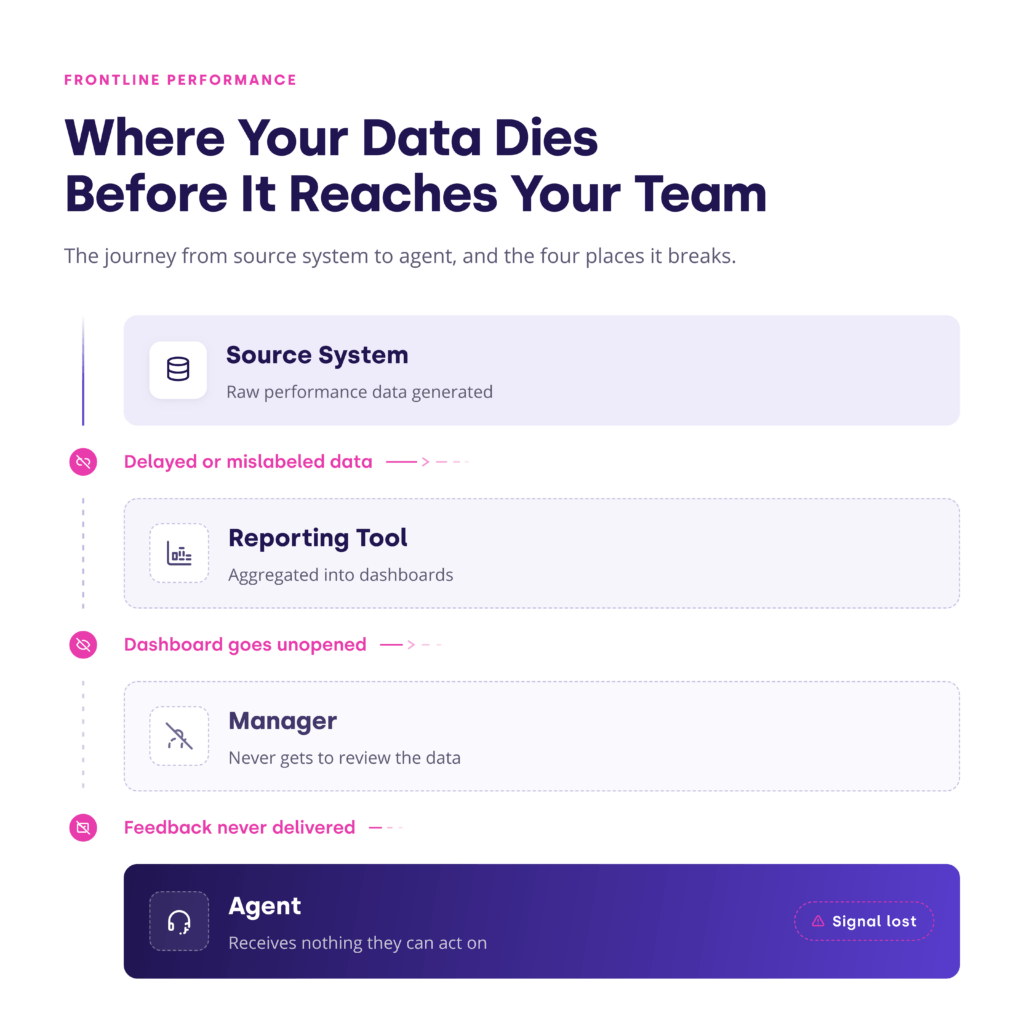
The path from data to action in most contact centers looks roughly like this: an ops lead (or performance team) pulls a report, formats it, and sends it to team leaders, who then share it with agents. By the time the data arrives, it’s often half a week old.
“The problem isn’t the access to that information,” Chappell says. “It’s how do we drive a culture of doing something with it?”
The delay makes the data irrelevant before agents ever see it. An agent who handled calls poorly last Tuesday and finds out about it the following Monday has already taken another 150 calls the same way. The coaching window has closed, and the behavior has reinforced itself.
And even when the data does arrive, it tends to land as a table of red and green numbers, with no context, no prioritization, and no clear indication of what the agent is supposed to do about it.
“Nobody is joining the dots,” Chappell says.
Monitoring is not the same as managing. Departments in most frontline operations get watched closely, measured constantly, and still don’t know what to fix next.
The gap between seeing a pattern and doing something about it
What “data rich, insight poor” looks like in practice
There is a common misconception about data quality. If the data is the problem, the solution is usually a new system, a new export, or a better dashboard. But none of that requires anyone to change how they work.
When the data is already good enough, and it almost always is, the question becomes harder. Because then the problem is operational: it’s about habits, workflows, and whether the organization has built a culture of acting on what it sees.
Chappell describes what that culture gap looks like from the outside: managers drowning in admin, juggling 10 things that don’t appear in their job description, running coaching sessions that get cancelled whenever service levels drop. A performance management process that everyone tolerates but nobody actually believes in.
“The biggest gap,” he says, “is between seeing something that’s happening and doing something about it.”
That gap has a direct cost: every week a performance issue goes unaddressed is another week of calls handled below standard, customer satisfaction scores sliding, and agents developing habits that become progressively harder to reverse.
How managers get stuck between data and action
Team leaders and frontline supervisors closest to the problem often want to act. But they often miss the time, the tools, and the translated insight to know where to start.
Melissa Esposito, Senior Director of Customer Success at Centrical, sees this post-sale: customers who have the data but still struggle to surface it to the right people at the right time. The result is what she describes as a “shotgun” approach to coaching, where managers address a room when they should be working one-on-one with the three agents who actually need attention that week.
Esposito describes the shift that separates teams that close the gap from those that don’t: managers moving from broad team interventions to what she calls “surgical actions” —i.e. targeted coaching conversations driven by specific performance signals rather than calendar schedules.
What closing the call center analytics gap actually looks like
Real-time visibility as the starting point
The first requirement is simple, and still rare: agents need to see their own performance data in real time, without waiting for a report to travel down the chain.
“Data belongs to that person,” says Chappell. “If we don’t want them to see that data, then how will we ever get them to want to improve?”
When agents can see where they stand—against their own targets, against their peers, against where they were yesterday—they start asking the right questions, because they want to know what to fix.
The parallel shift happens at the manager level. When a team leader can see, at a glance, which agents are drifting off-target and on which specific behaviors, coaching stops being a calendar exercise and becomes a response to something real.
From data visibility to coaching action
When managers get the right information at the right moment, the volume of coaching interactions they can run increases significantly. Esposito describes operations where managers who previously oversaw 15 to 20 agents have extended their effective coaching span to 20 to 25 thanks to Centrical’s AI Assistant, because prep time drops and session focus improves. The AI assistant, she explains, can surface in 10 to 15 seconds which agents need attention, what they’re struggling with, and which behaviors to address. This is work that previously took an hour of manual prep!
The result is more coaching interactions, better targeted, with less friction per session. For more on what those sessions look like in practice, see What good coaching actually looks like in a contact center.
Why “joining the dots” is a cultural problem, not a technical one
The organizations that close the insight-to-action gap do it by changing what they expect from managers and giving those managers the tools to deliver.
Chappell’s observation from years of contact center consulting: the best operations are characterized by the habits their managers have built:
- Reviewing performance consistently.
- Coaching specifically.
- Following up on what they said they’d fix.
For contact centers still tracking performance in spreadsheets, with data traveling down a chain that takes three days to reach an agent, that culture shift is the real project. The data was never the obstacle.
For a closer look at the metrics worth acting on, see The call center metrics you’re still using from 2003, and what to track instead
Before you go
Is our data actually a problem, or do we just think it is?
In most contact centers, the data is good enough. The issue is that it lives in a system that doesn’t get it to the right people at the right time. Before investing in a new data tool or analytics platform, audit how your current data travels from the source system through the performance team to team leaders and agents. The bottleneck is almost always in that handoff chain, not in the data itself.
Why do agents still not see their own performance data in real time?
The most common reason is structural: data gets pulled by a central team, formatted, and sent out on a weekly cadence. By the time it reaches agents, it’s already several days old and no longer actionable. Operations that have solved this give agents direct access to their own metrics through a live dashboard, so they can see where they stand today, not last Tuesday.
What’s the difference between a manager who acts on data and one who doesn’t?
Time and translation. Managers who act have two things their counterparts often lack: enough time freed from admin to actually coach, and data that arrives pre-translated into a coaching action rather than a raw number. When a manager has to spend an hour building the case for a coaching conversation before they can have it, many of those conversations simply don’t happen.
How do you build a culture of doing something with performance data?
Consistency is the foundation. Coaching sessions should not get cancelled even when service levels drop. Follow-through on what gets discussed. Agents who can articulate not just what they’re being measured on, but why. The culture comes from the habits that managers model.
What does “surgical” coaching look like compared to a blanket team approach?
A blanket approach addresses the whole team in a group session, covering issues that may be irrelevant to many of the people in the room. A surgical approach, instead, targets the specific agents who need attention, on the specific behaviors driving their underperformance, at the moment when a coaching intervention would have the most impact. Esposito describes the best-performing contact centers as those where managers spend more time with the people who actually need attention, rather than splitting time equally across a team regardless of who’s struggling.
About our experts
Ian Chappell is Director of Consulting, International at Centrical, leading presales consulting across EMEA and APAC. With over 20 years in contact centers and customer operations, he has worked across the frontline, workforce planning, BPO, and solution consulting, and is now one of Centrical’s specialists for the contact center and BPO space.
Melissa Chang Esposito is Senior Director of Customer Success at Centrical, where she helps enterprises turn employee engagement into stronger business results. She brings more than eight years of guiding clients across the full customer lifecycle and a foundation in organizational transformation from Deloitte Consulting’s Human Capital practice.







 Engage and motivate your frontline teams
 Deliver world class CX with dynamic, actionable quality evaluations
 Boost performance with personalized, actionable goals
 Nurture employee success with the power of AI
 Listen and respond to your frontline, continuously
 Drive productivity with performance-driven learning that sticks
 Drive agent efficiency, deliver client results
 Keep tech teams motivated and proficient on products and services while exceeding targets
 Maintain compliance while building customer happiness and loyalty
 Enlighten energy teams to boost engagement
 Engage, develop, and retain your agents while driving better CX
 Improve the employee experience for your reservations and service desk agents

 Gal Rimon
 Madeleine Freind
 Natalie Roth
 Linat Mart












 Doron Neumann
 Daphne Saragosti
 Ella Davidson
 Ariel Herman
 Ronen Botzer