This is the first installment of The Contact Center Gap, a series featuring expert perspectives from people who have spent years inside contact center operations: running them, selling into them, supporting them, and watching what separates the ones that perform from the ones that plateau.
A contact center that recently onboarded with Centrical told us something that stuck. Their previous operation, they said, felt like 1995. Managers were writing coaching notes in Microsoft Word and filing them, in the words of Melissa Esposito, Senior Director of Customer Success at Centrical, “to absolutely nowhere.”
There was no visibility, no follow-through; no way to know whether anything changed.
The frustrating part is that story has nothing to do with the software they used at the time. They had dozens of tools and they had loads of data; the problem was a system built around activity rather than outcomes, and a buying decision made without anyone asking the right questions first.
And that story is far from unusual. Contact centers today have more dashboards, tools, and reports than ever; yet, plateau despite significant technology spend, and supervisors spend hours doing manual bookkeeping instead of actually coaching. The data problem most leaders assume they have is often something else entirely.
So, before you sign a contract, before you run another demo, and before your procurement team builds a comparison spreadsheet, here are the questions worth asking that most contact center leaders skip entirely. Each one comes from
What you will find in this article: the four questions that actually determine whether a call center software deployment succeeds; why change management, not technology, drives most failures; and how to tell the difference between a platform that improves visibility and one that changes how managers and agents work every day.
Start with the outcomes, not the features
How to evaluate call center software before you open a single demo
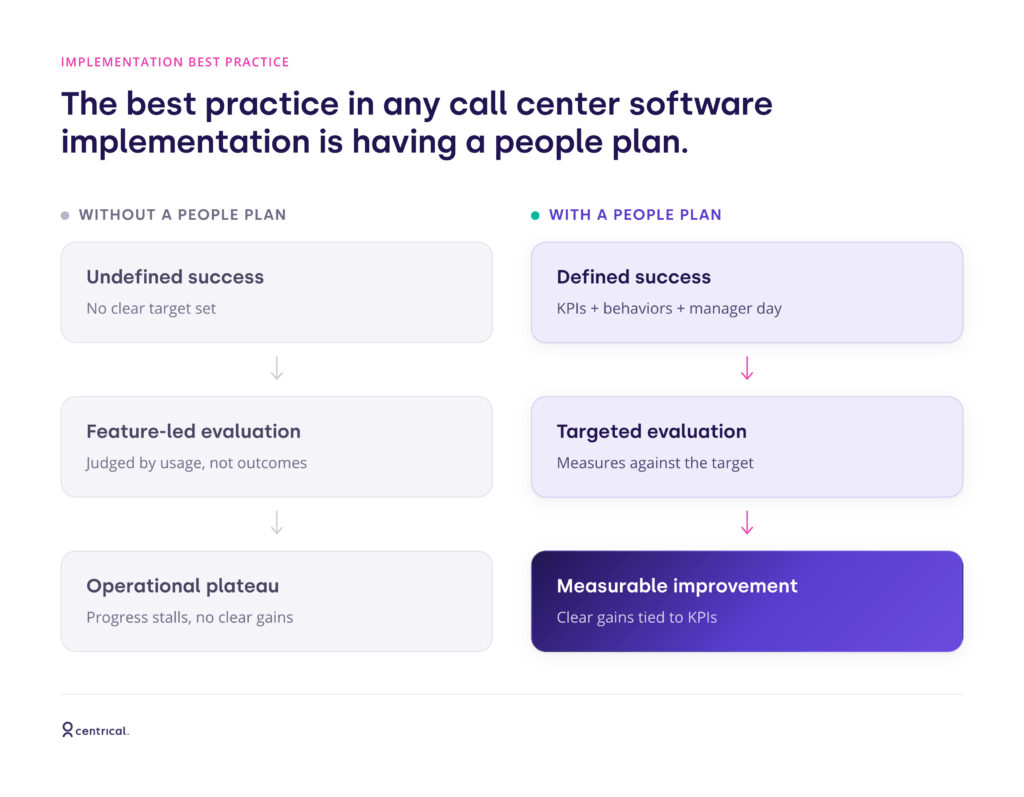
The most common mistake Chappell sees contact center leaders make in a software evaluation is starting with what the platform does rather than what the operation needs to look like when it works.
“Work backwards from what the end goal looks like,” he says. “Before you even look at a demo, get clear on: what does success look like in six months? What does a manager’s day look like when this is working? What are agents doing differently?”
Most software evaluations skip that step. They start with a feature comparison and then try to map the features back to a goal they never truly defined. The result is a platform that technically works and operationally stalls.
A more useful starting question for any evaluation: if you fast-forward 90 days post go-live, what has to be true for this to have been worth the investment? Name the KPIs, name the behaviors, name what a manager’s Tuesday morning looks like. Then evaluate whether the platform you are considering actually supports that outcome — not just the features that looked good in the demo.
Ask who owns change management, and get a real answer
“The failure is never going to be the technology,” Chappell says. “It’s always going to be the process, the success measures, and having the right people bought in before you even go live.”
A place where a platform might not succeed is cultural adoption: whether the system fits how people actually work, whether managers genuinely use it, and whether the frontline understands why it matters and what’s in it for them.
According to 2026 Gartner research, 91% of customer service leaders feel pressured into implementing AI technology — up from 77% in 2025 — and that pressure is forcing many into a fail-fast strategy that overlooks legacy systems, technical debt, and operational maturity, resulting in ambitious deployments that struggle to deliver.
Yet, only 25% of contact centers have successfully integrated their tools into daily operations, meaning 75% own capabilities they have not fully operationalized.
Operations leaders often focus on asking vendors how their platform integrates with their CCaaS. But there’s also another angle that’s important not to overlook. Ask: “What does your Push for specifics. What does the first 90 days look like operationally? Who owns manager enablement? What does adoption failure typically look like, and how do you catch it early?
The same discipline applies internally. Before you sign anything, get honest answers inside your own organization: do your managers have buy-in, or just awareness? Is your executive sponsor actually involved, or nominally attached? Has your frontline leadership had a say in the process?
“Having the right people bought in at the right times before you even go live” is the variable that often determines whether a deployment succeeds or plateaus.
Separate the data problem from the action problem
One of the most persistent misconceptions Chappell encounters in early-stage conversations is the belief that the operation’s core problem is data quality.
“Generally, most contact centers already have really good data,” he says. “There will be one single source of truth that everyone is managing processes and people from. The problem is not access to that information.”
The problem is the gap between seeing something in the data and doing something about it, for the right person, at the right time.
Frontline managers are drowning in metrics but short on prioritized, actionable next steps. Agents see performance data too late, if at all. Coaching happens in response to visible damage rather than early signals. As Chappell puts it: “People are data rich. They’re drowning in data. But it’s the insight and the action that is lacking.”
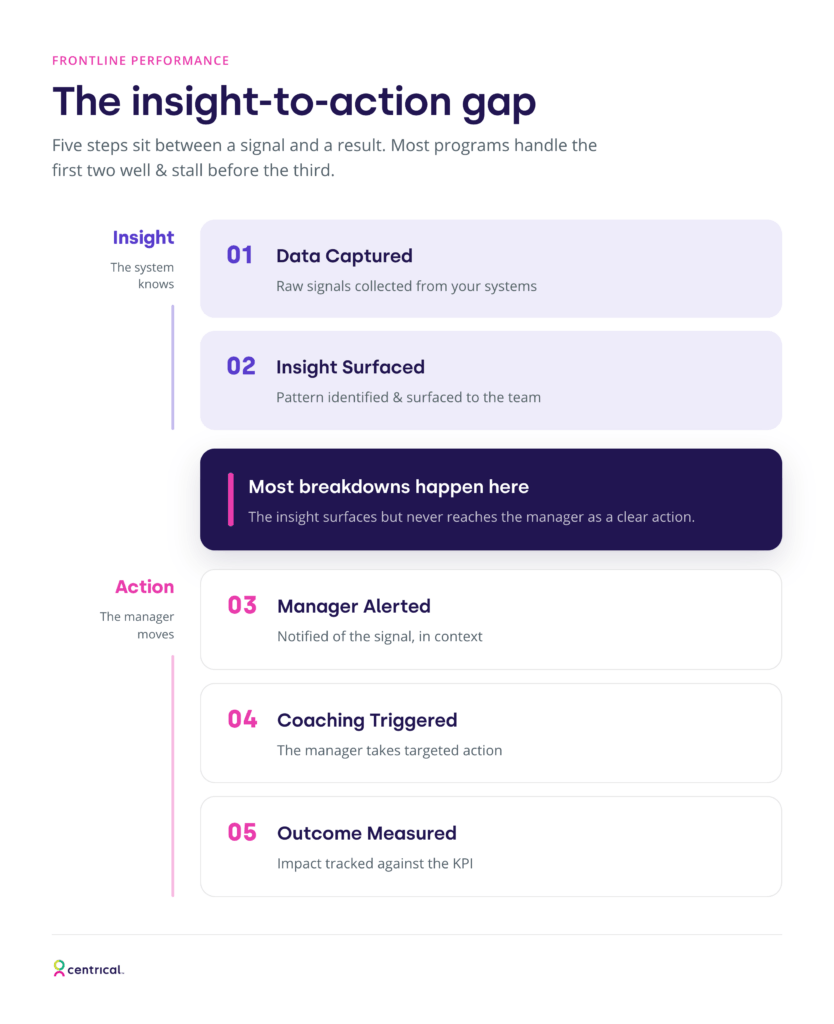
So, when you evaluate call center software, ask this question: “What does a manager do differently on Monday morning because of what this platform surfaces?”
If the answer is mainly dashboard access and improved reporting, the platform solves the visibility problem without touching the action problem.
The distinction matters because visibility and action are not the same investment.
A contact center that already has reasonable data visibility needs a platform that closes the loop from insight to coaching to skill-building to measurable improvement, not one that gives managers more charts to look at.
Treat the vendor relationship as a long-term partnership, not a transaction
Chappell’s final point rarely surfaces during a procurement process, but consistently separates deployments that sustain results from those that stall at the six-month mark.
“When you’re working with any tech vendor, it needs to be a partnership,” he says. “There should be skin in the game for both parties.”
What that looks like in practice: agreed success measures documented before go-live; a regular cadence, whether weekly, monthly, or quarterly, where both sides can challenge each other honestly; and a vendor willing to raise a flag when adoption is drifting or implementation is off track (and not just when the renewal is coming up).
Ask prospective vendors directly: what does your QBR process look like? What happens when a deployment is underperforming? Can you share an example of a time you flagged to a customer that something was not working, and what you did about it?
The answers will tell you more about whether this will be a genuine operating partnership than anything in the sales deck.
The questions that actually matter before you buy call center software
Before you enter your next software evaluation, run these by your internal team and your shortlisted vendors:
- What does success look like in 90 days, named specifically at the manager and agent level?
- Who owns change management beyond go-live, and what does that support look like in practice?
- What does the platform do differently the morning after a manager logs in, compared to what they do today?
- How do you handle an implementation that is drifting off track, and can you share a real example?
The call center software market offers no shortage of capable platforms. The operations that get lasting results from them are the ones that walk into the evaluation knowing what they need to be true on the other side, and who hold both themselves and their vendor accountable for getting there.
Before you go: A recap of the questions to ask
What should I ask a call center software vendor before buying?
Ask four questions before signing: what does success look like in 90 days at the manager and agent level; who owns change management beyond go-live; what does a manager do differently the morning after logging in; and how does the vendor handle an implementation that is drifting off track. According to Ian Chappell, Director of Consulting at Centrical, the failure in a deployment is usually not the technology; it is the mutually agreed outcome, the buy-in, and the change management that follows.
Why do call center software implementations fail?
Most implementations fail at the cultural adoption layer, not the technical one. Platforms work in roughly 95 to 99 percent of cases technically. What breaks down is whether managers genuinely use the system, whether the frontline understands why it matters, and whether change management was treated as a priority before go-live rather than an afterthought.
Visibility means managers can see more data. Performance improvement means the right action happens for the right person at the right time- automatically, not because a manager remembered to check a dashboard.
Most contact center operations today are not just data-rich and insight-poor. They are fragmented, with performance data living in one system, QA findings in another, coaching tools somewhere else. Learning content in an LMS that nobody opens between onboarding cycles. Practice simulations, if they exist at all, disconnected from the metrics that should be triggering them. And now AI agents, sourced from different vendors, running different workflows, are adding another layer to an already fractured stack.
The result is that a manager who wants to coach the right agent on the right behavior still has to manually connect the dots across four or five systems before they can act. Most do not. Not because they do not care, but because the system makes it too hard.
What the best contact center software does is orchestrate the next best action across the full improvement loop: from performance signal to coaching conversation to targeted learning to practice to measurement. For the manager, that means knowing exactly who to focus on and why without digging. For the agent, it means receiving the right intervention at the right moment rather than a generic training module six weeks after the gap first appeared.
Think of it as an operating system layer that sits across your contact center stack: it connects the signals, sequences the actions, and closes the loop for every individual.
Q: What should success look like 90 days after deployment of afor performance and development?
At 90 days, managers should be coaching more frequently with less prep time and with greater impact, agents should have real-time visibility into their own performance with personalized guided improvement (practice, microlearning, nudges), and the operation should be able to name specific KPI movements tied to platform-driven behaviors. If the only measurable output at 90 days is adoption rate, the deployment defined success too narrowly at the outset.
About our experts
Ian Chappell is Director of Consulting, International at Centrical, leading presales consulting across EMEA and APAC. With over 20 years in contact centers and customer operations, he has worked across the frontline, workforce planning, BPO, and solution consulting, and is now one of Centrical’s specialists for the contact center and BPO space.







 Engage and motivate your frontline teams
 Deliver world class CX with dynamic, actionable quality evaluations
 Boost performance with personalized, actionable goals
 Nurture employee success with the power of AI
 Listen and respond to your frontline, continuously
 Drive productivity with performance-driven learning that sticks
 Drive agent efficiency, deliver client results
 Keep tech teams motivated and proficient on products and services while exceeding targets
 Maintain compliance while building customer happiness and loyalty
 Enlighten energy teams to boost engagement
 Engage, develop, and retain your agents while driving better CX
 Improve the employee experience for your reservations and service desk agents

 Gal Rimon
 Madeleine Freind
 Natalie Roth
 Linat Mart












 Doron Neumann
 Daphne Saragosti
 Ella Davidson
 Ariel Herman
 Ronen Botzer