This is the second installment of The Contact Center Gap, a series featuring expert perspectives from people who have spent years inside contact center operations: running them, selling into them, supporting them, and watching what separates the ones that perform from the ones that plateau.
A call center manager walks the floor with calls in the queue. She stops at a desk, leans in, and says: I noticed you dropped off on FCR since yesterday. Anything you want to work through? Three minutes later, she moves on.
Ian Chappell calls that “drive-by coaching.”
He spent almost a decade working in contact centers and BPOs before moving into consulting. He has seen the full range of operations across EMEA and beyond, from the ones where performance conversations happen consistently to the ones where it exists mainly as a pro-forma calendar entry. The difference, he says, is not the format. It is whether the behavior actually changes.
Many managers treat coaching as a debrief.
Chappell describes the version he sees too often: sitting next to an agent, listening to a call, then saying “that was really good, but you need to work on your empathy” or “you’ve had a good month, but you need to improve your first contact resolution.”
“These things really mean nothing,” Chappell says. “They’re just observations with feedback.”
The problem is not intent. Managers in that situation usually do want to help. The problem is that the feedback is vague, unanchored in data, and delivered without a plan for best next steps and follow-up. Nothing moves. The agent takes another 150 calls on the same topic, doing things the same way, because the loop never closed.
The scale of the gap is worth noting. According to Gartner research, coaching outperforms training, staff retention programs, and recruiting high performers as a driver of frontline performance. Yet, most contact centers treat it as administrative rather than strategic.
Why agent coaching sessions keep getting cancelled, and why it matters
Those who have worked in a contact center long enough know the pattern. The coaching session is scheduled for Friday afternoon; by mid-afternoon, service level is out and the queue is building. The session gets postponed.
Chappell says this is one of the clearest signals that a coaching culture has not taken root.
“Those kinds of one-to-one coaching sessions should always be scheduled. In my opinion, they should never get dropped even if you have 100 calls in the queue and service level is already broken.”
His reasoning is practical: canceling the session does not solve the service level problem. But it does communicate something.
“Canceling them shows that the perception could be that you don’t really care about that. And that means that you don’t really care about coaching your people and developing them.”
The operations that get this right treat coaching as non-negotiable. Volume pressure is not a justification to cancel. It is precisely the kind of stress that makes consistent agent development more important.
When coaching does happen, the sessions that move performance share a structure.
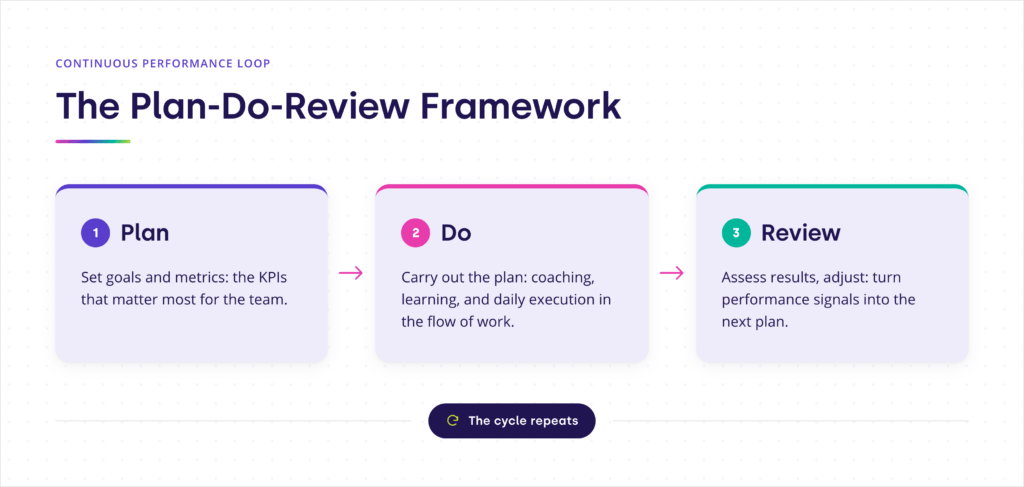
Chappell traces it back to a framework that has been around contact centers around the world for decades: plan, do, review.
- Plan what you will work on, grounded in data.
- Do the session with a focused topic and a clear next-step action.
- Then follow up. If the approach did not work, go back and try something else.
The review step is where most coaching falls apart. Managers deliver the session, mark it complete, and move on. The agent often doesn’t know what to do next and whether anything changed; the manager does not either.
“Use data, document it, and then follow it up,” Chappell says. “Those things together are what make coaching more valuable.”
Centrical’s own data, drawn from more than 200,000 coaching interactions across 50,000 frontline employees, puts a number on the importance of following through. When coaching tasks included a due date, KPI performance improved by 4% compared to coaching without one. Completion rates improved by 12%. A two-second habit, adding a deadline to a coaching task, moves the needle in a measurable way.
Scheduled sessions are not the only place agent coaching happens. Chappell draws a distinction that high-performing operations already understand: the formal one-to-one and the informal moment are both coaching.
“Coaching doesn’t always have to happen as a scheduled activity. It doesn’t even always have to have a structured, documented outcome or agreement.”
He describes a five-minute conversation in which a manager noticed an agent had dropped off the previous day, walked over, and asked if there was anything to work through. That exchange counts.
“One of the guys I used to work with used to call it drive-by coaching. It doesn’t always have to be a sheet of paper, scribbling down agreements. It can just be listening out and going, having a quick chat with someone, and then that person puts it into practice, then the progress is reviewed later.”
Rather than a shortcut, drive-by coaching can be a habit that keeps performance conversations alive between formal touchpoints.
Agents know someone is paying attention, and managers catch problems before they compound: the feedback loop shortens from weeks to hours.
Coaching completion vs. targeted coaching: why the difference matters
Melissa Esposito has spent almost a decade at Centrical, working with contact center teams through implementation and sustained performance improvement. She hears this question all the time: how often should managers coach their agents?
“It’s actually a trick question,” she answers, “because there is no single formula for good coaching.”
The challenge she typically sees: operations set a blanket rule, coach everyone once a week or once a month, then measure whether coaching took place, and not whether the agents actually improved.
“With that kind of umbrella approach, coaching becomes more of a compliance-based coaching, rather than [a strategy] to target the folks who actually need attention.”
Sessions happen, forms get filled, and performance does not move. And because the metric is sessions completed rather than behaviors changed, no one notices until the quarterly numbers come in.
Esposito describes this as mistaking activity for productivity.
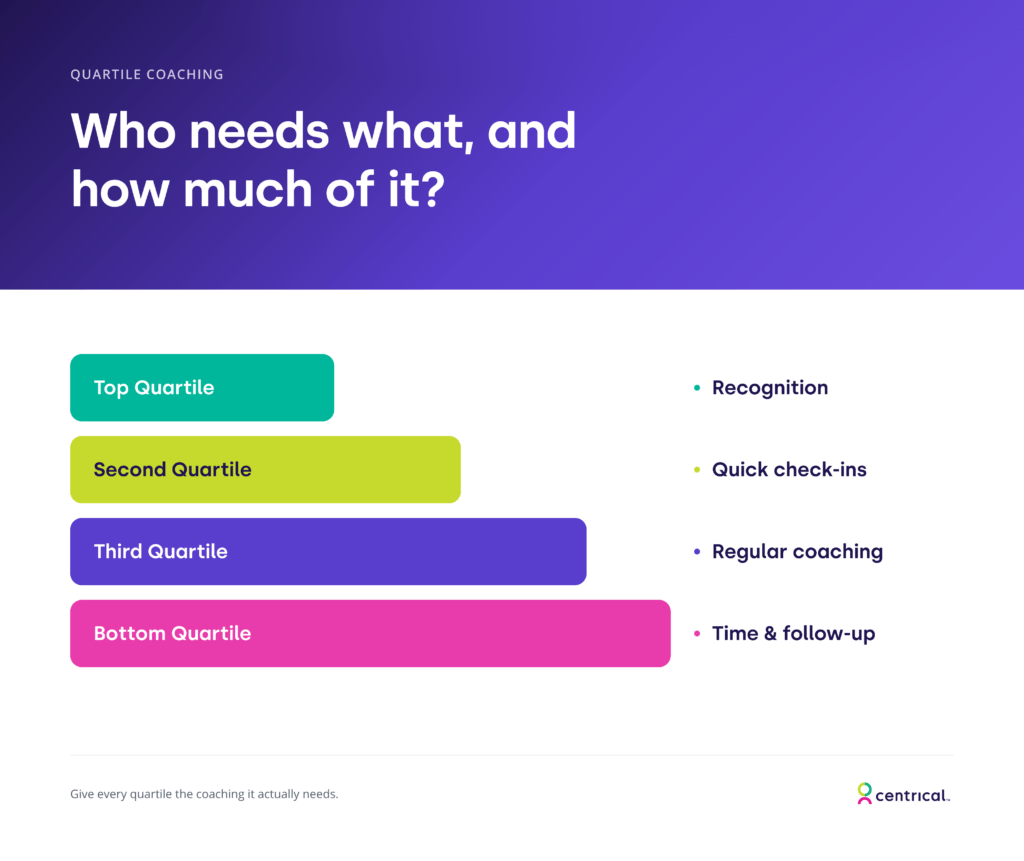
The approach Esposito has consistently seen produce results starts from a different question. Not “how often should we coach?” but “who needs what, and how much of it?”
A large hospitality client Esposito works with decided to stop treating all agents the same. Every quarter, frontline leaders divide the team into performance quartiles and coach each group differently, spending time where it will actually move the numbers.
“Depending on what quartile they fall into, the frontline leaders actually need to spend more time with those bottom performers,” she says. “Those top performers, maybe they get kudos in Centrical; or they get a shout out during a team meeting.”
A top performer does not need a structured hour-long session. They need recognition and space to keep doing what they are doing. An agent in the bottom quartile is working toward glide path goals and needs time, repetition, and close follow-up.
“Maybe one session gets them just shy of the target. Another session gets them to target.”
What good agent coaching looks like in practice: the Currys example
Currys, a leading omnichannel technology retailer in the UK, offers a concrete picture of what it looks like when coaching culture becomes operational discipline.
At their Loughborough contact center, team leaders use evaluations in the Centrical platform to guide performance and wellbeing conversations tailored to each agent’s individual needs. The results from their most recent performance period: weekly coaching activity increased by 300% compared to the prior year.
The Currys story won the Captain category at Centrical’s 2025 SELECT Awards, recognizing it as one of the strongest examples of sustained coaching transformation among Centrical customers.
The role of AI in scaling frontline agent coaching
Chappell ties the practical picture together with a clear principle: prioritize coaching, target it, keep it personal, and make it consistent.
“That’s what really grows that culture of improvement. I know that I’m going to go into my coaching session and something good’s going to come from it.”
A focused 20-minute session per agent per week on a specific, data-grounded topic outperforms a monthly hour-long session that covers everything and moves nothing.
The preparation burden is where AI now makes a real difference.
Centrical’s data shows that managers with access to our AI Assistant for Team Leaders delivered 88% more coaching actions than peers without it, without adding headcount or extending hours. AI removes the administrative work that often eats up the time required for coaching.
Esposito describes how this plays out at the team leader level. A manager prompts the AI Assistant, which takes no more than 10 seconds, and gets back a view of which agents need attention, what KPIs or behaviors to focus on, and the relevant performance history. Coaching notes come pre-populated with performance context. Documentation happens automatically.
The result: four or five coaching interactions at the start of a shift, rather than one or two, with no need to comb through spreadsheets or compose one-off emails.
For team leaders who want to put this into practice with generative AI, our AI Coaching Prompts Toolkit offers ready-to-use prompts for identifying performance trends, planning conversations, following up, and recognizing progress.
Before you go
Does coaching frequency actually matter, or is quality the only thing that counts?
Both matter, and they interact. Chappell describes a focused 20-minute weekly session as more effective than a monthly hour-long session that covers too much ground and revisits things that no longer apply. Frequency keeps the feedback loop short enough to be useful. Quality determines whether the agent walks away with a clear action. Centrical’s platform data reinforces this: when coaching tasks include a due date and a clear follow-up expectation, KPI performance improves by 4% over coaching without those conditions.
What separates compliance-based coaching from targeted agent coaching?
Compliance-based coaching occurs when the goal is the number of sessions completed. Every agent gets a check-in on schedule, a form is filled, and a box is checked. Targeted coaching starts with performance data, identifies who needs what kind of attention, and allocates manager time accordingly. Esposito describes a best practice used by a client who’s transformed their coaching approach: quartile segmentation, concentrating time spent with agents working toward glide path goals, while top performers receive recognition and a lighter touch rather than a full session.
Should coaching sessions ever be dropped when call volume spikes?
No. A manager who cancels coaching when service level breaks communicates, even if unintentionally, that agent development is not a priority. The session will not fix the volume problem. Keeping it does protect the coaching culture that makes performance sustainable over time.
Preparation shifts from an hour of data gathering to a 10 to 15 second prompt. Centrical’s AI Assistant surfaces which agents need attention, which behaviors to focus on, and what the historical trend looks like, with coaching forms pre-populated and past sessions already in context. The manager’s job is to coach, not assemble the materials. Centrical Labs data shows managers with AI support delivered 88% more coaching actions than peers without it.
What does a coaching culture look like at the team level?
Chappell describes it as a state where agents expect something useful to come from every coaching interaction. It builds through consistency: scheduled sessions that hold under volume pressure, informal drive-by moments that reinforce specific behaviors in real time, and follow-through that closes the loop between sessions. Over time, the expectation of useful coaching becomes the norm rather than the exception.
About our experts
Ian Chappell is Director of Consulting, International at Centrical, leading presales consulting across EMEA and APAC. With over 20 years in contact centers and customer operations, he has worked across the frontline, workforce planning, BPO, and solution consulting, and is now one of Centrical’s specialists for the contact center and BPO space.
Melissa Chang Esposito is Senior Director of Customer Success at Centrical, where she helps enterprises turn employee engagement into stronger business results. She brings more than eight years of guiding clients across the full customer lifecycle and a foundation in organizational transformation from Deloitte Consulting’s Human Capital practice.






 Engage and motivate your frontline teams
 Deliver world class CX with dynamic, actionable quality evaluations
 Boost performance with personalized, actionable goals
 Nurture employee success with the power of AI
 Listen and respond to your frontline, continuously
 Drive productivity with performance-driven learning that sticks
 Drive agent efficiency, deliver client results
 Keep tech teams motivated and proficient on products and services while exceeding targets
 Maintain compliance while building customer happiness and loyalty
 Enlighten energy teams to boost engagement
 Engage, develop, and retain your agents while driving better CX
 Improve the employee experience for your reservations and service desk agents

 Gal Rimon
 Madeleine Freind
 Natalie Roth
 Linat Mart












 Doron Neumann
 Daphne Saragosti
 Ella Davidson
 Ariel Herman
 Ronen Botzer