Coaching effectiveness shows whether coaching changes how frontline agents work, and whether that change improves a business result such as CSAT. A manager can complete every scheduled session and still fail the real test: whether agents apply the skill in live interactions and whether the target KPI moves. Measuring it means tracing the full path from learning to practice to proof, not stopping at activity.
The trap of coaching volume
Why activity logs can be misleading
Session counts show that a coaching conversation happened. They do not show whether the coaching addressed the right behavior, whether the agent could demonstrate the skill, or whether the intervention improved customer outcomes. When Centrical Labs analyzed 834,000 coaching actions, it found only a weak relationship between how often managers coached and how effective that coaching was.
Instead of focusing solely on coaching volume, build a measurement chain:
- Participation
- Performance in practice
- Behavior in live quality reviews
- Coaching quality
- The business result
A useful data-grounded coaching framework treats the session as one step in that operating loop.
The cost of check-the-box coaching
High volume can hide weak delivery. Managers at large outsourced contact centers often separate three questions. Did the session happen? Was it delivered well? Did it create a positive change? These are different measures. Coaching ROI becomes visible when the operation connects these questions to behavior and results. In a BPO setting, this requires aligning performance with client goals through real-time visibility.
Correlating behavior to business results
Start with one KPI, such as CSAT. Identify the observable behaviors that support it. Research published by ICMI found that the best customer satisfaction representatives perform one key quality behavior nearly 40% more often than their peers. This gives a supervisor a clear coaching target. It is better than a broad instruction to “improve CSAT.”
Track whether the behavior shows up in practice and live quality reviews. Then check whether the link between that behavior and the KPI holds over time. The goal is to identify the behaviors that matter most in your operation, without forcing every agent into one script. This shift in focus is essential when updating contact center metrics to move away from outdated indicators like average handle time.
Adjusting for work mix and tenure
Fair comparisons require context. Separate results by call type, channel, and tenure if those factors change the work. A digital bank might compare simple and complex calls separately instead of judging both against one benchmark. Set a baseline and use a comparison group where you can. Keep all findings visible. A small pilot with almost no difference is a result to investigate. Do not hide it.
This is the foundation of actionable frontline intelligence and practical contact center CX improvement: compare similar work, then adjust the coaching cadence.
Measuring the quality of the intervention
Voice of Employee surveys
Agent feedback shows if the intervention felt relevant and useful. After a session, ask:
- Which part of the coaching can you apply in your next interaction?
- Did the examples reflect the work you handle?
- What would make the next coaching session more useful?
Use these responses alongside observed behavior. This feedback loop is a critical component of a data-driven coaching culture, which helps maintain performance visibility even in distributed or remote environments.
Coach-the-coach sessions
A senior manager should review how the supervisor ran the session: whether they connected behavior to the metric, listened to the agent, and agreed on a practice plan together. A coaching platform can organize performance signals and recommendations, but the manager decides what to discuss and remains responsible for the human conversation.
The learn, practice, prove framework
- Learn: Deliver focused learning tied to one observable behavior.
- Practice: Let the agent rehearse the skill in a realistic scenario and receive feedback. A digital coach for employees can recommend practice or show gaps, but it does not make the coaching decision. Using gamification within the coaching loop can help keep agents engaged during this practice phase.
- Prove: Assess the skill again in practice and in live quality reviews. Do this before marking it as demonstrated.
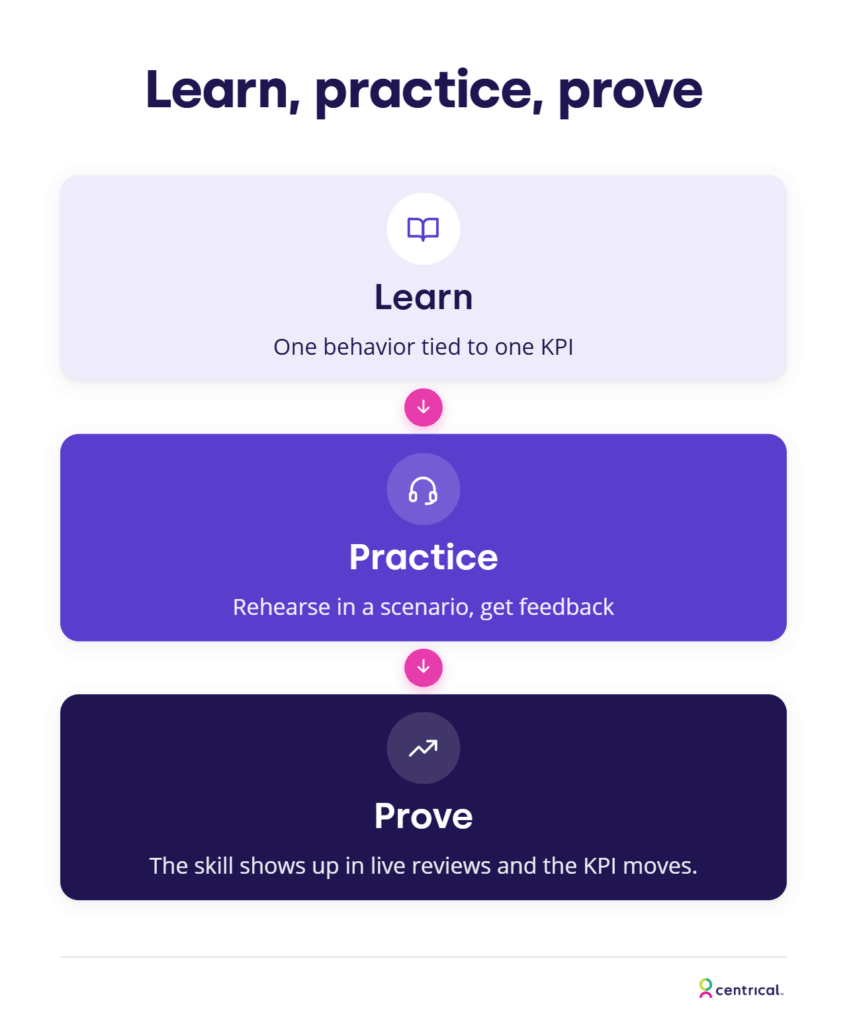
That progression turns coaching effectiveness from a log entry into proof of capability. It also gives your operation a clearer basis for coaching ROI.
Before you go
How do I start measuring coaching effectiveness?
Start measuring coaching effectiveness by choosing one KPI. Define one observable behavior linked to it and set a baseline across similar work. Track practice, live quality reviews, and agent feedback before you expand the model.
Can a digital coach for employees replace human managers?
Digital coaches for employees support human managers but do not replace them. The system organizes signals, suggests practice, and shows follow-up needs. The manager keeps the judgment, context, and empathy. The manager is still responsible for the coaching conversation.
Book a demo to see how the Workforce Orchestration System turns a business goal into a running performance program for your frontline.






 Turn any business goal into a running performance program in minutes.
 Practice with AI. Win with real customers.
 Nurture employee success with the power of AI
 Deliver world class CX with dynamic, actionable quality evaluations
 Drive productivity with performance-driven learning that sticks
 Boost performance with personalized, actionable goals
 Engage and motivate your frontline teams
 Listen and respond to your frontline, continuously
 Drive agent efficiency, deliver client results
 Keep tech teams motivated and proficient on products and services while exceeding targets
 Maintain compliance while building customer happiness and loyalty
 Enlighten energy teams to boost engagement
 Engage, develop, and retain your agents while driving better CX
 Improve the employee experience for your reservations and service desk agents


 Madeleine Freind














 Ariel Herman
 Ronen Botzer
 Linat Mart
 Ella Davidson
 Daphne Saragosti
 Doron Neumann
 Natalie Roth
 Gal Rimon