Coach the coach before a new supervisor has a first difficult conversation with a direct report. New supervisors need structured practice, feedback, and follow-up, because strong individual performance does not automatically create performance coaching skills.
For contact center and BPO leaders, DDI’s Leadership Transitions Report is a useful starting point. It identifies a formal self-assessment, leadership training, and coaching from senior leaders as the supports that help new leaders make the transition. The approach also includes peer support, behavior modeling, and repeated practice. The supervisor owns the conversation; technology can provide scenarios, prompts, and feedback, but it does not replace human judgment.
Why the buddy-to-boss transition creates a coaching gap
Promotion decisions often reward current performance over managerial potential, according to NBER research. That creates a competency gap. The new supervisor knows how to handle the work. However, they have not learned how to diagnose a gap, give feedback, agree on an action, or follow up with a former peer.
The same NBER study found that, among sales workers, doubling a newly promoted manager’s pre-promotion sales performance was associated with a 7.5% decline in the sales performance of each subordinate. High performers can still become good leaders, but a promotion alone doesn’t prepare them for it.
The cost of silence
When a supervisor avoids a conversation about a missed KPI, the issue stays open. The employee gets no clear path to change. Difficult conversations often get harder the longer a manager waits, especially when the manager rehearses alone or treats the meeting as a confrontation.
The anatomy of a failed coaching conversation
Four common breakdowns
A practical review should look for four breakdowns:
- A tense setup that makes the employee expect punishment instead of a work discussion.
- Feedback about attitude or effort rather than an observable behavior and its operational impact.
- A broad instruction such as “do better,” without one specific action or goal.
- No follow-up date, leaving both people unsure whether the conversation changed anything.
A survey by Interact and Harris Poll, reported in Harvard Business Review by Interact CEO Lou Solomon, found that two-thirds of managers are uncomfortable communicating with employees. Rehearsal gives supervisors a way to manage that nervousness before it shapes the real conversation.
Accusatory versus actionable feedback
Leadership teams should sample coaching notes for observable facts, neutral language, and one agreed action. They should also look for a follow-up point. If a note labels an employee as careless or uncommitted, rewrite it around the behavior, the KPI, and the next practice opportunity.
How to coach the coach: the rehearsal framework
Behavior modeling training (BMT)
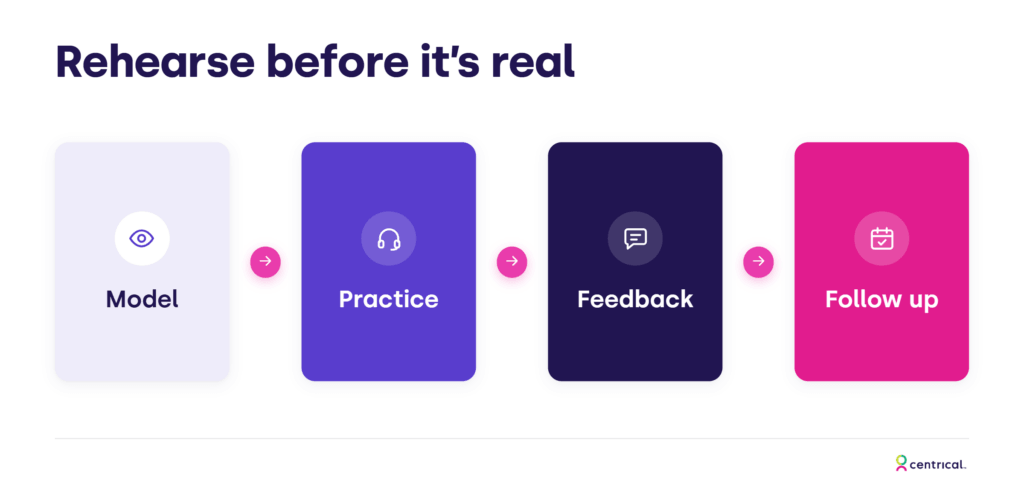
Use a four-step loop:
- Model: Show the behavior expected in the conversation, including a clear opening and a specific request.
- Practice: Have supervisors generate scenarios from familiar contact center situations, such as repeated adherence or quality gaps.
- Feedback: Add a peer observer who watches both the supervisor’s behavior and the employee’s reaction. QIC-WD reports large positive effects on skill development when behavior modeling includes modeling, practice, and feedback. Transfer to the job improves when trainees generate the practice scenarios and set specific on-the-job goals.
- Follow-up: Set one on-the-job behavior goal. Review the coaching note and revisit the outcome at the next check-in.
Safe environments: simulation and pause-and-rewind techniques
A digital coach for employees can provide a repeatable AI role-play environment for high-stakes conversations. AI plays the employee, waits for the supervisor’s reply, and lets them pause and try again. A human manager still decides what action to take and how to handle the real employee relationship.
Peer rehearsal remains valuable. Use the actual work setting where possible and let the supervisor stop an awkward scene. Ask the observer what changed in the employee’s reaction. SHRM describes simulation, observers, and pause-and-rewind practice as ways to build management proficiency. AI-powered coaching can extend that practice between live sessions, so managers can practice difficult coaching conversations in AI role-play before having them live. The regular coaching cadence then ties that practice to real coaching notes and follow-up.
Before you go
How do I know if my managers are actually coaching?
You know managers are coaching when their notes connect an observable behavior to a specific action, a shared goal, and a follow-up discussion. A note that only says feedback was given doesn’t count.
Can AI replace human role-play partners?
AI can supply repeatable scenarios and immediate prompts, but it cannot replace the supervisor’s responsibility for judgment, empathy, and the real coaching conversation.
Book a demo to see how the Workforce Orchestration System turns a business goal into a running performance program for your frontline.






 Turn any business goal into a running performance program in minutes.
 Practice with AI. Win with real customers.
 Nurture employee success with the power of AI
 Deliver world class CX with dynamic, actionable quality evaluations
 Drive productivity with performance-driven learning that sticks
 Boost performance with personalized, actionable goals
 Engage and motivate your frontline teams
 Listen and respond to your frontline, continuously
 Drive agent efficiency, deliver client results
 Keep tech teams motivated and proficient on products and services while exceeding targets
 Maintain compliance while building customer happiness and loyalty
 Enlighten energy teams to boost engagement
 Engage, develop, and retain your agents while driving better CX
 Improve the employee experience for your reservations and service desk agents



 Madeleine Freind














 Ariel Herman
 Ronen Botzer
 Linat Mart
 Ella Davidson
 Daphne Saragosti
 Doron Neumann
 Natalie Roth
 Gal Rimon