This is the fifth installment of The Contact Center Gap, a series featuring expert perspectives from people who have spent years inside contact center operations: running them, selling into them, supporting them, and watching what separates the ones that perform from the ones that plateau.
Every morning at the start of their shift, agents at TP Samsung’s Benelux contact center answer a simple question on the Centrical platform: how are you feeling today, and is there anything your manager can help you with?
The manager reads those answers before touching anything else.
Ian Chappell, who has worked closely with this contact center operation, describes what followed when well-being became a morning checkpoint rather than an annual HR survey: employee satisfaction climbed, and customer metrics moved with it.
“Happy employees, happy customers, happy CEO,” Chappell says. The contact centers that manage attrition well tend to understand that logic before they build any system around it.
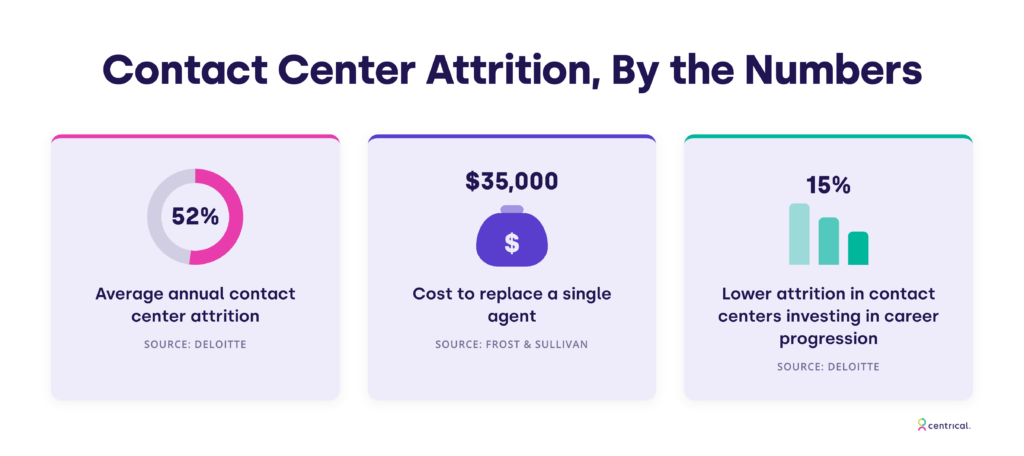
Annual contact center attrition averages 52% according to a global Deloitte survey. Frost & Sullivan says that replacing a single contact center agent can cost up to $35,000, once you account for recruiting, onboarding, and the months before a new hire reaches full competency.
Many operations underestimate the damage. Time to competence, according to Chappell, is a metric few contact centers track rigorously, even though it directly determines how long the business absorbs the cost of a departure.
“We still see customers that are obsessing over average handle time,” he says, “but what they’re not looking at is first-contact resolution, repeat contact rate, customer effort score.”
An agent who has been in the role for six months handles those metrics differently than someone three weeks out of onboarding. When attrition runs high, that gap stays open permanently.
The operations that manage attrition well share one defining characteristic: they treat it as an ongoing operational problem, not a hiring spike to absorb.
Melissa Esposito, who has spent nearly a decade working with contact center customers across the full implementation and post-sale lifecycle, describes a large BPO she has worked with for several years as a model for how the approach changes when attrition gets taken seriously at every stage of the employee journey.
“They look at attrition not just during those first 30 or 90 days but attrition as an ongoing battle,” Esposito says.
Most contact centers concentrate their attrition investment at the front of the funnel — the new hire journey — and treat production-stage attrition as a separate, harder problem they’ll get to later. The BPO Esposito describes built separate frameworks for both.
What drives attrition in the new hire journey, and how to catch it early
For new hires, the first 30 days carry a distinct set of attrition risks. The reasons someone leaves in week two are different from the reasons a tenured agent leaves in month fourteen; mixing those signals into a single attrition metric obscures both.
Esposito describes what the BPO built to address the new hire window: a structured onboarding journey that starts on day one, before an agent takes a single call. From the moment a new hire receives their laptop and headset, they enter a guided experience that covers the role, the culture, and the cohort of colleagues joining alongside them.
“They start to feel a bit of community as well,” she says. “And all of that lives in a single place.”
The journey captures data at each stage. When someone drops out during onboarding, the system records where in the funnel they stopped engaging, which gives HR and training the evidence to identify patterns across cohorts rather than treating every early departure as an individual case.
Voluntary vs. involuntary attrition: why treating them the same is a mistake
Production-stage attrition carries a different set of challenges. An agent who leaves voluntarily — because they found a better role, burned out, or disengaged — represents a different problem than an agent the business has decided to let go. The response to each has to be different, too.
“Voluntary and involuntary attrition are two different things,” Esposito says. “You have to tackle them separately.”
The BPO she describes ran a targeted sprint focused specifically on voluntary attrition. Using Centrical’s engagement trends and performance data, they built a system to flag agents who showed early signs of churn risk: performance drifting below their normal range, combined with a drop in engagement with the platform.
When both signals appeared together in an agent who had been with the company six months or longer, it triggered a priority conversation for management and leadership: not a performance warning, but a genuine check-in on what was going on and whether anything could change.
“What’s going on in their headspace, what’s going on with their workspace?” Esposito explains. “How do we help them stay at the company?”
TP Samsung’s contact center approached the same problem from a different angle. Rather than waiting for performance or engagement signals to decline, they built well-being into the start of every shift.
Agents logged a daily check-in: how they were feeling, how they perceived their workload, and whether there was anything their manager could help with. Managers read those responses first thing in the morning and acted on them directly: an extended lunch break for someone having a hard day, a five-minute conversation before the shift began.
The interactions handled by human agents today are often the most complex ones. They’re the interactions AI couldn’t handle: emotionally charged or difficult to resolve.
“Well-being, if you drive it through that kind of value lens, is something that we should all be doing more often in this industry, because the role is super tough,” Chappell says.
As a result of its well-being initiative, TP Samsung saw a +70 NPS increase, an 84% Great Place to Work score, and improved first-contact resolution rates.
What separates attrition strategy from attrition administration
Most contact centers have some version of an attrition program. Exit interviews, onboarding check-ins, manager one-to-ones.
The approach Esposito and Chappell describes is based on a system that connects signals and stores the data from every stage of the employee journey in one place.
When the data from every stage of the employee journey lives in one place, patterns surface that would otherwise stay invisible. Which onboarding module has the highest dropout rate? Which manager’s team shows the earliest signs of disengagement? Which agents who left voluntarily had shown a performance dip six weeks earlier?
Beyond agent well-being, another important factor that influences attrition rates is career development. A 2024 Deloitte survey found that contact centers actively investing in agent career progression report 15% lower annual attrition than those that don’t.
“When you have a true strategic and transformation team tackling attrition,” Esposito says, “and looking at the different parts of the employee journey, you get a lot more out of your different strategic initiatives.:
[INTERNAL LINK PLACEHOLDER: Link to Article 02 – the coaching article in this series — managing attrition connects directly to coaching frequency and quality]
[INTERNAL LINK PLACEHOLDER: Link to relevant Centrical product or resource page on employee engagement or attrition — confirm destination with Simone]
Before you go
Voluntary attrition happens when an agent chooses to leave, whether due to disengagement, burnout, or a better opportunity elsewhere. Involuntary attrition happens when the business ends the relationship, usually because of sustained performance failure. They require different interventions. Voluntary attrition responds to early signals: a drop in engagement, a drift in performance bands, a change in how an agent shows up day to day. Catching those signals early enough to act is what separates the operations managing voluntary attrition well from those that only notice it after the resignation lands.
Why does the new hire period carry such a high attrition risk?
The reasons a new hire leaves in the first 30 days are different from the reasons a tenured agent leaves in year two. New hire attrition tends to connect to role clarity, community, and whether the onboarding experience reflects the job that was sold. Operations that build a structured new hire journey (starting before the first call, with clear stages and data captured at each point) give HR and training the visibility to understand where the funnel is breaking down rather than treating every early departure as a one-off.
Does improving agent wellbeing actually move business metrics?
Chappell describes a BPO that built a daily wellbeing check-in into the start of every shift. Agents told their manager how they were feeling and whether they needed support. Managers acted on those responses before the shift began.
The BPOs managing attrition well don’t wait for a resignation to surface the risk. They watch for combinations of signals: performance drifting below an agent’s normal range, reduced engagement with tools and platforms, changes in interaction patterns. When multiple signals appear together (particularly for agents who have been with the business long enough to be considered stable) that combination triggers a proactive conversation, not a performance review.
About our experts
Ian Chappell is Director of Consulting, International at Centrical, leading presales consulting across EMEA and APAC. With over 20 years in contact centers and customer operations, he has worked across the frontline, workforce planning, BPO, and solution consulting, and is now one of Centrical’s specialists for the contact center and BPO space.
Melissa Chang Esposito is Senior Director of Customer Success at Centrical, where she helps enterprises turn employee engagement into stronger business results. She brings more than eight years of guiding clients across the full customer lifecycle and a foundation in organizational transformation from Deloitte Consulting’s Human Capital practice.






 Engage and motivate your frontline teams
 Deliver world class CX with dynamic, actionable quality evaluations
 Boost performance with personalized, actionable goals
 Nurture employee success with the power of AI
 Listen and respond to your frontline, continuously
 Drive productivity with performance-driven learning that sticks
 Drive agent efficiency, deliver client results
 Keep tech teams motivated and proficient on products and services while exceeding targets
 Maintain compliance while building customer happiness and loyalty
 Enlighten energy teams to boost engagement
 Engage, develop, and retain your agents while driving better CX
 Improve the employee experience for your reservations and service desk agents

 Gal Rimon
 Madeleine Freind
 Natalie Roth
 Linat Mart












 Doron Neumann
 Daphne Saragosti
 Ella Davidson
 Ariel Herman
 Ronen Botzer