KPIs in BPO are the primary tools for measuring how well an outsourced operation meets its contractual obligations and business objectives. The list runs longer than most: average handle time, first call resolution, CSAT, adherence, cost per call, service level. What makes them different from an internal contact center’s metrics is who sets them.
It’s important to note that a BPO answers to a client’s KPIs, not only its own. That double accountability is where most measurement problems in the industry start: the number on the contract and the number on the agent’s screen come apart, and nobody notices until the quarterly business review. Closing it takes a strategy-to-frontline ladder that connects the client’s goal to something an agent can actually do, and a signal-to-action loop that makes someone responsible for the step after noticing.
What are KPIs in BPO?
Which of them matter is a narrower question. While centers often track over 30 different data points, only a handful directly impact long-term operational success. An effective framework prioritizes outcome-driven metrics over activity tracking, so the operation stays focused on value rather than volume.
The metrics below are the ones BPOs are most often measured on. They fall into four groups, and the grouping matters: a client usually cares most about the first, pays for the second, audits the third, and never asks about the fourth.
Customer outcome metrics
These describe what the customer actually got.
- Customer Satisfaction (CSAT): a direct measure of how a customer perceives the service received.
- First Call Resolution (FCR): the percentage of queries resolved during the initial interaction. Higher FCR generally means higher satisfaction and fewer repeat contacts.
- Customer Effort Score (CES): how much effort the customer had to expend to get help, usually calculated after the call. A high score means low effort.
- Customer Churn Rate: the share of customers who stop doing business over a given period. In a BPO context this is the metric a client watches hardest, because it is the one attached to their revenue.
- Quality Management (QM) Scores: a qualitative assessment of adherence to process and of empathy. These sit differently from the rest, for reasons covered below.
Efficiency and cost metrics
These describe what the interaction cost to deliver.
- Average Handle Time (AHT): the total duration of a call including hold time and follow-up work. Divide total talk, hold and after-call time by total calls.
- Average Speed of Answer: how long a customer waits before an agent picks up.
- Response Time: the average length of calls, read as a rough indicator of how quickly issues get resolved. Some inquiries legitimately take longer than others.
- Cost Per Call: the average cost of an interaction, and the number most contract negotiations are built on.
- Occupancy Rate: the share of an agent’s logged time spent on calls or post-call updates.
- Agent Utilization Rate: the share of total paid time spent on customer calls. Sustained highs are a burnout warning, not a productivity win.
- Average After-Work Time: the minutes after a call spent updating records and filing notes. A climbing number usually means a training gap or an overloaded agent.
Contractual and staffing metrics
These are the ones written into the agreement, and the ones a client audits.
- Adherence: how closely the time an agent actually worked matches the time they were scheduled to work, expressed as a percentage. For BPOs this is central, because schedule compliance is usually a contractual commitment rather than an internal preference.
- Service Level: the percentage of calls answered within a defined window.
- Calls Blocked: calls that met a busy signal because no line or agent was available. Usually a staffing problem at peak, sometimes a routing one.
- Call Abandonment Rate: customers who hang up during the wait.
This group is where BPO measurement genuinely differs from an in-house operation. An internal contact center can decide adherence matters less this quarter. A BPO cannot.
People metrics
These predict the other three groups a quarter ahead, and they are usually the ones the client never asks about.
- Agent Turnover Rate: turnover in the industry is high, and it is rarely mysterious. It tends to follow underperformance, which itself follows irregular training, unacknowledged work, or no visible path forward.
- First-Day Ghosting: a candidate accepts the offer and does not appear on day one, almost always the result of a thin pre-boarding experience. It costs recruiting time and money, and it lands on the morale of the team that was expecting a new colleague.
A BPO that hits every contractual metric while replacing a third of its floor each year is not a stable operation. It is a temporarily lucky one.
Why volume metrics fail as standalone goals
High call volume looks like productivity. Often it is the same customer calling back.
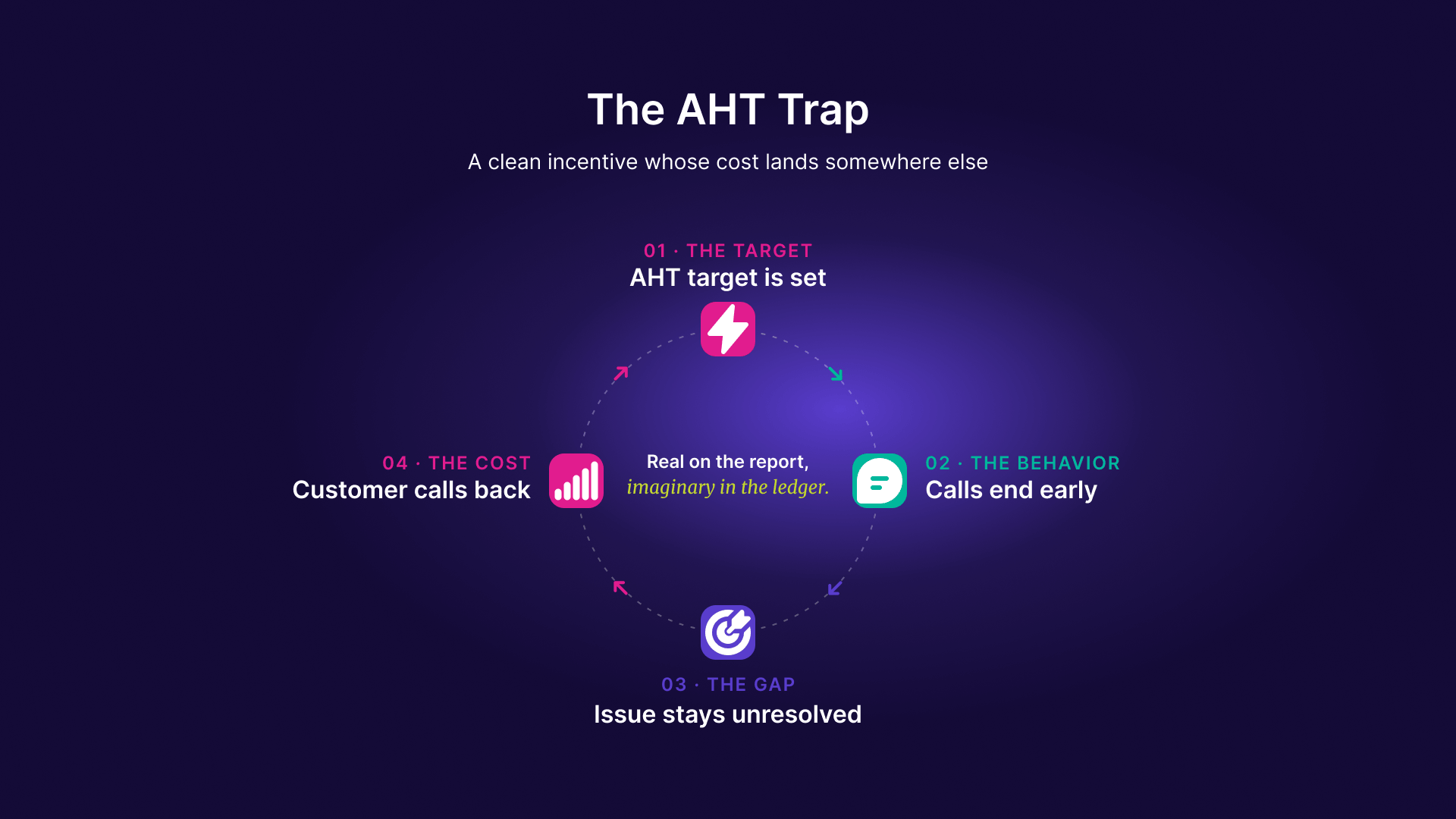
An outcome-driven framework measures the result of the interaction rather than the speed of the agent. That distinction sounds academic until you watch what a target does to behavior. Agents held to an AHT number will end calls to hit it, including the calls that needed more time, and the unresolved issue returns as a second contact at full cost. The efficiency was real on the report and imaginary in the ledger.
Shifting to outcomes is also what makes aligning KPIs with strategic goals possible, because every metric then has to answer for a business purpose: reducing churn, protecting lifetime value, keeping a contract. Leaders moving away from legacy benchmarks toward modern contact center metrics are doing it for that reason rather than for novelty.
One rule covers most of it: never manage to a metric without knowing what it does to the metric next to it.
Mapping BPO KPIs to frontline behavior
Every KPI is a proxy for something a person does. Naming that behavior is what makes a number coachable rather than merely reportable.
| BPO KPI |
Frontline Behavior Indicated |
| Average Handle Time (AHT) |
Technical proficiency and process efficiency |
| First Call Resolution (FCR) |
Problem-solving capability and resource access |
| Customer Satisfaction (CSAT) |
Empathy and communication effectiveness |
| Quality Management (QM) |
Compliance and brand alignment |
The mapping also shows why QM scores are not interchangeable with the rest. AHT tells you how fast the call was. QM tells you whether the agent actually helped, and it often surfaces what automated data misses (ICMI).
Moving from signal to action
First Call Resolution is a critical driver of both customer satisfaction and follow-up contact costs, and many centers track it as a top priority. Knowing the FCR rate is just the signal.
The fix is not a systems project. It is deciding who looks at the number, when, and what they do next. Most BPOs already have the data. What they lack is a named owner for the step after noticing.
The strategy-to-frontline ladder
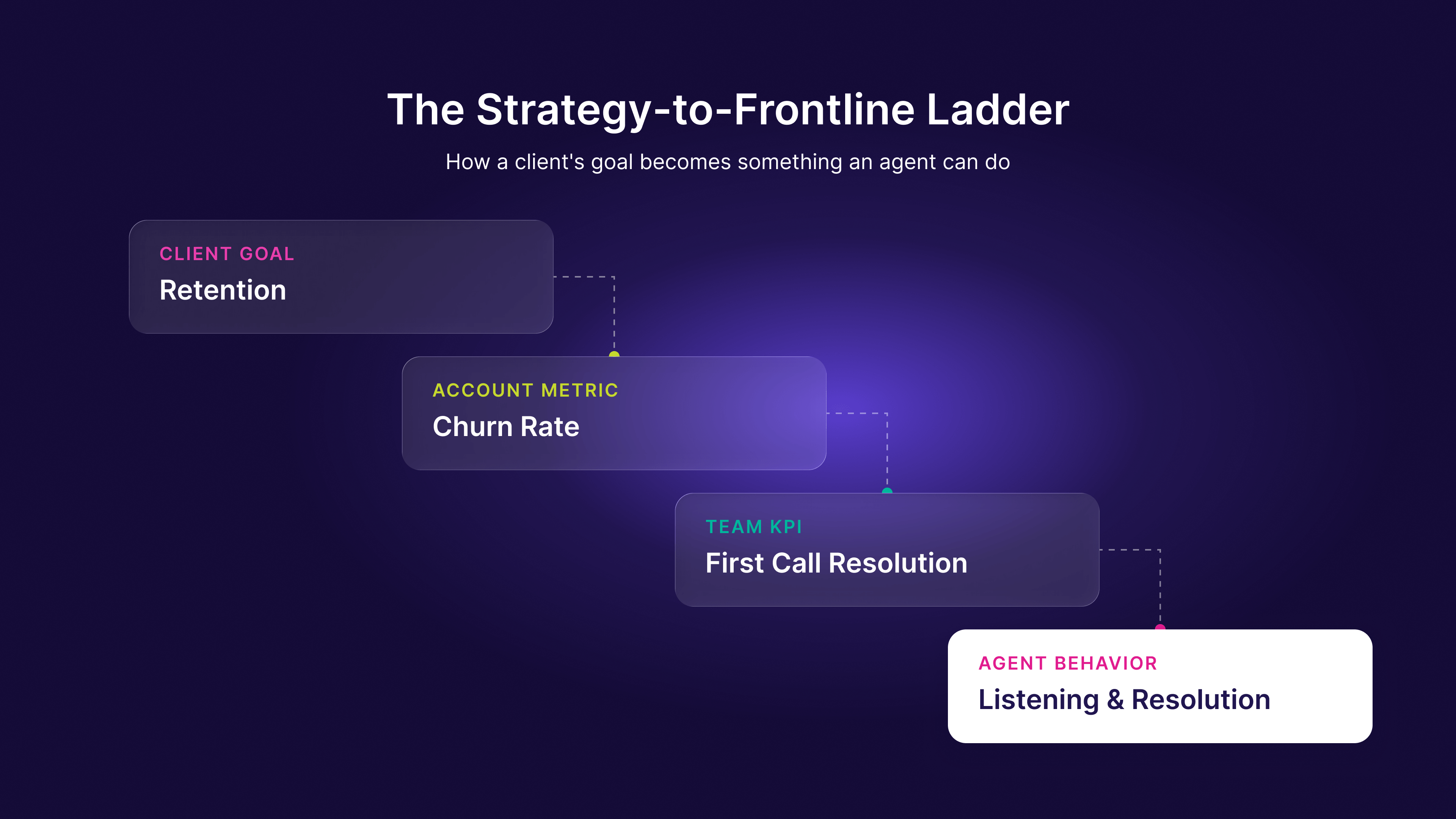
The ladder breaks a client’s high-level goal into behaviors an agent can control. If the client’s goal is retention, the ladder runs from retention to churn rate, from churn rate to FCR, and from FCR to the specific listening and resolution skills that produce a first-call fix. Each rung has to be visible to the person standing on it.
Without those connections, agents feel pressured by numbers they do not understand, which produces disengagement rather than performance. Defining and tracking essential customer service metrics is the foundation, but the foundation is not the building.
What the ladder looks like in practice
BPO managers hit their KPIs by managing the people behind them. Five things carry the weight.
Onboarding. A good onboarding experience raises the odds an agent performs well and stays. It needs a real introduction, level-appropriate training, and an explicit walk through the KPIs the account is measured on. It also needs the manager present during nesting, the stage after classroom training when a new hire is taking live calls but is not yet independent and still needs close observation and feedback.
Training. Training does not end when onboarding does. Continuous, personalized learning on the behaviors behind each KPI is what keeps performance from drifting, and its absence is a reliable predictor of turnover.
Coaching. Can a manager see where an agent needs help without assembling it from spreadsheets first? If finding the insight takes longer than acting on it, coaching becomes a quarterly ritual instead of a weekly habit.
Career path and growth. People stay where they can see a next step. Personalized training, honest feedback and a stated route forward do more for retention than most programs designed for it.
Team connection. A team with shared purpose and camaraderie hits its numbers more often than a group of individuals holding the same targets. Peer learning is part of that rather than an addition to it.
Bridging the gap with quality management
Quality management scores bridge hard efficiency metrics and what actually happened in the interaction. The practical question is timing. An agent who sees their QM score the day after the call can do something about it. One who sees it at the end of the month is reading history.
Tracking these customer service results keeps quality from being the first thing that slips when volume spikes.
To drive contact center CX improvement, refine the measurement stack around actionable performance goals. Four steps to audit what you have:
- Identify the metrics that correlate with your client’s primary business outcome.
- Audit your current AHT targets to make sure they do not reward ending a call on an unresolved issue.
- Map your Quality Management criteria directly to the behaviors that drive First Call Resolution.
- Establish a real-time feedback loop so agents see their impact during the shift rather than at the end of the month.
Before you go: getting started with BPO KPIs
How do I know if my KPIs are effective?
Effective BPO KPIs show a direct correlation between what an agent does and what the client’s business gets. If AHT is dropping while CSAT falls with it, the metric is buying you rework. Check FCR against total cost per resolved issue, not cost per call.
Which KPIs should a BPO report to the client, and which stay internal?
Report the ones the client’s business depends on: CSAT, FCR, churn, and the contractual commitments on service level and adherence. Keep the diagnostic ones internal, including occupancy, after-work time, QM detail and turnover, because those exist to run the operation rather than to judge it. Confusing the two turns every operational wobble into a client conversation.
How many KPIs should a BPO track at once?
Fewer than most do. Centers commonly collect thirty or more and actively manage a handful. The test is whether someone has a defined next step when a given number moves. If nobody does, it is a report line rather than a KPI.
Why do AHT targets backfire in a BPO?
Because the incentive is clean and the consequence lands somewhere else. An agent held to handle time ends calls faster, the unresolved issue returns as a second contact, and the cost reappears in a volume line nobody traces back to the AHT target.
What is the difference between a KPI and a service level agreement?
An SLA is a contractual promise with consequences attached. A KPI is a measurement you manage by. Some KPIs are SLAs, most are not, and treating all of them as contractual makes it impossible to tell which ones actually matter this quarter.
From client goal to frontline action
Book a demo to see how the Orchestration System turns a business goal into a running performance program for your frontline.







 Turn any business goal into a running performance program in minutes.
 Engage and motivate your frontline teams
 Deliver world class CX with dynamic, actionable quality evaluations
 Boost performance with personalized, actionable goals
 Nurture employee success with the power of AI
 Listen and respond to your frontline, continuously
 Drive productivity with performance-driven learning that sticks
 Drive agent efficiency, deliver client results
 Keep tech teams motivated and proficient on products and services while exceeding targets
 Maintain compliance while building customer happiness and loyalty
 Enlighten energy teams to boost engagement
 Engage, develop, and retain your agents while driving better CX
 Improve the employee experience for your reservations and service desk agents



 Gal Rimon
 Madeleine Freind

 Natalie Roth
 Linat Mart













 Doron Neumann
 Daphne Saragosti
 Ella Davidson
 Ariel Herman
 Ronen Botzer