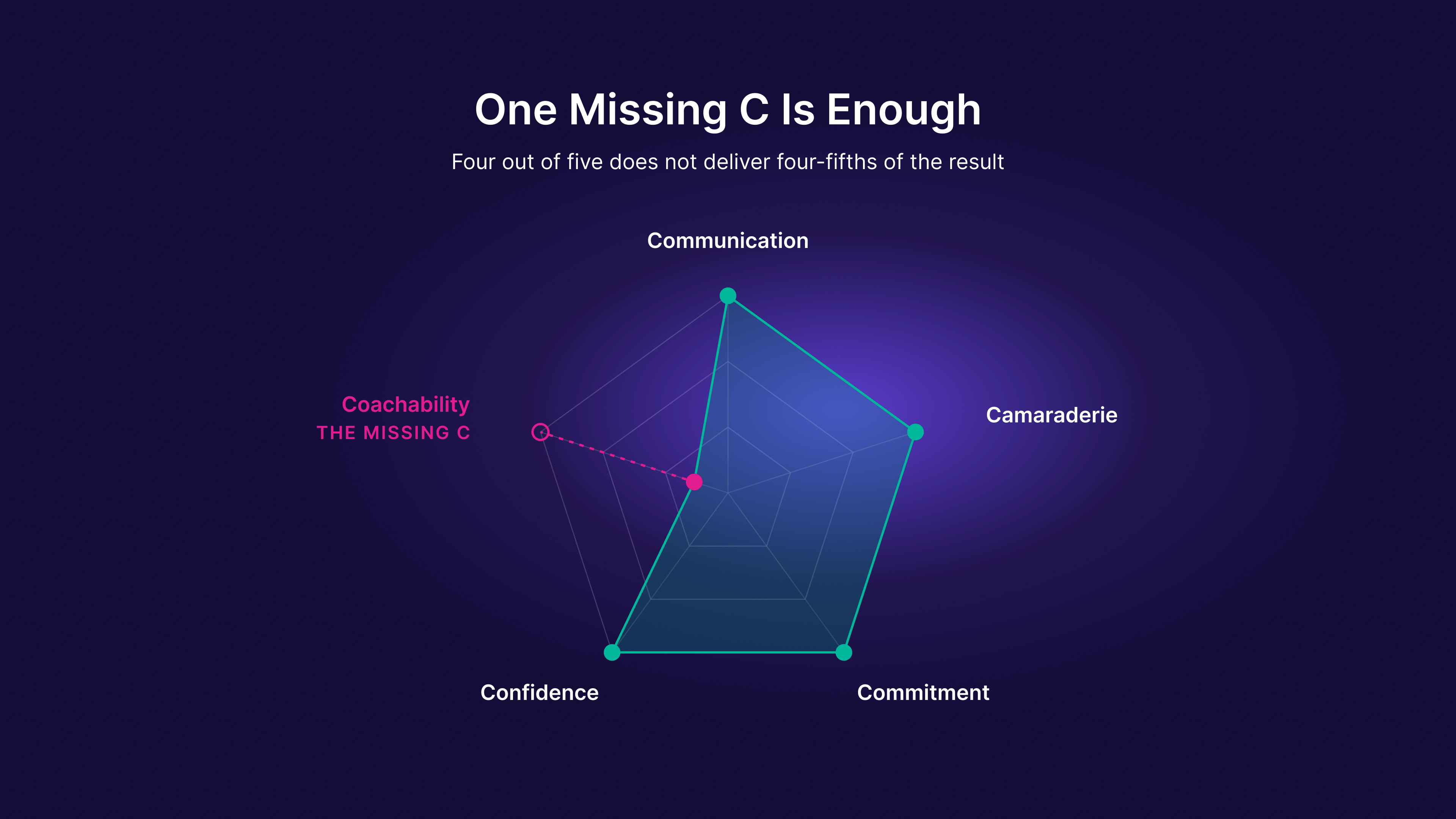
The five Cs of effective teamwork are communication, camaraderie, commitment, confidence, and coachability. Most teams can name all five. Far fewer can point to where any of them show up on a Tuesday afternoon.
Together, they help team members share information, build trust, take responsibility, and improve their performance. In this article, we’ll explore what each one signifies, why they tend to fade with time, and what can help you maintain them.
A closer look at each element of teamwork
Teamwork frameworks are easy to agree with and hard to see in daily work. Each employee has to contribute, but organizations also have to make the five Cs part of how the business runs. When comparing employee engagement platforms, evaluate features that promote the five Cs of teamwork, support the team leaders who hold them in place, and reinforce the behavior where the work actually happens.
Communication
A team leader should define and communicate each member’s roles and responsibilities. Open, two-way communication prevents misunderstandings and supports better decisions. Team members should listen actively, ask questions, and clarify anything ambiguous.
Communication fails in a predictable place: not in what the leader says, but in what the agent can repeat back.
Ian Chappell, Director of Consulting, International at Centrical, says: “Agents on the frontline should be able to articulate what they get measured on.” Without trust, people hesitate to share the information a project needs.
Camaraderie
Camaraderie is the bond of trust and respect between team members. It is also the one no offsite has ever created.
People need to understand how their complementary skills contribute to shared goals. A supportive culture makes colleagues more likely to enjoy working together. Team-building events help, but they are not the main source. Camaraderie develops through everyday interactions and what Chappell describes as “those regular check-ins, those conversations with their people.”
Commitment
Commitment shows up in the time, effort, and resources a team dedicates to a shared goal. Managers strengthen it by letting people own their work, holding them accountable for results, and putting them in close contact with colleagues.
Employees are more committed when they internalize their organization’s values. The failure mode is what Melissa Chang Esposito, Senior Director of Customer Success at Centrical, calls “mistaking activity for productivity”: a team that is busy, visible, and not moving anything.
Confidence
Confidence grows when leaders assign tasks with achievable goals, help team members learn from mistakes, and recognize successes. It helps people trust their own abilities and those of their teammates, which encourages creativity and calculated risk-taking.
Coachability
Coachability is usually described as a trait. It behaves more like a condition: people are coachable when coaching is worth being open to.
Team members should be open to feedback, willing to learn from mistakes, and committed to improving. That depends on what they get back. On coaching that skips the follow-through, Chappell says: “These things really mean nothing. They’re just observations with feedback.” On the other failure, where every agent gets the same session on the same cadence, Esposito says: “With that kind of umbrella approach, coaching becomes more of a compliance-based coaching.” Both quotes are from what good agent coaching actually looks like in a contact center.
Why teamwork frameworks fade
Most teams know the five Cs as a concept. But if nothing in the daily work reinforces them, these frameworks tend to drift back into a poster on the wall.
The gap is rarely talent. It is a coaching gap: the difference between the best team and the average one is usually a visible, repeatable habit a manager holds, not better hires. “The best operations aren’t really determined by the technology that they use,” Chappell says. What separates them is whether anyone protects the time. And that time is under pressure. “Supervisors are drowning in admin and work that takes them away,” he adds.
There is a second, newer reason. The lifespan of what works is shrinking. A program built for how the floor ran last year describes a floor that no longer exists, because the work, the tools, and the escalation paths keep moving. Programs go stale. Whatever replaces one needs a built-in way to keep adjusting.
Five Cs of teamwork vs. five Cs of leadership accountability
The two frameworks are often confused. They sit at different levels of the same system.
| What the team practices |
What the leader owns |
| Communication |
Common purpose |
| Camaraderie |
Clear expectations |
| Commitment |
Communication and alignment |
| Confidence |
Coaching and collaboration |
| Coachability |
Consequences and results |
A team can practice all five Cs of teamwork and still plateau if no leader is accountable for holding them in place.
Putting the five Cs to work in customer experience
A framework changes outcomes only when managers can see it and act on it. In a customer experience operation, that turns the five Cs into a loop.
It starts with a signal: feedback from employees and customers after real interactions. A metric matters only if it triggers a specific next action for a specific person, so the next step is grouping recurring friction into a shortlist a team leader can coach. The behavior is then reinforced where it happens, through recognition and practice rather than a quarterly reminder. The last step is the one most operations skip: checking whether any of it moved.
What changes when AI agents join the workflow
Frontline work is increasingly shared. An AI agent handles part of an interaction, a person picks up the rest, and the handoff goes back and forth around one customer. One team, not two systems.
Every new tool, KPI, or process creates new skills and coaching needs for the people around it, and that ripple effect is what most AI rollouts underestimate. Six months in, the return looks smaller than projected. The reason is rarely the model. It is that nobody optimized the human half of the workflow alongside it.
Technology surfaces the signal. The five Cs decide what anyone does with it.
The five Cs are a management habit, not a training topic
Nobody fails at the five Cs because they disagree with them. They fail because nothing in the week reinforces them. And one missing element is enough: four out of five does not deliver four-fifths of the result.
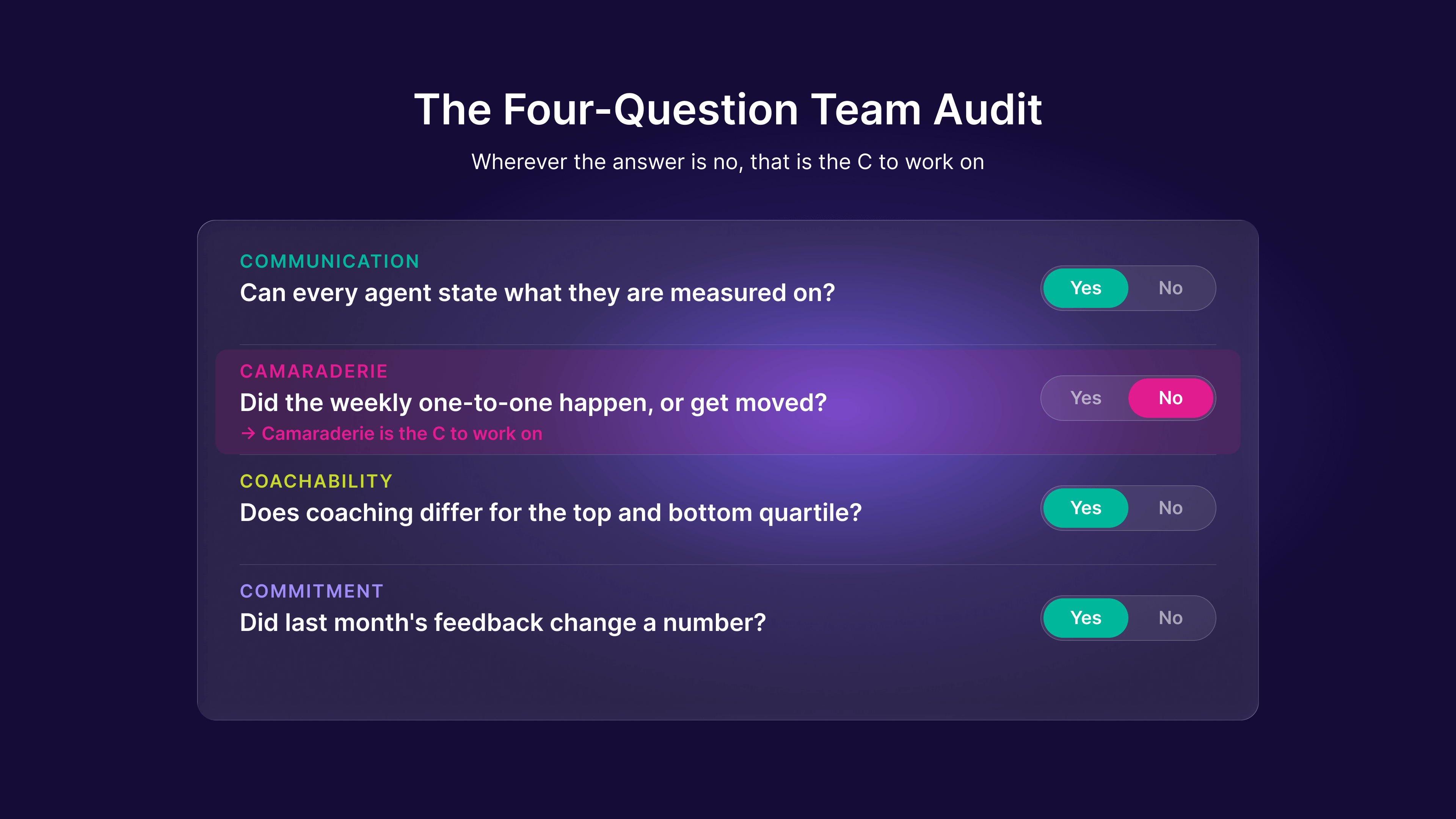
That makes the framework easy to audit. Pick one team and ask four questions. Can every agent state what they are measured on? Did the weekly one-to-one happen, or get moved? Does the coaching look different for the top quartile than for the bottom? Has anyone checked whether last month’s feedback changed a number?
Wherever the answer is no, that is the C to work on. The rest is a poster.
Before you go: getting started with the five Cs
How do you build camaraderie on a remote or hybrid frontline team?
Through frequency, not events. Camaraderie comes from short, regular contact: check-ins that happen on schedule, visible recognition between peers, and shared context about what the team is working toward. A quarterly virtual social does not substitute for a weekly one-to-one that never gets cancelled.
Which of the five Cs should a new team leader work on first?
Communication, because the other four depend on it. If agents cannot articulate what they are measured on, commitment has nothing to attach to, and coaching has no shared reference point.
How do you tell a coachability problem from a skills problem?
A skills problem improves with practice. A coachability problem doesn’t improve with practice, which usually means the feedback isn’t specific, isn’t followed up, or isn’t worth acting on.
What changes about teamwork when AI agents are part of the workflow?
Handoffs multiply and the pace of change increases. People need to know which part of an interaction is theirs, what the AI already did, and where to escalate, and that changes faster than an annual training cycle can cover. The five Cs still apply. What changes is how often they have to be re-established.
Build stronger teamwork
Explore how Centrical can help your organization reinforce the principles that support effective teamwork across frontline teams.
Request a Demo






 Engage and motivate your frontline teams
 Deliver world class CX with dynamic, actionable quality evaluations
 Boost performance with personalized, actionable goals
 Nurture employee success with the power of AI
 Listen and respond to your frontline, continuously
 Drive productivity with performance-driven learning that sticks
 Drive agent efficiency, deliver client results
 Keep tech teams motivated and proficient on products and services while exceeding targets
 Maintain compliance while building customer happiness and loyalty
 Enlighten energy teams to boost engagement
 Engage, develop, and retain your agents while driving better CX
 Improve the employee experience for your reservations and service desk agents

 Gal Rimon
 Madeleine Freind
 Natalie Roth
 Linat Mart












 Doron Neumann
 Daphne Saragosti
 Ella Davidson
 Ariel Herman
 Ronen Botzer