This is the sixth installment of The Contact Center Gap, a series featuring expert perspectives from people who have spent years inside contact center operations: running them, selling into them, supporting them, and watching what separates the ones that perform from the ones that plateau.
It usually goes like this. An agent has a strong year. They lead by example, hit their numbers, and everyone knows they’re the best on the floor. So, on a Friday afternoon, management tells them they’re being moved into a team leader role. The agent comes into the office on Monday morning with a new job title and exactly the same preparation they had when walking out the door on Friday.
Martin Teasdale, host of the Get Out of Wrap podcast, calls it the “magic weekend.”
Ian Chappell, Director of Consulting at Centrical, has been watching it play out across contact centers for over 20 years. “You’ve been this great agent,” Chappell describes it. “You finish your shift on Friday, you come back Monday, and you’re now a team leader. And that’s where there’s a huge gap.”
Promoting from within is one of the most instinctive decisions a contact center makes. The best agent gets the job. It saves on external hiring, preserves institutional knowledge, and sends a message about what the organization values.
But the cost of doing it badly compounds in ways that most contact centers never fully price in.
The conversation about contact center performance management often focuses on agents. How do you measure them? How do you coach them? How do you retain them?
But Chappell points to the layer above: the team leader as the variable that most operations underinvest in. Get that layer right and almost everything else gets easier. Miss it, and the impact runs deep.
“There needs to be a real view on not only the hidden cost of allowing managers to fail,” Chappell says, “but also the hidden cost of the inconsistency once they are at a level where they do an acceptable job.”
That second part carries more weight than most leadership teams realize. A new team leader who is just acceptable, but not impactful, affects every agent on their team, every week. Multiply that across a 500-agent operation, and the performance drag is significant, even if no single manager looks like an obvious problem.
What the magic weekend actually costs
New team leaders need support.
But few contact centers actually follow through and provide enough of it.
Promoting the best agent on the floor makes sense. They know the product, they know the customers, they know the floor. But knowing how to do a job and knowing how to develop someone else in that job are different skills.
Chappell notes the problem often surfaces not in a dramatic failure but in quiet, invisible activity: a team leader who fills their week with tasks, updates, admin, and meetings without ever producing something that makes their agents better.
The time that should go to coaching and one-to-ones gets consumed by admin, internal projects, and requests. A team leader can spend a full week visibly occupied without producing a single conversation that moves an agent’s performance. And because the output of good coaching only shows up in the numbers over time, that pattern can run for months before anyone identifies the cause.
The gap between acceptable and impactful
There is a difference between “acceptable” and “impactful” performance.
Acceptable means the operation continues to run, calls get handled, and reports get filed. Coaching sessions may appear on the schedule, at least some of the time.
But acceptable also means that performance conversations happen reactively rather than deliberately. An agent who has been drifting off target for three weeks gets a conversation after the monthly report, not during the drift. Coaching becomes a compliance exercise rather than something that genuinely changes what happens on the next call.
What a framework for new team leaders actually looks like
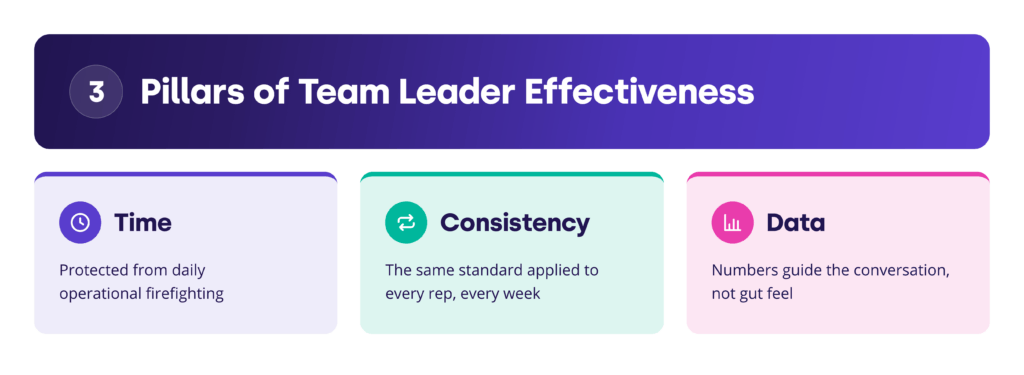
Chappell describes an effective framework for new team leaders, which addresses three key points: time, consistency, and data.
- Make time for coaching. A team leader who spends the majority of their week on admin, projects, and internal tasks is not coaching. Getting them to consistent, regular contact with their people requires reserving time for it.
- Coach consistently, not reactively. The value of coaching compounds when agents experience it regularly and when it targets specific behaviors tied to specific metrics. A focused 20-minute session that addresses one clear thing does more work than an hour-long conversation that covers everything and changes nothing.
- Use data to make your coaching effective. A team leader who has to spend hours pulling together performance information before they can have a coaching conversation will either skip the preparation or skip the conversation. Chappell describes what this looks like in well-run operations using Centrical’s Performance Intelligence OS: a manager prompts the AI assistant for who needs attention that day, gets three names and the specific behaviors to address, and walks into coaching sessions with the preparation already done.
This framework can make a major difference in efficiency. It changes what the team leader’s role actually is: from someone managing information to someone using it.
Organizations that promote well build a maturity curve into the role. They recognize that a new team leader needs to develop their coaching practice over time, with support, feedback, and a structure that lets them track whether their interventions are working.
“We need to get to a point where we can take that person from being an agent, through the magic weekend, through that maturity curve within that role, and set them up with the framework to be successful,” Chappell says.
That framework is not just about what the team leader does in their first month, but also about what they’re held accountable for, what data they can see, and whether their own development as a coach is being tracked alongside their team’s performance.
For operations exploring how call center performance management software can support this, the coaching and performance intelligence capabilities in platforms like Centrical are designed precisely around this problem: giving team leaders the data and structure they need to develop their people, not just monitor them.
What good agent coaching actually looks like in a contact center/
Coaching and performance management
When the organization invests in the team leader
Chappell’s account of well-run operations points to a consistent pattern.
Team leaders in these environments know which agents need attention and why. They spend more time with the people who need it, rather than distributing coaching evenly regardless of need. Their sessions are targeted, documented, and followed up.
“We need to do a lot more around team leaders,” Chappell says, “and how we get them to be impactful coaches, to be more consistent, to spend more time more consistently with their people.”
Questions we also hear
Why do contact centers often promote the best agents into team leader roles?
Promoting from within is often the right instinct. The agent already knows the environment, the customers, and the culture. The problem is not the decision to promote but the assumption that the skills transfer without support. Contact centers that do this well align the promotion with a development process. They build a framework around the new team leader role rather than assuming the title does the work.
What’s the difference between a team leader who coaches and one who just manages?
A team leader who manages focuses on whether things got done: were sessions held, were reports filed, were targets communicated. A team leader who coaches focuses on whether behavior changed: did the agent do something differently on the next call, and did that show up in the data? The distinction matters because the first approach produces compliance; the second produces improvement. Chappell describes the goal as a team leader who uses data to target specific behaviors in specific individuals rather than delivering the same message to everyone.
How often should team leaders be coaching their agents in a contact center?
Frequency matters less than consistency and specificity. A focused 20-minute weekly session tied to one clear behavior does more than a monthly one-hour review of everything. Chappell notes that the sessions should never get cancelled even under volume pressure: cancelling them sends a signal about what the organization actually values. The best operations build coaching time into the schedule and protect it.
What does a call center performance management framework for team leaders need to include?
At minimum: clear accountability for coaching frequency and quality, access to individual-level performance data in real time, a documented record of coaching interactions and agreed actions, and some mechanism for tracking whether those actions produced a change. Without the data layer, team leaders default to coaching from memory and instinct. With it, they can see what’s working and adjust.
How does performance management software help new team leaders succeed?
The biggest practical impact is time. A team leader who has to pull performance data from multiple systems before every coaching session has less time to actually coach. Platforms like Centrical surface who needs attention, on what, and with what prior context, so the preparation happens automatically. Chappell describes the change in how team leaders experience the role: from spending time on information to spending time on people.
About our experts
Ian Chappell is Director of Consulting, International at Centrical, leading presales consulting across EMEA and APAC. With over 20 years in contact centers and customer operations, he has worked across the frontline, workforce planning, BPO, and solution consulting, and is now one of Centrical’s specialists for the contact center and BPO space.







 Engage and motivate your frontline teams
 Deliver world class CX with dynamic, actionable quality evaluations
 Boost performance with personalized, actionable goals
 Nurture employee success with the power of AI
 Listen and respond to your frontline, continuously
 Drive productivity with performance-driven learning that sticks
 Drive agent efficiency, deliver client results
 Keep tech teams motivated and proficient on products and services while exceeding targets
 Maintain compliance while building customer happiness and loyalty
 Enlighten energy teams to boost engagement
 Engage, develop, and retain your agents while driving better CX
 Improve the employee experience for your reservations and service desk agents


 Gal Rimon
 Madeleine Freind
 Natalie Roth
 Linat Mart












 Doron Neumann
 Daphne Saragosti
 Ella Davidson
 Ariel Herman
 Ronen Botzer