A customer reaches a human agent after working through a bot, only to answer the same questions again. The agent inherits the frustration without having rehearsed the handoff. Many operations lose the customer’s trust at this point in the workflow.
Generic role-play scenarios rarely cover this moment, because they are built around scripts rather than the failure patterns in your operation. To prevent this, managers should build customer service role-play scenarios around the moments that actually go wrong.
The data-driven selection framework
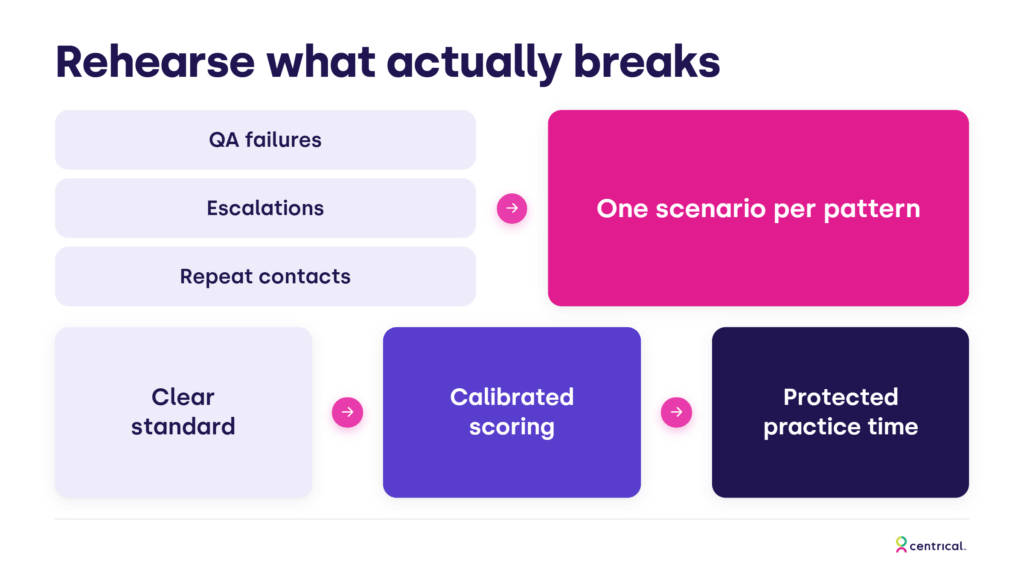
Training managers should select scenarios from interaction data, QA findings, customer feedback, and frontline observations. Reviewing calls, chats, and emails shows where agents need practice. Survey comments and direct feedback show what frustrates customers most. Call center data only helps when it turns into specific coaching moments.
The process has three steps:
- Find the pattern. Review the previous month’s QA results, escalations, repeat contacts, policy changes, and call types with different difficulty levels. Label the behavior, not just the queue or product. As ICMI notes, a strong QA program covers soft skills such as active listening, empathy, problem-solving, and communication, so its failure patterns show which skills need practice.
- Define the standard. Write what good looks like using your organization’s quality criteria. Soft-skill scenarios should test empathy, listening, and clear communication. Compliance scenarios should test adherence to applicable requirements and company policy.
- Test and calibrate. Ask agents and supervisors to review the scenario before launch. Early, low-stakes practice helps teams get used to the format, the scoring rubric, and the customer role. Calibrating first keeps the coaching cadence focused on development instead of box-ticking.
This approach supports contact center CX improvement because each scenario targets a real, measurable problem.
Comparison of role-play scenario archetypes
| Scenario Archetype |
Focus Area |
Success Criteria |
| AI-to-human handoff |
Contextual continuity |
Reducing repetition and acknowledging prior AI interaction data |
| Complex policy pivot |
Regulatory and policy adherence |
Combining empathy with precise policy language and compliance |
| Soft-skill scenarios |
Behavioral communication |
Demonstrating empathy, active listening, and clear communication |
| Routine vs. complex |
Difficulty scaling |
Adapting to third-party involvement or unclear customer needs |
High-priority scenario archetypes for 2026
The context-heavy AI-to-human handoff
Practice the moment a virtual agent transfers a customer who has already provided details. The agent should acknowledge the available context and confirm only what remains unclear. They must then take ownership of the next step. Five9 research found that 83% of consumers say they still have to repeat themselves at least sometimes after being transferred.
Good performance means reducing repetition without assuming the handoff data is complete. AI may surface context, but the agent decides what to confirm and how to respond to the customer’s frustration. Tools such as AI-driven role-play let agents rehearse these handoffs in a low-stakes environment before they handle live escalations.
The complex policy pivot
Build one scenario around explaining a policy change to an upset customer. Build another around a high-stakes authentication or privacy requirement. This short demo shows an agent practicing an account-access call that starts with identity verification. Good performance combines empathy with precise policy language. In regulated operations, the standard is adherence to the organization’s requirements.
Add a repeat contact after a failed fix. Then vary the difficulty. You might use a routine request versus a complex problem, a third party joining the call, or an escalation where the customer’s need is unclear. For each, specify the behavior to rehearse and the evidence of success. These scenarios also support a continuous learning journey for specialized functions such as retention and loyalty management. Reskilling frontline workers prepares them for the high-complexity interactions that remain as routine tasks become automated. Gartner predicts that no Fortune 500 company will have fully eliminated human customer service by 2028, as AI takes on routine problems and people focus on complex, high-value interactions.
Managing the scenario lifecycle
Ownership and calibration
A scenario library needs clear owners as well as content. Assign responsibilities clearly across QA, operations, learning, supervisors, and agents. Clear owners and regular calibration keep QA scoring consistent, so supervisors can rely on it for coaching.
QA identifies recurring failure patterns and proposes scenarios. Operations and policy owners approve workflow and compliance standards. Supervisors and agents test realism, calibrate scoring, and suggest improvements. Learning leaders schedule reviews and retire scenarios when workflows change.
Retiring obsolete workflows
Review the library alongside the QA cadence and after each major process change. Remove scenarios that no longer match the workflow. A license or library does not create practice time. Schedule protected rehearsal blocks, keep groups small enough for feedback, and hold supervisors accountable for completing the cycle.
Before you go
How often should we update role-play scenarios?
Review role-play scenarios with each workflow change and during the regular QA review cycle. Use new failure patterns, escalations, and frontline feedback to decide whether to revise, add, or retire a scenario.
How do we ensure agents have time to practice?
Agents need protected time on the operating schedule to practice, receive feedback, and try again. Treat rehearsal as a scheduled part of the coaching cadence.
Start with last month’s top three escalation reasons. Turn each into a scenario, define the standard, and put next week’s rehearsal time on the schedule.
Book a demo to see how the Workforce Orchestration System turns a business goal into a running performance program for your frontline.






 Turn any business goal into a running performance program in minutes.
 Practice with AI. Win with real customers.
 Nurture employee success with the power of AI
 Deliver world class CX with dynamic, actionable quality evaluations
 Drive productivity with performance-driven learning that sticks
 Boost performance with personalized, actionable goals
 Engage and motivate your frontline teams
 Listen and respond to your frontline, continuously
 Drive agent efficiency, deliver client results
 Keep tech teams motivated and proficient on products and services while exceeding targets
 Maintain compliance while building customer happiness and loyalty
 Enlighten energy teams to boost engagement
 Engage, develop, and retain your agents while driving better CX
 Improve the employee experience for your reservations and service desk agents
 Madeleine Freind














 Ariel Herman
 Ronen Botzer
 Linat Mart
 Ella Davidson
 Daphne Saragosti
 Doron Neumann
 Natalie Roth
 Gal Rimon