Centrical and Zenarate both promise sharper, more confident frontline agents, and on paper they appear to share a few overlapping capabilities. In this article, you’ll see how they differ across role-play, coaching, frontline training, gamification, and performance; so, if you’re deep in a vendor evaluation, this is for you.
Updated on: August 31, 2026
Centrical vs Zenarate at a glance
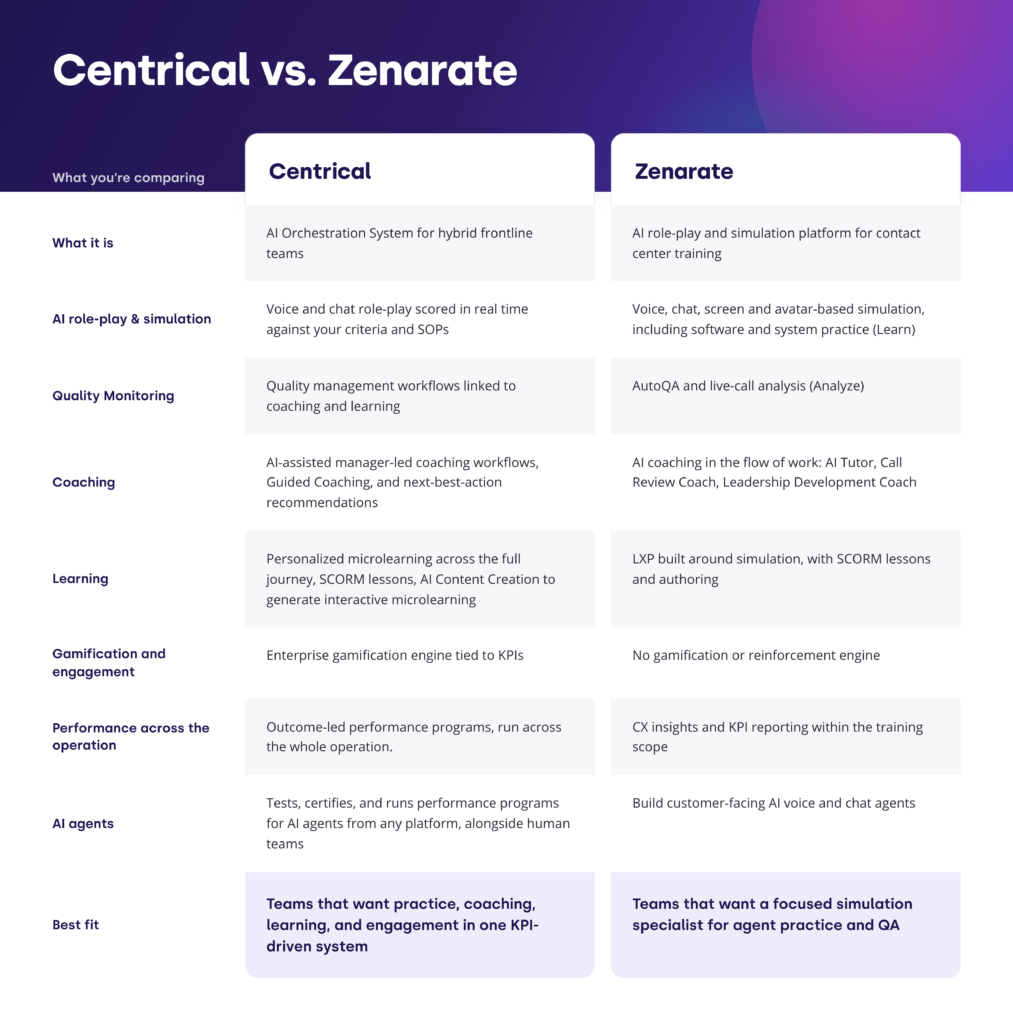
AI role-play and simulation: Zenarate leads on avatar realism and native screen practice today. Its Learn product runs voice, chat, screen, and avatar-based practice, so a rep rehearses the words and the system navigation together. Centrical’s role-play uses multi-agent personas that play the customer, evaluator, and coach, and its AI Coach scores against your own quality evaluation criteria and SOPs.
Live-interaction QA and analysis: Both platforms turn interaction quality into action, but in different ways. Zenarate can score live calls with AutoQA and route findings to practice.
Centrical works the loop both ways. It ingests QA data from your CCaaS or conversational intelligence tools and assigns the right role-play, coaching, or learning to close the gap. It also runs role-play simulations scored against your own quality criteria and uses that performance to recommend the next coaching or training step. Either direction ties back to the KPI the behavior affects.
Coaching: Zenarate’s Coach product is delivered agent-side and inside tools like Teams. Centrical centers the manager: AI-Assisted Coaching uses next-best-action guidance to surface who to coach and on what, based on business goals, and Guided Coaching preps each conversation with the right context, documents what was discussed, and activates the follow-up.
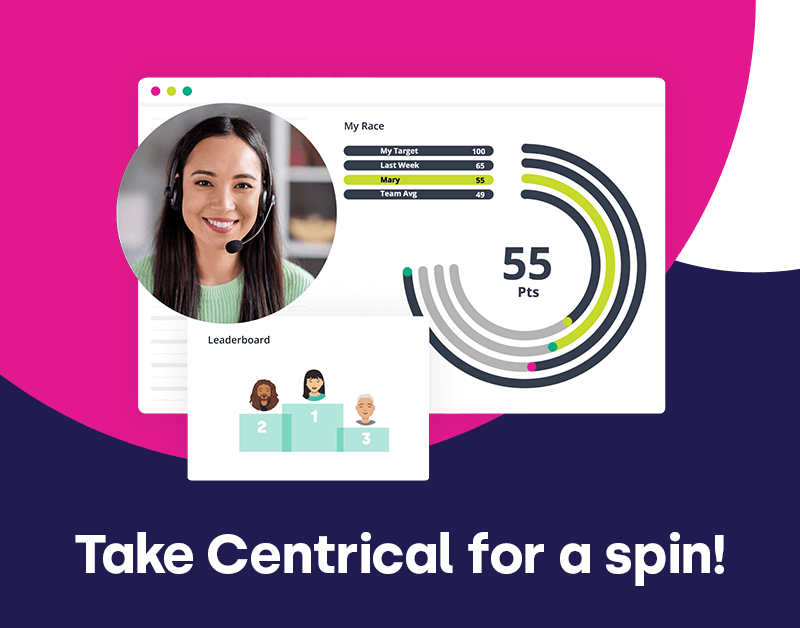
Gamification and engagement: Zenarate markets no gamification or reinforcement layer. Centrical’s engagement engine, run for over a decade in large enterprise settings, ties points, training missions, recognition, and competitions to the KPIs a team is measured on, so engagement drives the behavior change that moves those KPIs, not just activity for its own sake.
AI agents: Zenarate’s Evolve lets non-technical teams build and test customer-facing AI voice and chat agents. Centrical runs performance programs for AI agents working alongside human teams, monitoring both for quality and compliance issues.
The section below outlines the goals a contact center operations team is working toward, and how Centrical and Zenarate each help you reach them.
Goal 1: Get new hires call-ready faster
Both solutions exist to give agents a safe place to practice before they face a live customer. For pure simulation depth, Zenarate is a specialist. Its Learn product runs conversation, chat, screen, and avatar-based simulations, so a new hire can practice the interactions and the system navigation at once. Reviewers on G2 mention that the practice feels realistic.
Centrical approaches the same job from the performance side. Its AI role-play sits inside onboarding missions, so practice is one step in a ramp that also carries microlearning, knowledge checks, and gamified progress. Its role-play uses multi-agent personas and scores against your own quality evaluation criteria in real time. Zenarate’s avatar realism and native screen practice still go deeper today.
If your top priority is the most lifelike standalone simulation, consider Zenarate. If you want practice that exists within a structured, KPI-tracked performance ecosystem, from onboarding through ongoing performance, that is Centrical’s territory.
Goal 2: Turn QA findings into behavior change
Finding the skill gap is the easy part, but closing it is where these tools diverge.
Zenarate’s Analyze product scores live calls with AutoQA, spots the gaps, and builds an automated development plan that routes the agent back into targeted practice. The loop runs inside its training scope, which fits its origin as a practice-first platform.
Centrical connects the same signal to a wider set of actions. A quality result can trigger a coaching task for the manager, a microlearning mission, or a gamified goal, each one keeping score against the KPI the behavior affects. So, after the finding, Zenarate points the agent at more practice, while Centrical also triggers manager-led coaching and the learning path and holds the metric accountable.
Goal 3: Coach at scale without sidelining the manager
Zenarate has built out real contact center agent coaching. Its Coach product delivers AI-led development in the flow of work, with an AI Tutor, a Call Review Coach, and a Leadership Development Coach that preps managers for feedback conversations. Much of it runs agent-side and inside the tools people already use, like Teams.
Centrical has built an experience for managers, too. The platform prioritizes coaching opportunities based on business goals. Guided Coaching pulls in recent history and past conversations to prep each session, then captures and documents what was discussed and activates the follow-up, and live KPI tracking keeps each recommendation current as performance shifts.
Both solutions coach. The gap is how far the coaching reaches into a manager’s daily workflow and existing coaching processes, and how tightly it binds to performance data, learning, and gamified follow-through.
Dive deeper: What Good Agent Coaching Actually Looks Like in a Contact Center
Goal 4: Keep agents engaged after onboarding
Practice and coaching get an agent ready. Keeping them motivated three months in is a different problem, and it is where the two platforms part most clearly.
Zenarate does not run a gamification or reinforcement engine. Its site markets simulation, QA, coaching, and AI agents, with no points, goals, competitions, or recognition layer to sustain engagement once the initial ramp ends.
Gamification is where Centrical started, and the engine has over a decade of enterprise use behind it. Points, missions, recognition, and team competitions map onto the KPIs a leader actually cares about, so the motivation to keep practicing and improving does not fade after week two. Points can also convert into real rewards through a built-in store, so recognition isn’t just a badge on a dashboard. For a floor fighting attrition and mid-tenure drop-off, that ongoing engagement layer is the clearest line between the two.
Zenarate’s analytics live inside the training and QA it runs. You get call analysis, CX insights, and KPI reporting tied to the skills it coaches, which is a strong loop for a practice-first platform.
Centrical reports across the whole performance picture, beyond the slice tied to practice. As an open platform, it pulls everything into one place: KPI data, quality results, sentiment and employee input, knowledge and skill gaps from training, and other external signals, flagging which agents are trending toward a miss before the number lands. For an operations leader who wants one view of performance, engagement, and development, that breadth is the practical difference between a training tool and a workforce engagement platform.
Goal 6: Bring AI into frontline operations
Both companies are moving into AI-assisted work, but in different directions, which is worth knowing before you buy.
Zenarate’s newer Evolve product lets non-technical teams build and test customer-facing AI voice and chat agents, then share data between how humans onboard and how the AI agents perform. Zenarate is expanding from training humans into building the AI agents that work alongside them.
Centrical tests, certifies, and runs programs for AI agents from any platform, alongside human teams, including agent-to-agent training.
A closer look at Centrical
Centrical is an AI Orchestration System for the hybrid frontline: human teams and AI agents, side by side. It runs performance programs that connect practice, coaching, and learning to the KPIs a contact center runs on, drawing in quality results, sentiment, and skill-gap data from any source, wrapped in a gamification layer the company has run since 2013.
The through-line is the closed loop. A KPI gap can trigger a coaching task, a microlearning mission, a role-play, or a gamified goal, and each action reports back against the metric it set out to move, so managers see what changed and agents see why it mattered. That same loop now extends to AI agents: Centrical can test and certify agents built on any platform against the same quality evaluation criteria used for human teams. The connective tissue across learning, coaching, engagement, and performance, for people and AI agents alike, is what separates a platform from a single-purpose tool.
Centrical’s role-play uses multi-agent personas and scores against your quality evaluation criteria in real time. Zenarate goes deeper on avatar realism and native-screen practice today. Where Centrical pulls ahead is scope: for a leader who wants practice, coaching, learning, and engagement working as one system across roles, sites, and now AI agents, that breadth is the point.
And while this comparison sits in a contact center context, the same OS runs across any frontline environment, retail, healthcare, field service, wherever people and AI agents are held to a standard and need to improve against it.
A closer look at Zenarate
Zenarate started as a natural-language AI role-play tool for contact center agents and recently grew into a four-product platform, which it now calls a frontline performance platform. The four products are Learn (conversation, screen, chat, and avatar simulation with an LXP), Analyze (AutoQA and live-call analysis), Coach (AI-led coaching in the flow of work), and Evolve (building customer-facing AI voice and chat agents), which launched in June 2026.
The company sells mostly to large enterprises and BPOs in banking, insurance, healthcare, telecom, retail, and travel, and its customer base skews to contact center training and onboarding teams. Its heritage shows in what it does best: giving agents a lifelike place to rehearse real calls, system navigation included, before they go live.
Its own G2 reviewers, who rate it highly overall, point to real limits. Simulations can feel scripted or linear when a rep goes off the expected path; the AI sometimes misreads what an agent says, reporting depth comes up as a request, and keeping simulation content current takes ongoing effort. Buyers also note that tenured agents get less out of it than new hires.
Read as a whole, Zenarate is a strong simulation specialist that has added QA, coaching, and agent-building around a practice-first core. What the platform lacks is a gamification engine to sustain engagement, a manager coaching system that ties coaching to KPIs, learning, and reinforcement in one loop, or performance management programs that run across the whole operation.
When to choose Zenarate
Zenarate is the better call in a few clear cases:
- If your single biggest need is the most lifelike simulation, avatar-based role-play, or the most native screen and system practice.
- For teams focused on pre-hire assessment and new-hire readiness that do not need gamified reinforcement or broad performance management programs.
- Some buyers want a vendor whose team builds their simulations for them. Zenarate’s services-led model fits that preference, and its customers often praise the hands-on build support.
- And when building customer-facing AI voice or chat agents sits high on your roadmap, Evolve gives you that in the same platform as your training.
When Centrical is the better fit
Centrical is the stronger choice in a few buyer profiles:
- When you are standardizing practice, coaching, learning, and engagement across many roles or sites, Centrical runs them as a single KPI-driven system in place of a set of point tools.
- When you need to test and certify AI agents against the same standards as your human team, regardless of which platform built them, Centrical runs that alongside your existing performance programs.
- For teams that want coaching to integrate into the manager’s daily workflow, Centrical ties each coaching action to KPIs, learning, and reinforcement in one loop rather than leaving it agent-side.
- Operations leaders who need a single view of performance, engagement, and development across the whole floor get that breadth from Centrical, beyond the training-focused analytics of a simulation specialist.
- If your priority is sustained performance after onboarding, the gamification and reinforcement engine keeps agents engaged past the first few weeks, where a practice-only tool tends to fade.
How the two rate with independent reviewers
Third-party review scores give a neutral read, with two caveats worth stating up front: the two products sit in different G2 categories, and their review counts are far apart.
G2 ratings, as of August 2026
- Centrical: 4.6 out of 5, from about 127 reviews.
- Zenarate: 4.9 out of 5, from 33 reviews.
Zenarate scores higher on roughly a quarter of the reviews, with many dating back to 2022. Centrical’s score sits a little lower across a deeper, broader pool. Both rate well with the people who use them.
Zenarate has no Capterra reviews; Centrical carries only a handful, scoring 4.4 out of 5 from 8 reviews.
Before you go: What buyers want to know
Is Centrical a real alternative to Zenarate for AI role-play? Yes. Centrical runs AI role-play for agents and managers, with multi-agent personas that score against your own quality evaluation criteria in real time. Zenarate leads on avatar realism and native screen practice. The difference is that Centrical’s role-play plugs into onboarding missions, coaching, and gamified goals tied to KPIs, so practice connects to the rest of your performance management programs.
Does Zenarate do coaching, or only simulation? Zenarate does both. Its Coach product delivers AI-led coaching in the flow of work, including a Call Review Coach and a Leadership Development Coach. Centrical’s coaching centers the manager’s workflow and ties each coaching action to KPIs, learning, and reinforcement in one loop.
Does either platform focus on employee engagement? Centrical does, with an enterprise gamification engine run over a decade and tied to the KPIs a team is measured on. Zenarate does not run an engagement or reinforcement engine, which becomes a factor when you need to sustain engagement past the first few weeks.
Can Centrical work with AI agents built on other platforms, like Zenarate’s Evolve? Yes. Centrical tests and certifies AI agents against the same quality evaluation criteria used for human teams, regardless of which platform built them. Zenarate’s Evolve builds agents within its own platform; Centrical manages and certifies their performance once they’re live, alongside your human team and any other agents in your environment.
Choosing the right Zenarate alternative: Zenarate is a strong, focused platform for AI role-play and simulation. Centrical brings that practice into a wider system, where coaching, learning, engagement, and KPIs run as one loop across human teams and AI agents. If you want the deepest standalone simulation, you might prefer Zenarate. If you want practice that drives sustained performance across the whole frontline, that is the Zenarate alternative Centrical is built for.






 Engage and motivate your frontline teams
 Deliver world class CX with dynamic, actionable quality evaluations
 Boost performance with personalized, actionable goals
 Nurture employee success with the power of AI
 Listen and respond to your frontline, continuously
 Drive productivity with performance-driven learning that sticks
 Drive agent efficiency, deliver client results
 Keep tech teams motivated and proficient on products and services while exceeding targets
 Maintain compliance while building customer happiness and loyalty
 Enlighten energy teams to boost engagement
 Engage, develop, and retain your agents while driving better CX
 Improve the employee experience for your reservations and service desk agents

 Gal Rimon
 Madeleine Freind
 Natalie Roth
 Linat Mart












 Doron Neumann
 Daphne Saragosti
 Ella Davidson
 Ariel Herman
 Ronen Botzer