In contact centers, AI role-play training addresses a familiar problem. A new hire knows the procedure but has never used it with an upset customer on the line. Often the missing piece is practice: the step between understanding a procedure and using it under pressure.
AI role-play simulations help agents build frontline proficiency faster by letting them practice realistic situations again and again. They sit between e-learning and live calls: an agent tries a behavior, gets feedback, and tries again, without a real customer on the line.
The psychological gap between knowing and executing
Why knowledge bases are not enough
A knowledge base supports recall. It does not rehearse tone, pacing, or de-escalation when a customer interrupts. Training leaders at large retail banks commonly hear employees ask for more opportunities to practice what they have just learned. In a digital banking contact center, a coach may work on an agent’s confidence, send them back to live calls, and review one or two contacts a week later. Nothing in between gives the agent a place to rehearse.
The gap is about doing as much as it about knowing. Learners need to move from describing the correct response to performing it. Research on behavior modeling training shows that skill improvements are greater when trainees prepare for practice by visualizing themselves performing the behavior. Closing that gap takes a continuous learning journey that pairs performance data with targeted practice.
The role of behavior modeling
Good training describes the skill, shows a model, lets the learner practice, gives feedback, and plans how they will use the behavior on the floor. The same research describes five steps: description, modeling, practice, feedback, and transfer. The sequence prepares the agent to use the behavior in a live interaction.
How AI role-play training accelerates proficiency
Simulating real-world pressure
A focused session targets a specific skill, such as handling an escalation or explaining a policy in plain language. A scenario presents the context, and an AI-played customer responds to the agent’s words. AI then scores the response against the organization’s own quality criteria.
Role-play libraries should come from real operational experience. Tenured agents and quality teams can supply the situations that show whether a learner is ready.
- Scenario: The agent receives a realistic customer situation tied to a defined behavior.
- Interaction: The agent responds in conversation and makes decisions without putting a live customer at risk.
- Feedback and retry: AI scores the response against the selected criteria, and the agent adjusts and practices again.
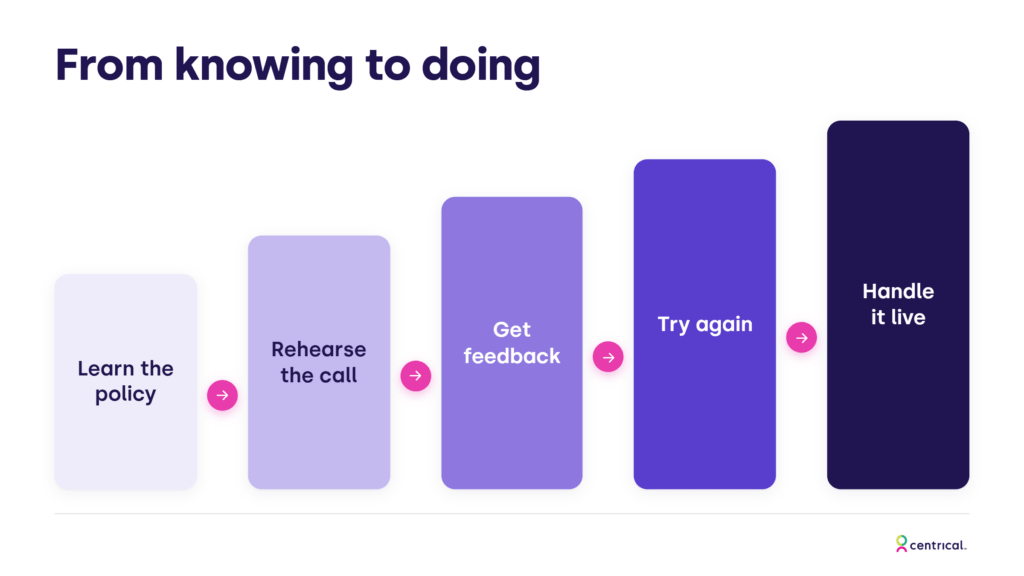
This two-minute demo walks through the full loop, from a customer service scenario to instant feedback and coaching recommendations.
With AI feedback, agents can practice between formal coaching sessions. A manager still decides what happens next. As automation takes over routine contacts, agents need practice for the judgment-heavy conversations that remain. AI simulations let agents role-play more often, which can help shorten agent onboarding time.
Integrating simulation into the development cycle
Complementing e-learning
E-learning explains the policy or product. AI role-play tests whether the agent can use that knowledge in a conversation. Real-time agent assistance offers suggestions during live interactions, and the agent decides what to say.
Each tool covers a different moment: role-play prepares the agent before the call, and assistance helps during it. Connecting them helps accelerate training with performance management, because practice and data reinforce the same lessons.
Reinforcement on the floor
After practice, supervisors need to reinforce the same behaviors in live contacts. ICMI recommends that supervisors and quality monitors reinforce on the floor what training teaches, down to specific word choices. The loop is clear: identify the gap, teach the skill, practice it, and then review live performance. Platforms like Centrical can act as a digital coach for employees, supporting contact center CX improvement by keeping that loop running.
Use AI role-play where a defined behavior matters and repetition is difficult to schedule. That keeps practice tied to a real operational need. Replacing a contact center agent is expensive, so early proficiency and retention matter.
The operational impact: retention and ramp time
- Agents get a safe place to make mistakes before making them in front of a customer.
- Managers can reserve live coaching for judgment, context, and empathy.
- L&D teams can evaluate application, not only knowledge-test completion. ICMI describes role-play as a way to evaluate whether learners are ready to apply new skills and knowledge in real interactions.
- Operations leaders can connect practice to agent onboarding time and frontline employee retention.
Before you go
Does AI role-play replace human coaching?
AI role-play does not replace human coaching because AI provides feedback and recommendations while managers remain responsible for context, judgment, and the coaching conversation.
How do we build realistic scenarios?
Realistic scenarios come from recurring customer situations, quality findings, and examples supplied by tenured agents and quality teams, then mapped to the organization’s own performance criteria.
Where should an operation start with AI role-play?
An operation should start by identifying one high-cost interaction and one behavior that agents need to rehearse, then closing the loop from practice to live interactions.
Book a demo to see how the Workforce Orchestration System turns a business goal into a running performance program for your frontline.

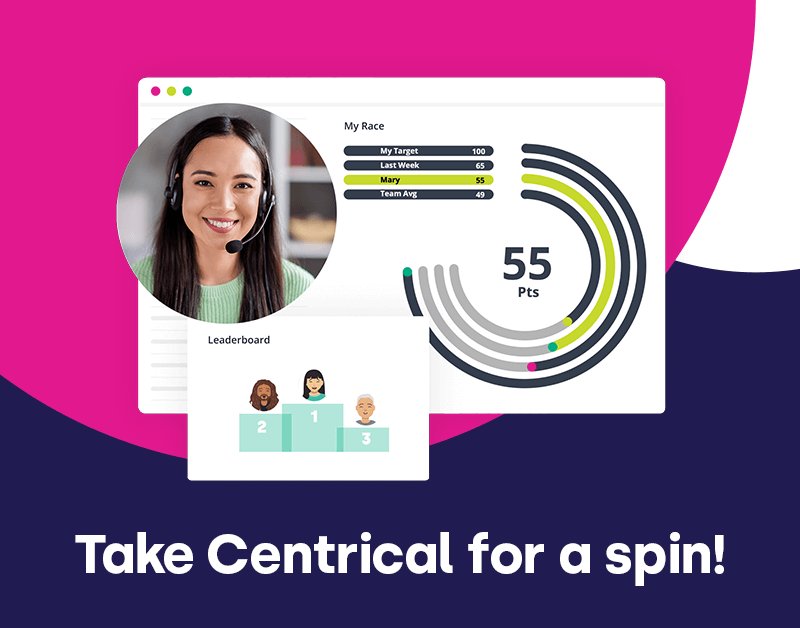





 Turn any business goal into a running performance program in minutes.
 Practice with AI. Win with real customers.
 Nurture employee success with the power of AI
 Deliver world class CX with dynamic, actionable quality evaluations
 Drive productivity with performance-driven learning that sticks
 Boost performance with personalized, actionable goals
 Engage and motivate your frontline teams
 Listen and respond to your frontline, continuously
 Drive agent efficiency, deliver client results
 Keep tech teams motivated and proficient on products and services while exceeding targets
 Maintain compliance while building customer happiness and loyalty
 Enlighten energy teams to boost engagement
 Engage, develop, and retain your agents while driving better CX
 Improve the employee experience for your reservations and service desk agents
 Madeleine Freind














 Ariel Herman
 Ronen Botzer
 Linat Mart
 Ella Davidson
 Daphne Saragosti
 Doron Neumann
 Natalie Roth
 Gal Rimon