This is the eighth installment of The Contact Center Gap, a series featuring expert perspectives from people who have spent years inside contact center operations: running them, selling into them, supporting them, and watching what separates the ones that perform from the ones that plateau.
It’s 6:30 a.m. A call center agent prepares to start her shift.
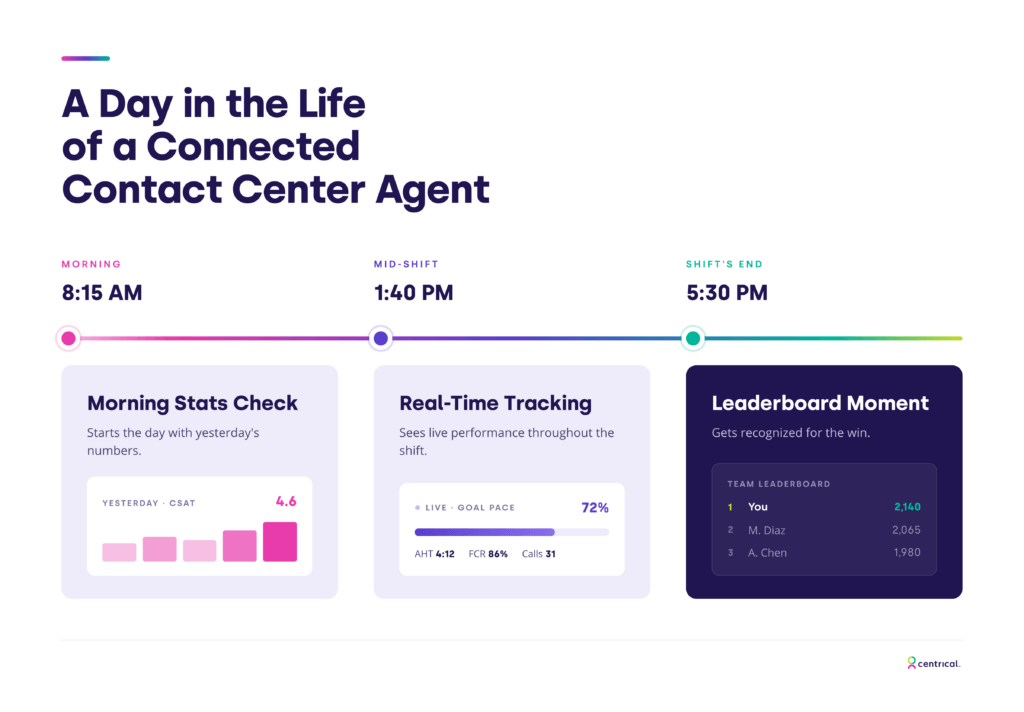
She pulls up her stats from yesterday: CSAT, first-call resolution, where she landed against her weekly targets. She sees the coaching note her manager sent her two days ago, still sitting right where she left it. Then she checks the leaderboard for this month’s challenge and sees her team sitting in second place, four points behind the frontrunners.
None of this required her to open a spreadsheet, ping her manager, or wait for anyone to send her a report. It was already there.
Most conversations about call center performance management stop at the strategy level: dashboards, KPIs, coaching cadence. Fewer conversations show what a single shift actually looks like once those pieces stop living in separate systems.
Melissa Chang Esposito, Senior Director of Customer Success at Centrical, has watched hundreds of contact centers make this shift. She walks through what a connected day looks like from both sides of the floor: the agent taking calls, and the manager coaching the team taking them.
“An agent who has Centrical’s Performance Intelligence OS as part of their workspace, once they have all their applications open, ideally they’ll actually start their day off in Centrical,” Esposito says. “They’ll take a look at their stats from yesterday or from this current week, see how they are tracking towards their goal for the week or for the month.”
What happens when an agent’s shift, coaching, and recognition live in one place?
The agent’s morning starts with visibility, not a guessing game. She can see her productivity numbers and her CSAT score. She can see what her manager flagged in her last coaching session, so nothing from that conversation gets lost between sessions.
Then there’s the part tied to recognition. Esposito describes a bracket-style challenge running that month, and the agent checking her ranking before her first call.
“They can see—here’s how I rank in that challenge, and here’s how my team ranks in that challenge,” Esposito says. “So they get that boost of motivation.”
The engagement piece is built around the same performance data driving the coaching conversations, just pointed at a different motivator:
- Hitting a target earns points;
- Points build toward recognition or reward the agent can see in real time.
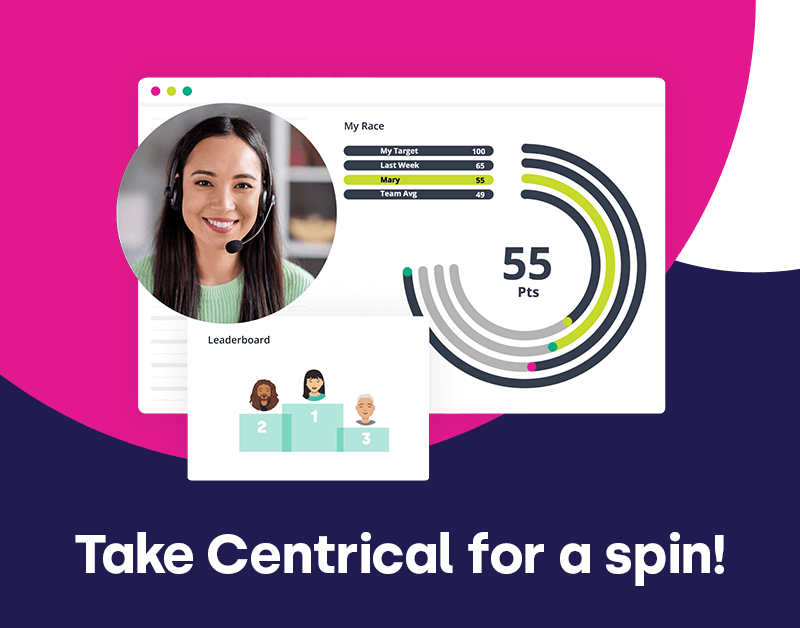
Esposito describes an agent who hits her CSAT and first call resolution goals in the same shift and lands on top of the leaderboard, earning coins she can redeem for something she actually wants:
- Some of it is tangible (e.g. a chocolate bar, a gift card, etc.);
- Some of it is intangible (e.g. an extra break, asking her manager to sing a song in front of everyone, etc.)
Through this mechanism, hitting a target produces something the agent notices the same day, and not a stat that disappears into a monthly report.
How does an AI assistant change a manager’s coaching prep?
The manager’s version of this same morning starts differently. Instead of pulling reports or scanning a spreadsheet for who’s struggling, she asks Centrical’s AI assistant a single question:
Give me a quick view of who needs attention today, who are the people that are struggling.
The assistant returns three names, the specific behaviors behind each one, and what to coach on to move the underlying KPI.
“That’s a quick prompt, something that takes no more than 10 to 15 seconds,” Esposito says.
What used to take a manager an hour of pulling notes together now takes 15 seconds, which changes what’s possible for the rest of the shift. Esposito estimates that a manager can now get through four to five coaching sessions in a day instead of one or two, because the prep work that used to take up the manager’s morning happens before they even sit down.
Every session pulls in the agent’s past coaching history, the KPIs they’ve struggled with, and what they’re doing well, so the manager walks in ready to coach the person, rather than just the number that’s off target.
During the session, the manager pulls up:
- the agent’s performance stats;
- the specific behaviors to focus on;
- a set of microlearning modules or AI role-play simulations tied to exactly what that agent needs to work on next.
What happens after the coaching session ends?
When the conversation wraps up, the evaluation goes to the agent in real time. Esposito describes the alternative most managers know well: the agent coming back a week later, asking what was actually said in the last session, because the notes lived in a notebook or a chat thread no one could find again.
“All of it is documented in Centrical automatically,” Esposito says. “No more meeting notes being taken by hand.”
The manager moves to the next coaching session with the same 15-second prep window ahead of her, and repeats the process for the rest of the shift.
None of this depends on the agent or the manager doing anything differently. What changes is how much has to happen manually before either of them can act.
The agent doesn’t wait for a report to know where she stands. The manager doesn’t spend the morning assembling context before a single coaching conversation happens. Call center performance management stops being something that happens in a monthly review and starts being something that happens continuously, in the background, all shift long.
That’s the gap this series keeps coming back to. The data, the coaching frameworks, and the recognition mechanics already exist in most contact centers. What’s usually missing is the connection between them.
Before you go:
How much time does an AI assistant actually save a contact center manager?
Esposito describes a coaching-prep task that used to take up to an hour, now handled in ten to 15 seconds through a single prompt. That time gets redirected into more coaching sessions per shift rather than admin work.
The engagement layer Esposito describes ties directly to the same performance metrics driving coaching, so points and recognition track real KPI performance rather than sitting apart from it as a separate incentive.
How many coaching sessions can a manager realistically run in one shift?
Esposito estimates four to five sessions in an eight-hour day once prep work is handled ahead of time, compared to one or two when a manager has to pull data and notes together manually first.
What happens to coaching notes after a session ends in a connected system?
The evaluation goes to the agent immediately and lives in the same system going forward, removing the step where notes get filed in a document, a notebook, or a separate chat thread and become hard to find again.
No. Esposito describes agents seeing stats from the prior day or week whenever they log in, alongside their most recent coaching note and their standing in any active team challenge.
[PLACEHOLDER: verify last FAQ answer name spelling before publish]
About our experts
Melissa Chang Esposito is Senior Director of Customer Success at Centrical, where she helps enterprises turn employee engagement into stronger business results. She brings more than eight years of guiding clients across the full customer lifecycle and a foundation in organizational transformation from Deloitte Consulting’s Human Capital practice.






 Engage and motivate your frontline teams
 Deliver world class CX with dynamic, actionable quality evaluations
 Boost performance with personalized, actionable goals
 Nurture employee success with the power of AI
 Listen and respond to your frontline, continuously
 Drive productivity with performance-driven learning that sticks
 Drive agent efficiency, deliver client results
 Keep tech teams motivated and proficient on products and services while exceeding targets
 Maintain compliance while building customer happiness and loyalty
 Enlighten energy teams to boost engagement
 Engage, develop, and retain your agents while driving better CX
 Improve the employee experience for your reservations and service desk agents

 Gal Rimon
 Madeleine Freind
 Natalie Roth
 Linat Mart












 Doron Neumann
 Daphne Saragosti
 Ella Davidson
 Ariel Herman
 Ronen Botzer