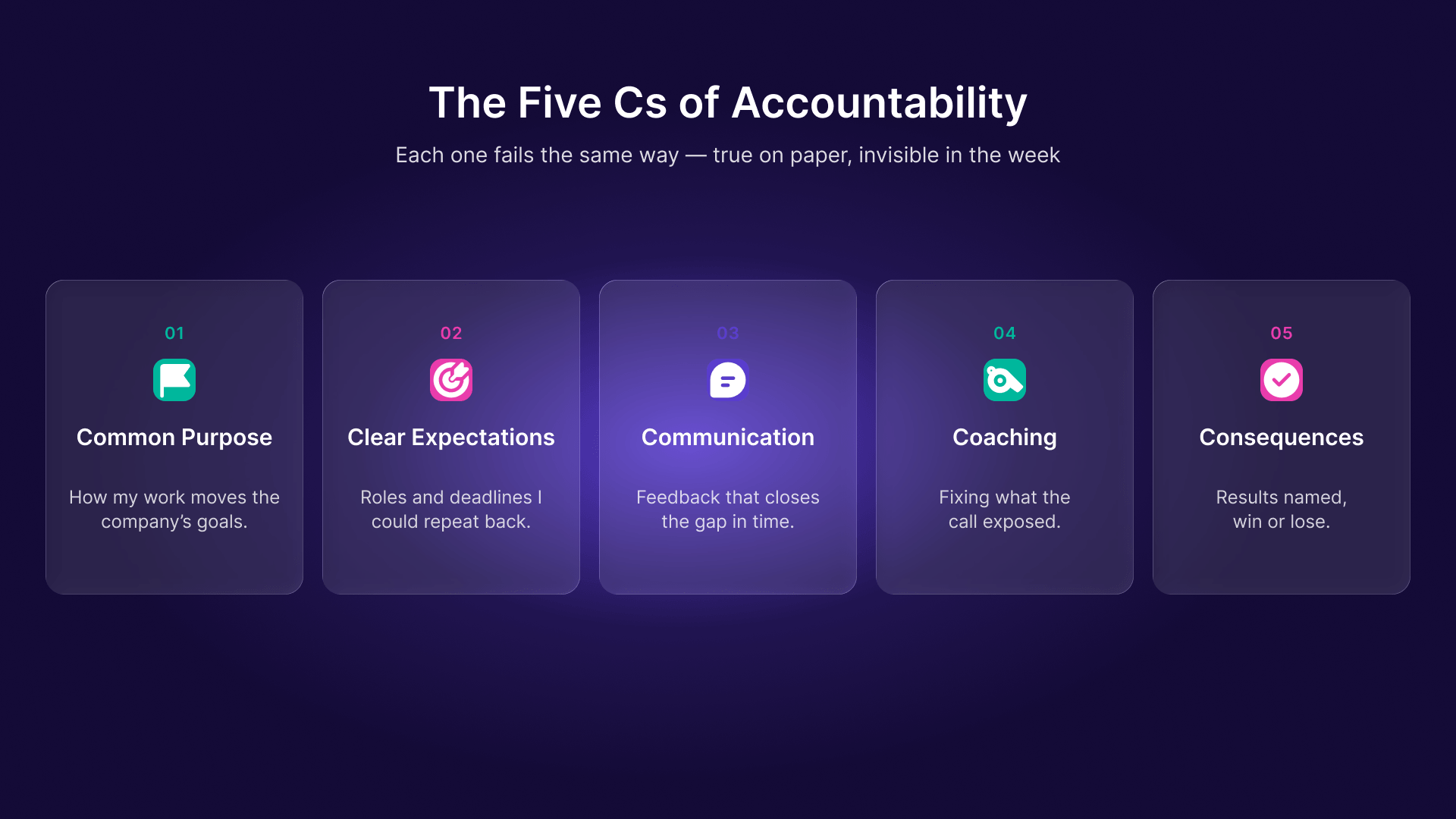
The five Cs of leadership and team accountability are common purpose, clear expectations, communication and alignment, coaching and collaboration, and consequences and results. Accountability rarely breaks down because a team lacks values. It breaks down because nobody can see, day to day, whether an expectation is being met.
Most operations track performance one agent at a time, then wonder why the floor moves unevenly. Shared targets change that: a team that owns a number together tends to surface a problem before a manager finds it. Holding that alignment across thousands of people takes structure rather than good intentions, and a structural reporting model is what ties an individual’s output back to the business levers it moves.
What are the five Cs of leadership and team accountability?
Each of the five describes something a leader is answerable for, and each one fails the same way: by being true on paper and invisible in the week.
Common purpose
Common purpose is the answer to a question an agent rarely gets asked: how does my work contribute to the company’s goals?
When people can trace their own metrics to the organization’s broader business goals, the work stops being a queue. Clearly defined goals also make planning easier and setbacks less destabilizing, because there is a reference point to return to. Bring internal and external stakeholders in early as well. Buy-in from the teams your work touches is what keeps a purpose from turning into an internal slogan.
Clear expectations
Clear expectations mean roles, responsibilities, outcomes, deadlines and dependencies that a person could repeat back without checking. Managers get there by setting quantifiable goals per person, meeting often enough to catch problems while they are still small, and tracking progress at both the individual and the team level.
Then comes the part most operations skip. An expectation only holds if there is a way to see whether it is being met. That means a signal-to-action loop: the agent sees where they stand during the shift rather than at the end of the month, and can adjust while adjusting still matters.
In a contact center, the actionable performance goals that carry this usually look like:
- Maintaining a specific average handle time while meeting quality assurance standards
- Achieving a target first-call resolution rate on specific inquiry types
- Meeting daily adherence targets to keep service levels consistent
Communication and alignment
Leaders who are transparent and concise about goals, mission and vision keep the operation pointed the same way. Leading by example does more of that work than any communication plan, because it shows the same standards apply upward.
Alignment is also two-way. An open door that people actually walk through surfaces improvements nobody at the top would have found, and it builds the trust that makes a team pitch in without being asked. Weekly meetings and regular check-ins keep a shared purpose from drifting, and they are where priorities get adjusted before a quarter is lost.
The practical version of communication is closing the gap between a performance dip and the corrective action. Organizations that build a data-driven coaching culture find that remote and hybrid teams hold engagement better, for the plain reason that visibility travels where presence cannot.
Coaching and collaboration
The shift is from grading the call to fixing the thing the call exposed.
Coaching improves performance and the sense of ownership that comes with it, and it matters most for people new to a team who do not yet know the systems or the colleagues. Build an evaluation stage into the process so each person understands how their own actions and skills move the outcome.
Coaching is also the main lever on consistency across a floor. With real-time performance intelligence a supervisor can intervene where it is needed rather than where the calendar says. Strategic agent coaching keeps sessions targeted and data-grounded instead of administrative, and frontline supervisor development is what gives managers the capacity to do it without burning out. The collaboration elements from the five Cs of effective teamwork, commitment and coachability, are what make the coaching land on the other side.
Consequences and results
Constructive feedback matters as much after a success as after a failure, and it has to be specific to the role to be effective. Reviewed constructively, both kinds build confidence and close the gap to a better result. Celebrate the milestones out loud, through internal communications and rewards, because that is the clearest signal that accountability is worth something here. A formal accountability culture balances results with respect.
Consistency is a coaching gap, not a talent gap. When performance varies wildly across a team, the feedback loop is usually what is uneven, not the people. Feedback that inspires behavior changes sustains outcomes better than a review cycle, and contact center CX improvement depends on that link between individual growth and operational results holding week to week.
What accountability actually depends on
Accountability is less a value than a systems problem. It depends on where information goes and how fast it gets there.
Each of the five has a recognizable failure mode: a purpose nobody can trace, an expectation nobody can check, communication that only runs downward, coaching that happens on a calendar, results that arrive a month late. Visibility is what turns the five into daily practice rather than a framework.
Before you go: getting started with the five Cs of accountability
How do I audit my operation against the five Cs?
Five checks, in order:
- Ask agents to explain how their daily tasks support the mission. If they cannot, the purpose has not reached the floor.
- Look at your KPI dashboards and confirm agents have real-time visibility into their own numbers, not only their manager’s view.
- Review your coaching cadence. Are interventions triggered by data, or by a scheduled administrative block?
- Audit your internal communication channels for whether feedback is timely and specific enough to act on.
- Check that recognition and incentive programs point at the strategic goals rather than at whatever is easiest to count.
Which of the five Cs breaks first in a high-volume operation?
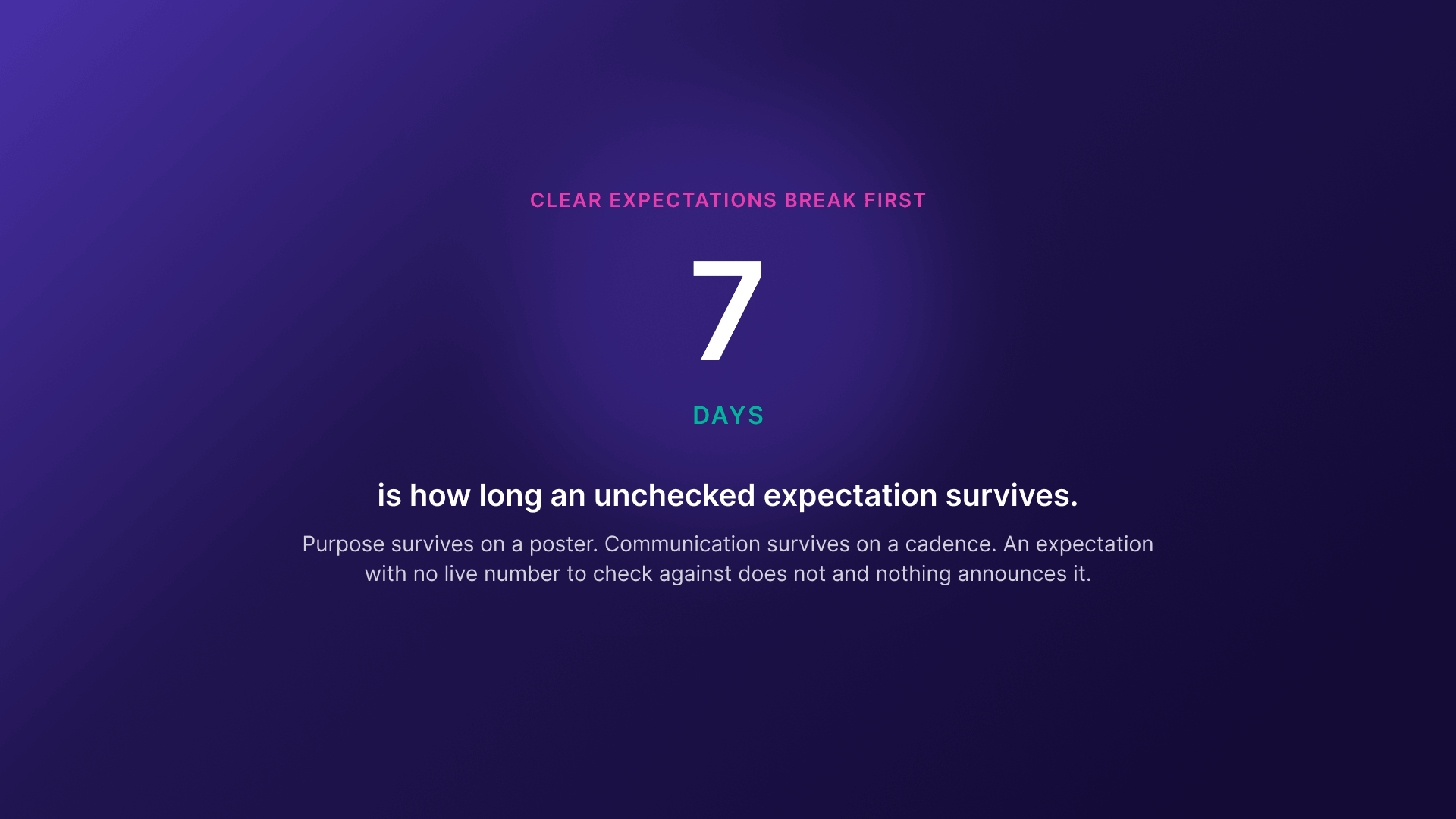
Clear expectations, and it usually breaks quietly. Purpose survives on a poster and communication survives on a cadence, but an expectation nobody can check against a live number stops functioning within a week, and nothing announces it.
What is the difference between accountability and consequences?
Consequences are one of the five Cs. Accountability is the whole system. An operation that has only consequences has a discipline process, because people are being held to outcomes they had no way of tracking on the way there.
How are the five Cs of leadership different from the five Cs of teamwork?
They sit at different levels of the same system. The five Cs of effective teamwork (communication, camaraderie, commitment, confidence, and coachability) describe what a team practices. The five Cs of leadership and team accountability describe what a leader is answerable for. A team can practice all five of theirs and still plateau if nobody owns holding them in place.
Turn the five Cs into daily practice
Book a demo to see how the Orchestration System turns a business goal into a running performance program for your frontline.







 Engage and motivate your frontline teams
 Deliver world class CX with dynamic, actionable quality evaluations
 Boost performance with personalized, actionable goals
 Nurture employee success with the power of AI
 Listen and respond to your frontline, continuously
 Drive productivity with performance-driven learning that sticks
 Drive agent efficiency, deliver client results
 Keep tech teams motivated and proficient on products and services while exceeding targets
 Maintain compliance while building customer happiness and loyalty
 Enlighten energy teams to boost engagement
 Engage, develop, and retain your agents while driving better CX
 Improve the employee experience for your reservations and service desk agents


 Gal Rimon
 Madeleine Freind
 Natalie Roth
 Linat Mart












 Doron Neumann
 Daphne Saragosti
 Ella Davidson
 Ariel Herman
 Ronen Botzer